
Penny Dreadfuls, 1854 · page 396 of 394
Joseph Wilmot, or, The Memoirs of a Man-Servant — page 396: what you’re looking at
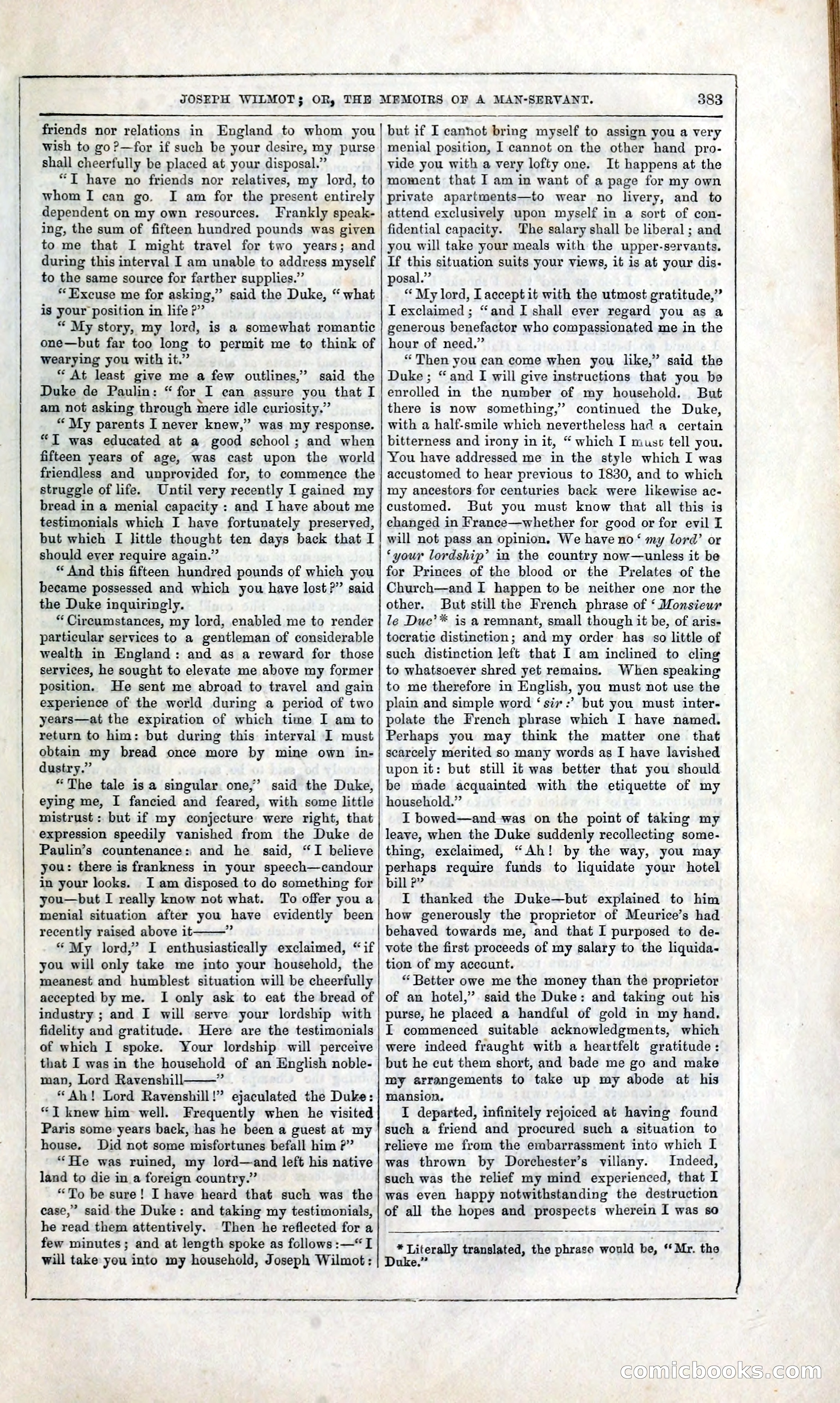
A restored page from Penny Dreadfuls, 1854. Page through the whole issue in the reader above.
📄 Transcribed text from this page (OCR, searchable)
Machine-transcribed from the original scan — historical spelling and the odd misread are preserved.
JOSEPH WILMOT$ OR, THE MEMOIRS OF A MAN-SERVANT. friends nor relations in England to whom you wish to go?—for if such be your desire, my purse shall cheerfully be placed at your disposal.” “I have no friends nor relatives, my lord, to whom I can go. I am for the present entirely dependent on my own resources. Frankly speak- ing, the sum of fifteen hundred pounds was given to me that I might travel for two years; and during this interval I am unable to address myself to the same source for farther supplies.” Excuse me for asking,” said the Duke, “ what is your position in life ?” * My story, my lord, is a somewhat romantic one—but far too long to permit me to think of Wearying you with it.” * At least give me a few outlines,” said the Duke de Paulin: “ for I can assure you that I am not asking through mere idle curiosity.” “ My parents I never knew,” was my response. “I was educated at a good school; and when fifteen years of age, was cast upon the world friendless and unprovided for, to commence the struggle of life. Until very recently I gained my bread in a menial capacity : and I have about me testimonials which I have fortunately preserved, but which [I little thought ten days back that I should ever require again.” * And this fifteen hundred pounds of which you became possessed and which you have lost?” said the Duke inquiringly. “ Cireumstances, my lord, enabled me to render particular services to a gentleman of considerable wealth in England: and as a reward for those services, he sought to elevate me above my former position. He sent me abroad to travel and gain experience of the world during a period of two years—at the expiration of which time I am to return to him: but during this interval I must obtain my bread once more by mine own in- dustry.” “The tale is a singular one,’ said the Duke, eying me, I fancied and feared, with some little mistrust: but if my conjecture were right, that expression speedily vanished from the Duke de Paulin’s countenance: and he said, “I believe you: there is frankness in your speech—candour in your looks. Iam disposed to do something for you—but I really know not what. To offer you a menial situation after you have evidently been recently raised above it x * My lord,” I enthusiastically exclaimed, “if you will only take me into your household, the meanest and humblest situation will be cheerfully accepted by me. I only ask to eat the bread of industry ; and I will serve your lordship with fidelity and gratitude. Here are the testimonials of which I spoke. Your lordship will perceive that I was in the household of an English noble- man, Lord Ravenshill * * Ah! Lord Ravenshill!” ejaculated the Duke: “I knew him well. Frequently when he visited Paris some years back, has he been a guest at my house. Did not some misfortunes befall him ?” ““He was ruined, my lord—and left his native land to die in a foreign country.” “To be sure! I have heard that such was the case,” said the Duke: and taking my testimonials, he read them attentively. Then he reflected for a few minutes; and at length spoke as follows :—“I will take you into my household, Joseph Wilmot: 583 but if I cannot bring myself to assign you a very menial position, I cannot on the other hand pro- vide you with a very lofty one. It happens at the moment that I am in want of a page for my own private apartments—to wear no livery, and to attend exclusively upon myself in a sort of con- fidential capacity. The salary shall be liberal ; and you will take your meals with the upper-servants. If this situation suits your views, it is at your dis- posal.” “ My lord, I accept it with the utmost gratitude,” I exclaimed ; “and I shall ever regard you as a generous benefactor who compassionated me in the hour of need.” “Then you can come when you like,” said the Duke ; “and I will give instructions that you be enrolled in the number of my household. But there is now something,” continued the Duke, with a half-smile which nevertheless had a certain bitterness and irony in it, “ which I must tell you. You have addressed me in the style which I was accustomed to hear previous to 1830, and to which my ancestors for centuries back were likewise ac- customed. But you must know that all this is changed in France—whether for good or for evil I will not pass an opinion. We have no‘ my lord’ or ‘your lordship’ in the country now—unless it be for Princes of the blood or the Prelates of the Church—and I happen to be neither one nor the other. But still the French phrase of ‘ Monsieur le Due’* is a remnant, small though it be, of aris- tocratie distinction; and my order has so little of such distinction left that I am inclined to cling to whatsoever shred yet remains. When speaking to me therefore in English, you must not use the plain and simple word ‘stv’ but you must inter- polate the French phrase which I have named. Perhaps you may think the matter one that scarcely merited so many words as I have lavished upon it: but still it was better that you should be made acquainted with the etiquette of my household.” I bowed—and was on the point of taking my leave, when the Duke suddenly recollecting some- thing, exclaimed, “Ah! by the way, you may perhaps require funds to liquidate your hotel bill P” I thanked the Duke—but explained to him how generously the proprietor of Meurice’s had behaved towards me, and that I purposed to de- vote the first proceeds of my salary to the liquida- tion of my account. “ Better owe me the money than the proprietor of an hotel,” said the Duke: and taking out his purse, he placed a handful of gold in my hand, I commenced suitable acknowledgments, which were indeed fraught witb a heartfelt gratitude: but he cut them short, and bade me go and make my arrangements to take up my abode at his mansion. I departed, infinitely rejoiced at having found such a friend and procured such a situation to relieve me from the embarrassment into which IL was thrown by Dorchester’s villany. Indeed, such was the relief my mind experienced, that I was even happy notwithstanding the destruction of all the hopes and prospects wherein I was so > Literally translated, the phraso would be, ‘Mr. the e.” CORNICE LOO@ “<S in co