
Penny Dreadfuls, 1854 · page 378 of 394
Joseph Wilmot, or, The Memoirs of a Man-Servant — page 378: what you’re looking at
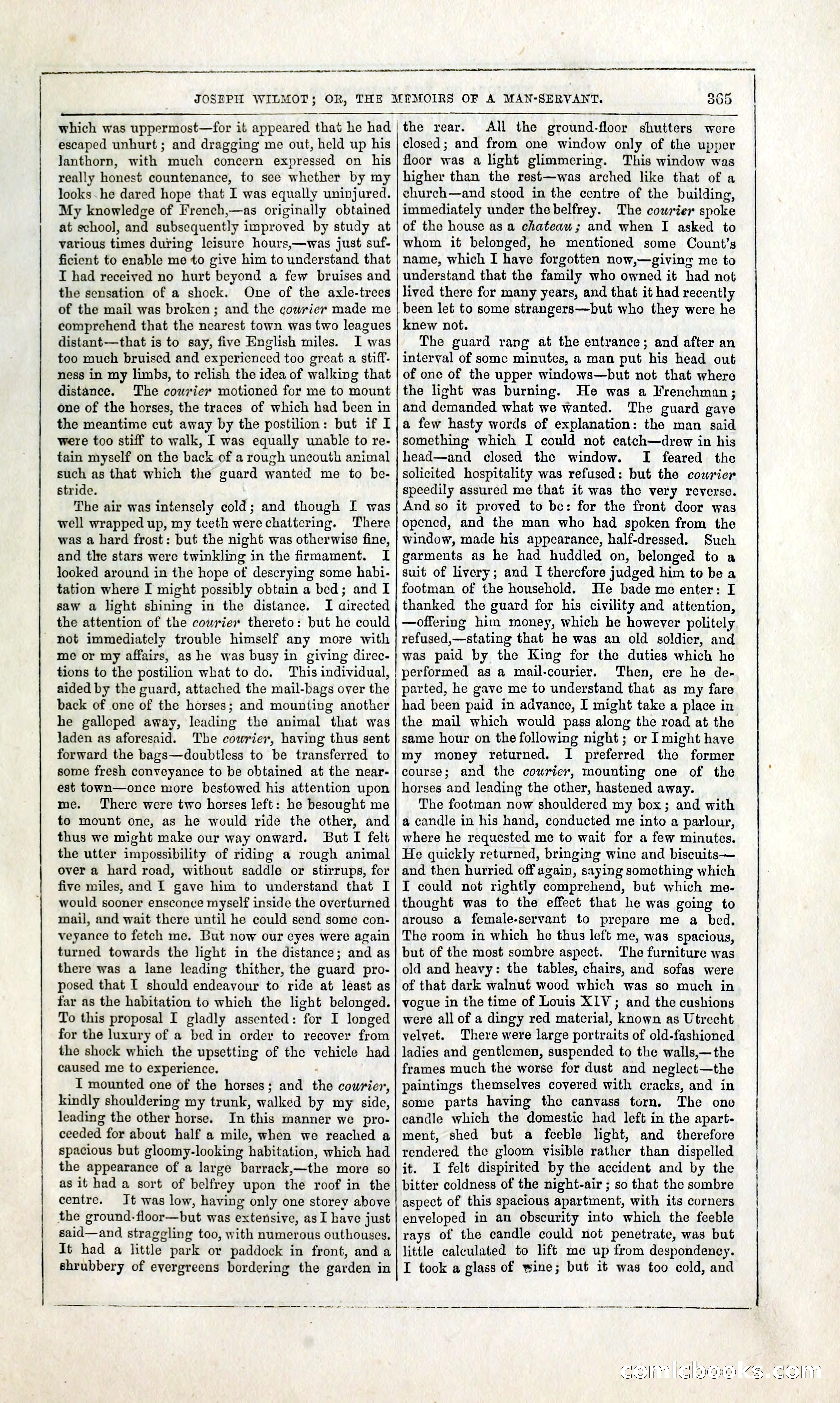
A restored page from Penny Dreadfuls, 1854. Page through the whole issue in the reader above.
📄 Transcribed text from this page (OCR, searchable)
Machine-transcribed from the original scan — historical spelling and the odd misread are preserved.
ET LT LL LOL LE OE JOSEPH WILMOT; OR, THE MEMOIRS OF A MAN-SERVANT. ee Ae Ae ene 365 which was uppermost—for it appeared that he had escaped unhurt; and dragging me out, held up his Janthorn, with much concern expressed on his really honest countenance, to see whether by my looks. he dared hope that I was equally uninjured. My knowledge of French,—as originally obtained at school, and subsequently improved by study at various times during leisure hours,—was just suf- ficient to enable me to give him to understand that T had received no hurt beyond a few bruises and the sensation of a shock. One of the axle-trees of the mail was broken; and the courier made me comprehend that the nearest town was two leagues distant—that is to say, five English miles. I was too much bruised and experienced too great a stiff- ness in my limbs, to relish the idea of walking that distance. The courvicr motioned for me to mount one of the horses, the traces of which had been in the meantime cut away by the postilion: but if I were too stiff to walk, I was equally unable to re- tain myself on the back of a rough uncouth animal such as that which the guard wanted me to be- stride. The air was intensely cold; and though I was well wrapped up, my teeth were chattering. There was a hard frost: but the night was otherwise fine, and tlre stars were twinkling in the firmament. I looked around in the hope of descrying some habi- tation where I might possibly obtain a bed; and I saw a light shining in the distance. I airected the attention of the courier thereto: but he could - not immediately trouble himself any more with me or my affairs, as he was busy in giving dircc- tions to the postilion what to do. This individual, aided by the guard, attached the mail-bags over the back of one of the horses; and mounting another he galloped away, leading the animal that was Jaden as aforesaid. The courier, having thus sent forward the bags—doubtless to be transferred to some fresh conveyance to be obtained at the near- est town—once more bestowed his attention upon me. There were two horses left: he besought me to mount one, as he would ride the other, and thus we might make our way onward. But I felt the utter impossibility of riding a rough animal over a hard road, without saddle or stirrups, for five miles, and I gave him to understand that I would sooner ensconce myself inside the overturned mail, and wait there until he could send some con- veyance to fetch me. But now our eyes were again turned towards the light in the distance; and as there was a lane leading thither, the guard pro- posed that I should endeavour to ride at least as far as the habitation to which the light belonged. To this proposal I gladly assented: for I longed for the luxury of a bed in order to recover from the shock which the upsetting of the vehicle had caused me to experience. : I mounted one of the horses; and the courier, kindly shouldering my trunk, walked by my side, leading the other horse. In this manner we pro- ceeded for about half a mile, when we reached a spacious but gloomy-looking habitation, which had the appearance of a large barrack,—the more so as it had a sort of belfrey upon the roof in the centre. It was low, having only one storey above the ground-floor—but was extensive, as I have just said—and straggling too, with numerous outhouses. It had a little park or paddock in front, and a shrubbery of evergreens bordering the garden in —— —— —_- Le ee ee es ee eS the rear. All the ground-floor shutters were closed; and from one window only of the upper floor was a light glimmering. This window was higher than the rest—was arched like that of a church—and stood in the centre of the building, immediately under thebelfrey. The cowrier spoke of the house as a chateau; and when I asked to whom it belonged, he mentioned some Count’s name, which I have forgotten now,—givine me to understand that the family who owned it had not lived there for many years, and that it had recently been let to some strangers—but who they were he knew not. The guard rang at the entrance; and after an interval of some minutes, a man put his head out of one of the upper windows—but not that where the light was burning. He was a Frenchman; and demanded what we wanted. The guard gave a few hasty words of explanation: the man said something which I could not catch—drew in his head—and closed the window. I feared the solicited hospitality was refused: but the courier speedily assured me that it was the very reverse. And so it proved to be: for the front door was opened, and the man who had spoken from the window, made his appearance, half-dressed. Such garments as he had huddled on, belonged to a suit of livery; and I therefore judged him to bea footman of the household. He bade me enter: I thanked the guard for his civility and attention, —offering him money, which he however politely refused,—stating that he was an old soldier, and was paid by the King for the duties which he performed as a mail-courier. Then, ere he de- parted, he gave me to understand that as my fare had been paid in advance, I might take a place in the mail which would pass along the road at the same hour on the following night ; or I might have my money returned. I preferred the former course; and the courier, mounting one of the horses and leading the other, hastened away. The footman now shouldered my box; and with a candle in his hand, conducted me into a parlour, where he requested me to wait for a few minutes. He quickly returned, bringing wine and biscuits— and then burried off again, saying something which I could not rightly comprehend, but which me- thought was to the effect that he was going to arouse a female-servant to prepare me a bed. The room in which he thus left me, was spacious, but of the most sombre aspect. The furniture was old and heavy: the tables, chairs, and sofas were of that dark walnut wood which was so much in vogue in the time of Louis XIV ; and the cushions were all of a dingy red material, known as Utrecht velvet. There were large portraits of old-fashioned ladies and gentlemen, suspended to the walls,—the frames much the worse for dust and neglect—the paintings themselves covered with cracks, and in some parts having the canvass turn, The one candle which the domestic had left in the apart- ment, shed but a feeble light, and therefore rendered the gloom visible rather than dispelled it. I felt dispirited by the accident and by the bitter coldness of the night-air ; so that the sombre aspect of this spacious apartment, with its corners enveloped in an obscurity into which the feeble rays of the candle could not penetrate, was but little calculated to lift me up from despondency. I took a glass of wine; but it was too cold, and werent tree Gloo <S) (CS) AA