
Penny Dreadfuls, 1854 · page 357 of 394
Joseph Wilmot, or, The Memoirs of a Man-Servant — page 357: what you’re looking at
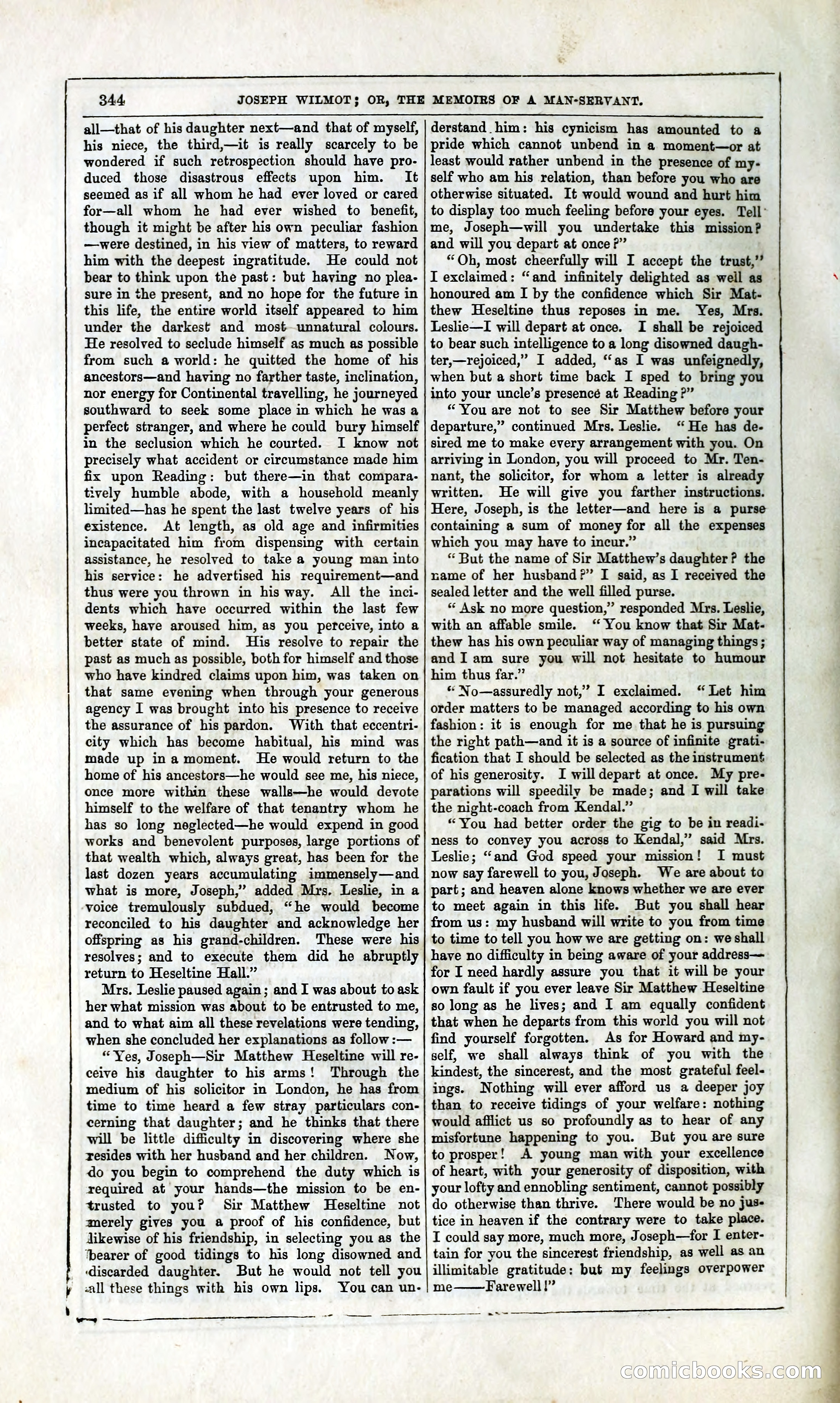
A restored page from Penny Dreadfuls, 1854. Page through the whole issue in the reader above.
📄 Transcribed text from this page (OCR, searchable)
Machine-transcribed from the original scan — historical spelling and the odd misread are preserved.
i 344. all—that of his daughter next—and that of myself, his niece, the third,—it is really scarcely to be wondered if such retrospection should have pro- duced those disastrous effects upon him. It seemed as if all whom he had ever loved or cared for—all whom he had ever wished to benefit, though it might be after his own peculiar fashion —were destined, in his view of matters, to reward him with the deepest ingratitude. He could not bear to think upon the past: but having no plea- sure in the present, and no hope for the future in this life, the entire world itself appeared to him under the darkest and most-unnatural colours. He resolved to seclude himself as much as possible from such a world: he quitted the home of his ancestors—and having no farther taste, inclination, nor energy for Continental travelling, he journeyed southward to seek some place in which he was a perfect stranger, and where he could bury himself in the seclusion which he courted. I know not precisely what accident or circumstance made him fix upon Reading: but there—in that compara- tively humble abode, with a household meanly limited—has he spent the last twelve years of his existence. At length, as old age and infirmities incapacitated him from dispensing with certain assistance, he resolved to take a young man into his service: he advertised his requirement—and thus were you thrown in his way. All the inci- dents which have occurred within the last few weeks, have aroused him, as you perceive, into a better state of mind. His resolve to repair the past as much as possible, both for himself and those who have kindred claims upon him, was taken on that same evening when through your generous agency I was brought into his presence to receive the assurance of his pardon. With that eccentri- city which has become habitual, his mind was made up ina moment. He would return to the home of his ancestors—he would see me, his niece, once more within these walls—he would devote himself to the welfare of that tenantry whom he has so long neglected—he would expend in good works and benevolent purposes, large portions of that wealth which, always great, has been for the last dozen years accumulating immensely—and what is more, Joseph,’ added Mrs. Leslie, in a voice tremulously subdued, “he would become reconciled to his daughter and acknowledge her offspring as his grand-children. These were his resolves; and to execute them did he abruptly return to Heseltine Hall.” Mrs. Leslie paused again; and I was about to ask her what mission was about to be entrusted to me, and to what aim all these revelations were tending, when she concluded her explanations as follow :— “Yes, Joseph—Sir Matthew Heseltine will re- ceive his daughter to his arms! Through the medium of his solicitor in London, he has from time to time heard a few stray particulars con- cerning that daughter; and he thinks that there will be little difficulty in discovering where she resides with her husband and her children. Now, do you begin to comprehend the duty which is required at your hands—the mission to be en- trusted to you? Sir Matthew Heseltine not amerely gives you a proof of his confidence, but dikewise of his friendship, in selecting you as the ‘bearer of good tidings to his long disowned and ‘discarded daughter. But he would not tell you y -all these things with his own lips. You can un- ' v= —- -——- ot ——— JOSEPH WILMOT; OR, THE MEMOIRS OF A MAN-SERVANT. derstand him: his cynicism has amounted to a pride which cannot unbend in a moment—or at least would rather unbend in the presence of my- self who am his relation, than before you who are otherwise situated. It would wound and hurt him to display too much feeling before your eyes. Tell’ me, Joseph—will you undertake this mission? and will you depart at once?” “Oh, most cheerfully will I accept the trust,” I exclaimed: “and infinitely delighted as weil as honoured am I by the confidence which Sir Mat- thew Heseltine thus reposes in me. Yes, Mrs. Leslie—I will depart at once. I shall be rejoiced to bear such intelligence to a long disowned daugh- ter,—rejoiced,” I added, “as I was unfeignedly, when but a short time back I sped to bring you into your uncle’s presencé at Reading ?” “You are not to see Sir Matthew before your departure,” continued Mrs. Leslie. ‘‘ He has de- sired me to make every arrangement with you. On arriving in London, you will proceed to Mr. Ten- nant, the solicitor, for whom a letter is already written. He will give you farther instructions. Here, Joseph, is the letter—and here is a purse containing a sum of money for all the expenses which you may have to incur.” “ But the name of Sir Matthew’s daughter? the name of her husband?” I said, as I received the sealed letter and the well filled purse. “* Ask no more question,” responded Mrs. Leslie, with an affable smile. ‘ You know that Sir Mat- thew has his own peculiar way of managing things ; and Iam sure you will not hesitate to humour him thus far.” * No—assuredly not,” I exclaimed. “ Let him order matters to be managed according to his own fashion: it is enough for me that he is pursuing the right path—and it is a source of infinite grati- fication that I should be selected as the instrument of his generosity. I willdepart at once. My pre- parations will speedily be made; and I will take the night-coach from Kendal.” “You had better order the gig to be in readi- ness to convey you across to Kendal,” said Mrs. Leslie; “and God speed your mission! I must now say farewell to you, Joseph. We are about to part; and heaven alone knows whether we are ever to meet again in this life. But you shall hear from us: my husband will write to you from time to time to tell you how we are getting on: we shall have no difficulty in being aware of your address— for I need hardly assure you that it will be your own fault if you ever leave Sir Matthew Heseltine so long as he lives; and I am equally confident that when he departs from this world you will not find yourself forgotten. As for Howard and my- self, we shall always think of you with the kindest, the sincerest, and the most grateful feel- ings. Nothing will ever afford us a deeper joy than to receive tidings of your welfare: nothing would afflict us so profoundly as to hear of any misfortune happening to you. But you are sure to prosper! A young man with your excellence of heart, with your generosity of disposition, with your lofty and ennobling sentiment, cannot possibly do otherwise than thrive. There would be no jus- tice in heaven if the contrary were to take place. I could say more, much more, Joseph—for I enter- tain for you the sincerest friendship, as well as an illimitable gratitude: but my feelings overpower me Farewell!” GEOG ooo <S) (CO)