
Penny Dreadfuls, 1854 · page 345 of 394
Joseph Wilmot, or, The Memoirs of a Man-Servant — page 345: what you’re looking at
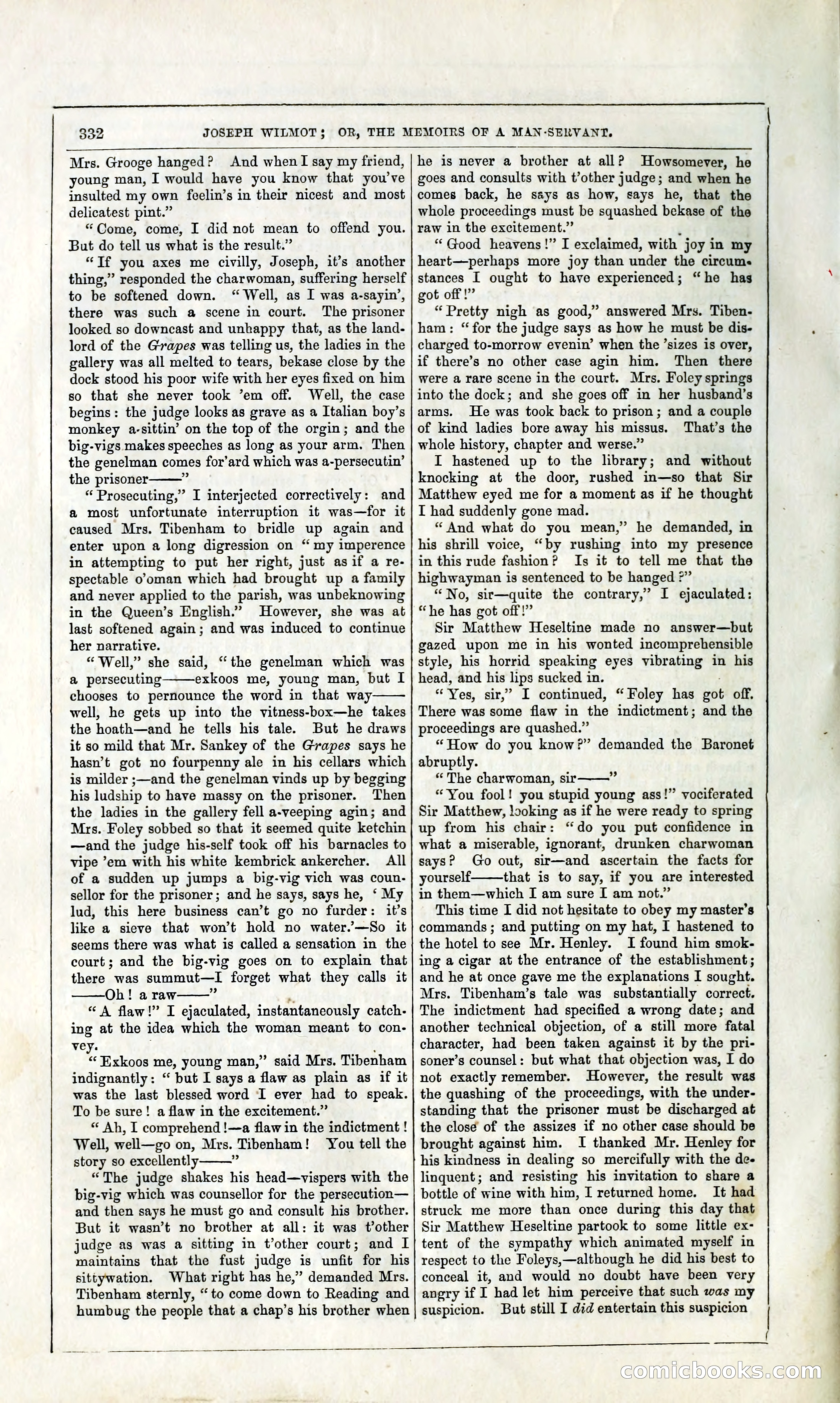
A restored page from Penny Dreadfuls, 1854. Page through the whole issue in the reader above.
📄 Transcribed text from this page (OCR, searchable)
Machine-transcribed from the original scan — historical spelling and the odd misread are preserved.
332 JOSEPH WILMOT; Mrs. Grooge hanged? And whenI say my friend, young man, I would have you know that you've insulted my own feelin’s in their nicest and most delicatest pint.” “Come, come, I did not mean to offend you. But do tell us what is the result.” “Tf you axes me civilly, Joseph, it’s another thing,” responded the charwoman, suffering herself to be softened down. “Well, as I was a-sayin’, there was such a scene in court. The prisoner looked so downcast and unhappy that, as the land- lord of the Grapes was telling us, the ladies in the gallery was all melted to tears, bekase close by the dock stood his poor wife with her eyes fixed on him so that she never took ’em off. Well, the case begins: the judge looks as grave as a Italian boy’s monkey a-sittin’ on the top of the orgin; and the big-vigs makes speeches as long as your arm. Then the genelman comes for’ard which was a-persecutin’ the prisoner “ Prosecuting,” I interjected correctively: and a most unfortunate interruption it was—for it caused Mrs. Tibenham to bridle up again and enter upon a long digression on “ my imperence in attempting to put her right, just asif a re- spectable o’oman which had brought up a family and never applied to the parish, was unbeknowing in the Queen’s English.” However, she was at last softened again; and was induced to continue her narrative. “Well,” she said, “the genelman which was a persecuting exkoos me, young man, but I chooses to pernounce the word in that way well, he gets up into the vitness-box—he takes the hoath—and he tells his tale. But he draws it so mild that Mr. Sankey of the Grapes says he hasn’t got no fourpenny ale in his cellars which is milder ;—and the genelman vinds up by begging his ludship to have massy on the prisoner. Then the ladies in the gallery fell a-veeping agin; and Mrs. Foley sobbed so that it seemed quite ketchin —and the judge his-self took off his barnacles to vipe ’em with his white kembrick ankercher. All of a sudden up jumps a big-vig vich was coun- sellor for the prisoner; and he says, says he, ‘ My lud, this here business can’t go no furder: it’s like a sieve that won't hold no water.’—So it seems there was what is called a sensation in the court; and the big-vig goes on to explain that there was summut—I forget what they calls it Oh! a raw ’ “A flaw!” I ejaculated, instantaneously catch- ing at the idea which the woman meant to con- vey. “‘Exkoos me, young man,” said Mrs. Tibenham indignantly: “ but I says a flaw as plain as if it was the last blessed word I ever had to speak. To be sure! a flaw in the excitement.” « Ah, I comprehend !—a flaw in the indictment ! Well, well—go on, Mrs. Tibenham! You tell the story so excellently ¥ “The judge shakes his head—vispers with the big-vig which was counsellor for the persecution— and then says he must go and consult his brother. But it wasn’t no brother at all: it was t’other judge as was a sitting in t’other court; and I maintains that the fust judge is unfit for his sittywation. What right has he,” demanded Mrs. Tibenham sternly, “to come down to Reading and humbug the people that a chap’s his brother when en OR, THE MEMOIRS OF A MAN-SERVANT, he is never a brother at all? Howsomever, he goes and consults with t’other judge; and when he comes back, he says as how, says he, that the whole proceedings must be squashed bekase of the raw in the excitement.” ‘ “Good heavens!” I exclaimed, with joy in my heart—perhaps more joy than under the circums stances I ought to have experienced; “he has got off !” “Pretty nigh as good,” answered Mrs. Tiben- ham: “ for the judge says as how he must be dis- charged to-morrow evenin’ when the ’sizes is over, if there’s no other case agin him. Then there were a rare scene in the court. Mrs. Foley springs into the dock; and she goes off in her husband’s arms. He was took back to prison; and a couple of kind ladies bore away his missus. That’s the whole history, chapter and werse.” I hastened up to the library; and without knocking at the door, rushed in—so that Sir Matthew eyed me for a moment as if he thought I had suddenly gone mad. “ And what do you mean,’ he demanded, in his shrill voice, “by rushing into my presence in this rude fashion? Is it to tell me that the highwayman is sentenced to be hanged ?” “No, sir—quite the contrary,’ I ejaculated: “he has got off!” Sir Matthew Heseltine made no answer—but gazed upon me in his wonted incomprehensible style, his horrid speaking eyes vibrating in his head, and his lips sucked in. “Yes, sir,’ I continued, “Foley has eet off, There was some flaw in the indictment; and the proceedings are quashed.” “How do you know?” demanded the Baronet abruptly. “The charwoman, sir “You fool! you stupid young ass!” vociferated Sir Matthew, looking as if he were ready to spring up from his chair: “do you put confidence in what a miserable, ignorant, drunken charwoman saysP Go out, sir—and ascertain the facts for yourself. that is to say, if you are interested in them—which I am sure I am not.” This time I did not hesitate to obey my master’s commands; and putting on my hat, I hastened to the hotel to see Mr. Henley. I found him smok- ing a cigar at the entrance of the establishment; and he at once gave me the explanations I sought. Mrs. Tibenham’s tale was substantially correct. The indictment had specified a wrong date; and another technical objection, of a still more fatal character, had been taken against it by the pri- soner’s counsel: but what that objection was, I do not exactly remember. However, the result was the quashing of the proceedings, with the under- standing that the prisoner must be discharged at the closé of the assizes if no other case should be brought against him. I thanked Mr. Henley for his kindness in dealing so mercifully with the de- linquent; and resisting his invitation to share a bottle of wine with him, I returned home. It had struck me more than once during this day that Sir Matthew Heseltine partook to some little ex- tent of the sympathy which animated myself in respect to the Foleys,—although he did his best to conceal it, and would no doubt have been very angry if I had let him perceive that such was my suspicion. But still I did entertain this suspicion 99 Ce ene en ee eS as ae | ( OOO) (COUM (Cc SH co \ ‘