
Penny Dreadfuls, 1854 · page 336 of 394
Joseph Wilmot, or, The Memoirs of a Man-Servant — page 336: what you’re looking at
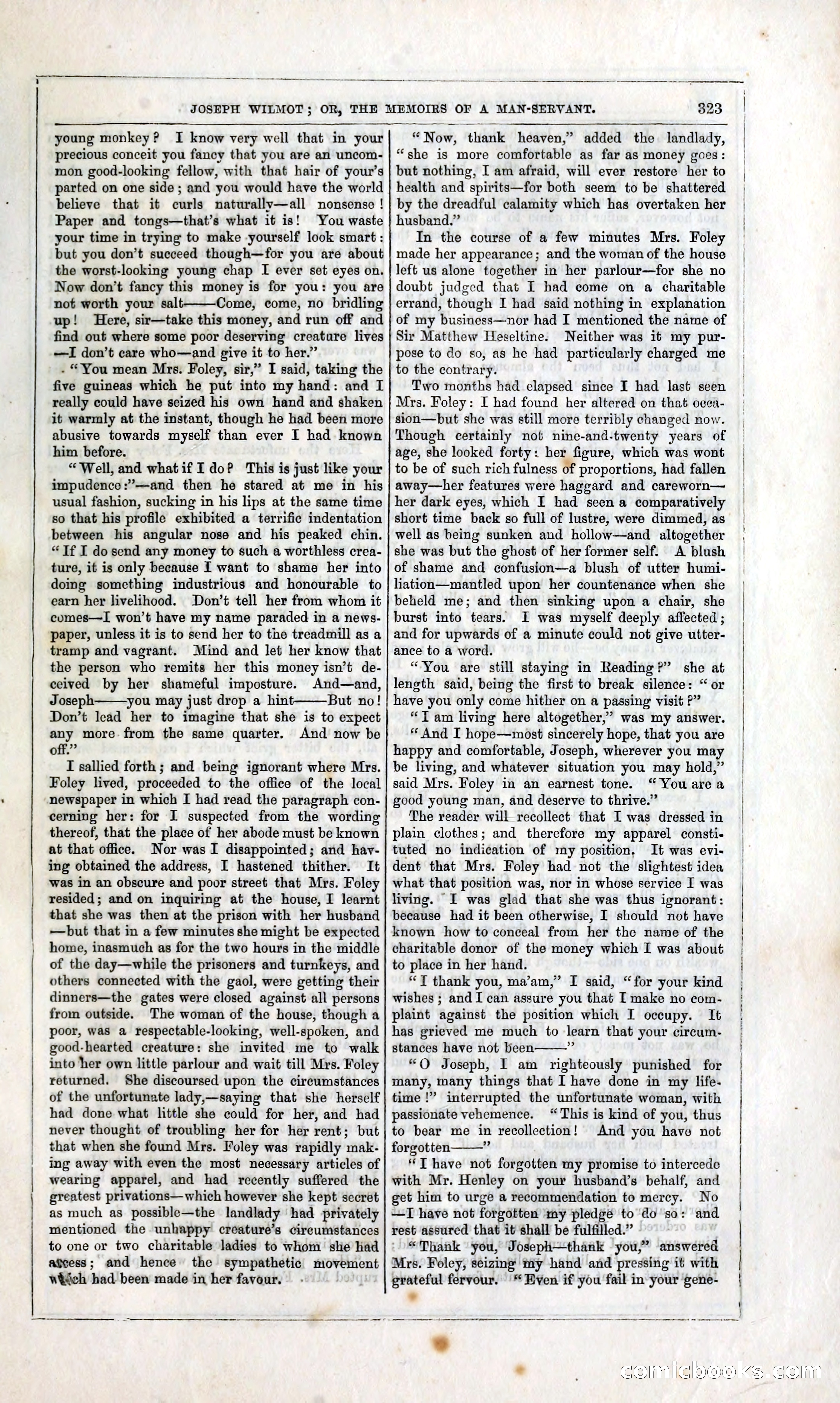
A restored page from Penny Dreadfuls, 1854. Page through the whole issue in the reader above.
📄 Transcribed text from this page (OCR, searchable)
Machine-transcribed from the original scan — historical spelling and the odd misread are preserved.
— JOSEPH WILMOT; OR, THE MEMOIRS OF A MAN-SERVANT. young monkey? I know very well that in your precious conceit you fancy that you are an uncom- mon good-looking fellow, with that hair of your’s parted on one side ; and you would have the world believe that it curls naturally—all nonsense ! Paper and tongs—that’s what it is! You waste your time in trying to make yourself look smart : but you don’t succeed though—for you are about the worst-looking young chap I ever set eyes on. Now don’t fancy this money is for you: you are not worth your salt——-Come, come, no bridling up! Here, sir—take this money, and run off and find out where some poor deserving creature lives —I don’t care who—and give it to her.” - “You mean Mrs. Foley, sir,” I said, taking the five guineas which he put into my hand: and I really could have seized his own hand and shaken it warmly at the instant, though he had been more abusive towards myself than ever I had known him before. “Well, and whatif Ido? This is just like your impudence:”—and then he stared at me in his usual fashion, sucking in his lips at the same time so that his profile exhibited a terrific indentation between his angular nose and his peaked chin. “If I dosend any money to such a worthless crea- ture, it is only because I want to shame her into doing something industrious and honourable to earn her livelihood. Don’t tell her from whom it comes—I won’t have my name paraded in a news- paper, unless it is to send her to the treadmill as a tramp and vagrant. Mind and let her know that the person who remits her this money isn’t de- ceived by her shameful imposture. And—and, Joseph you may just drop a hint——-But no! Don’t lead her to imagine that she is to expect any more from the same quarter. And now be off.” I sallied forth ; and being ignorant where Mrs. Foley lived, proceeded to the office of the local newspaper in which I had read the paragraph con- cerning her: for I suspected from the wording thereof, that the place of her abode must be known at that office. Nor was I disappointed; and hay- ing obtained the address, I hastened thither. It was in an obscure and poor street that Mrs. Foley resided; and on inquiring at the house, I learnt that she was then at the prison with her husband —but that m a few minutes she might be expected home, inasmuch as for the two hours in the middle of the day—while the prisoners and turnkeys, and others connected with the gaol, were getting their dinners—the gates were closed against all persons from outside. The woman of the house, though a poor, was a respectable-looking, well-spoken, and good-hearted creature: she invited me to walk into her own little parlour and wait till Mrs. Foley returned. She discoursed upon the circumstances of the unfortunate lady,—saying that she herself had done what little she could for her, and had never thought of troubling her for her rent; but that when she found Mrs. Foley was rapidly mak- ing away with even the most necessary articles of wearing apparel, and had recently suffered the greatest privations— which however she kept secret as much as possible—the landlady had privately mentioned the unhappy creature’s circumstances to one or two charitable ladies to whom she had afeess; and hence the sympathetic movement weaich had been made in her favour. - | ee ee ie ee —-——™ a es “Now, thank heaven,’ added the landlady, “she is more comfortable as far as money goes: but nothing, I am afraid, will ever restore her to health and spirits—for both seem to be shattered by the dreadful calamity which has overtaken her husband.” In the course of a few minutes Mrs. Foley made her appearance; and the woman of the house left us alone together in her parlour—for she no doubt judged that I had come on a charitable errand, though I had said nothing in explanation of my business—nor had I mentioned the name of Sir Matthew Heseltine. Neither was it my pur- pose to do so, as he had particularly charged me to the contrary. Two months had elapsed since I had last seen Mrs. Foley: I had found her altered on that ocea- sion—but she was still more terribly changed now. Though certainly not nine-and-twenty years of age, she looked forty: her figure, which was wont to be of such rich fulness of proportions, had fallen away—her features were haggard and careworn— her dark eyes, which I had seen a comparatively short time back so full of lustre, were dimmed, as well as being sunken and hollow—and altogether she was but the ghost of her former self. A blush of shame and confusion—a blush of utter humi- liation—mantled upon her countenance when she beheld me; and then sinking upon a chair, she burst into tears. I was myself deeply affected ; and for upwards of a minute could not give utter- ance to a word. “You are still staying in Reading?” she at length said, being the first to break silence: “or have you only come hither on a passing visit P” “Tam living here altogether,’ was my answer. ** And I hope—most sincerely hope, that you are happy and comfortable, Joseph, wherever you may be living, and whatever situation you may hold,” said Mrs. Foley in an earnest tone. “ You are a good young man, and deserve to thrive.” The reader will recollect that I was dressed in plain clothes; and therefore my apparel consti- tuted no indication of my position, It was evi- dent that Mrs. Foley had not the slightest idea what that position was, nor in whose service I was living. I was glad that she was thus ignorant: because had it been otherwise, I should not have known how to conceal from her the name of the charitable donor of the money which I was about to place in her hand. “1 thank you, ma’am,” I said, “for your kind wishes ; and I can assure you that I make no com- plaint against the position which I occupy. It has grieved me much to learn that your circum- stances have not been a “OQ Joseph, I am righteously punished for many, many things that I have done in my life. time !” interrupted the unfortunate woman, with passionate vehemence. “This is kind of you, thus to bear me in recollection! And you have not forgotten " T have not forgotten my promise to intercede with Mr. Henley on your husband’s behalf, and get him to urge a recommendation to mercy. No —TI have not forgotten my pledge to do so: and rest assured that it shall be fulfilled.” “Thank you, Joseph—thank you,” answered Mrs. Foley, seizing my hand and pressing it with evateful fervour. Even if you fail in your gene- : | | : ' | nd ee a ee OS Se eee CORNICE O@ SS co im