
Penny Dreadfuls, 1854 · page 333 of 394
Joseph Wilmot, or, The Memoirs of a Man-Servant — page 333: what you’re looking at
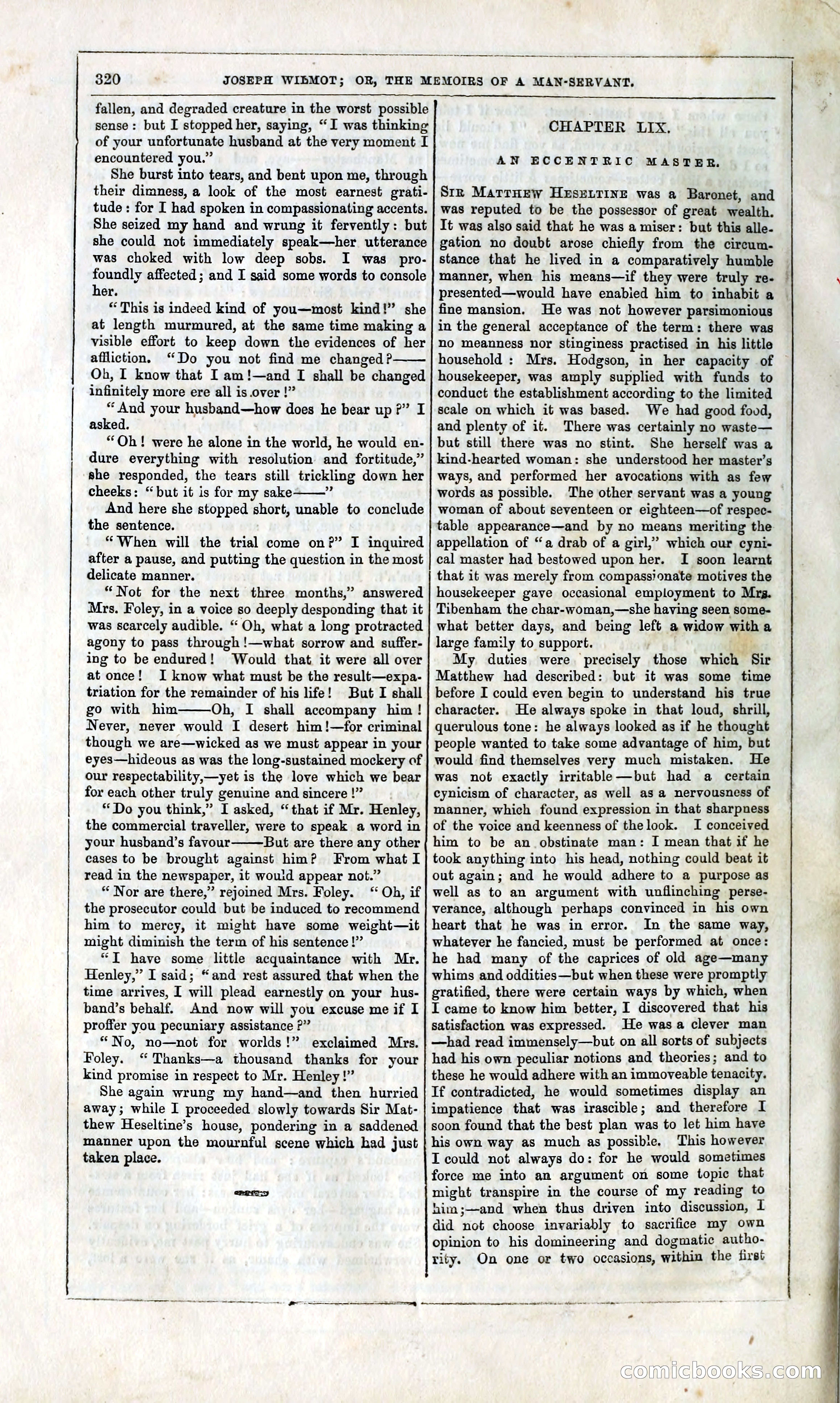
A restored page from Penny Dreadfuls, 1854. Page through the whole issue in the reader above.
📄 Transcribed text from this page (OCR, searchable)
Machine-transcribed from the original scan — historical spelling and the odd misread are preserved.
OO ere ae er ee 320 fallen, and degraded creature in the worst possible sense: but I stopped her, saying, “I was thinking of your unfortunate husband at the very moment I encountered you.” She burst into tears, and bent upon me, through their dimness, a look of the most earnest grati- tude : for I had spoken in compassionating accents. She seized my hand and wrung it fervently: but she could not immediately speak—her utterance was choked with low deep sobs. I was pro- foundly affected ; and I said some words to console her. “This is indeed kind of you—most kind!’ she at length murmured, at the same time making a visible effort to keep down the evidences of her affliction. “Do you not find me changed? Oh, I know that I am!—and I shall be changed infinitely more ere all is.over !” “And your husband—how does he bear up ?” I asked. ‘Oh! were he alone in the world, he would en- dure everything with resolution and fortitude,” she responded, the tears still trickling down her cheeks: “but it is for my sake fs And here she stopped short, unable to conclude the sentence. “When will the trial come on?” I inquired after a pause, and putting the question in the most delicate manner. * Not for the next three months,’ answered Mrs. Foley, in a voice so deeply desponding that it was scarcely audible. “ Oh, what a long protracted agony to pass through !—what sorrow and suffer- ing to be endured! Would that it were all over at once! I know what must be the result—expa- triation for the remainder of his life! But I shall go with him Oh, I shall accompany him! Never, never would I desert him!—for criminal though we are—wicked as we must appear in your eyes—hideous as was the long-sustained mockery of our respectability,—yet is the love which we bear for each other truly genuine and sincere !” “Do you think,” I asked, “that if Mr. Henley, the commercial traveller, were to speak a word in your husband’s favour But are there any other cases to be brought against him? From what I read in the newspaper, it would appear not.” “ Nor are there,” rejoined Mrs. Foley. ‘Oh, if the prosecutor could but be induced to recommend him to mercy, it might have some weight—it might diminish the term of his sentence !” “T have some little acquaintance with Mr. Henley,” I said; “and rest assured that when the time arrives, I will plead earnestly on your hus- band’s behalf. And now will you excuse me if I proffer you pecuniary assistance P” * No, no—not for worlds!” exclaimed Mrs. Foley. “ Thanks—a thousand thanks for your kind promise in respect to Mr. Henley!” She again wrung my hand—and then hurried away; while I proceeded slowly towards Sir Mat- thew Heseltine’s house, pondering in a saddened manner upon the mournful scene which had just taken place. a a a na his own way as much as possibile, 4 SS eet ass ws ss sl re JOSEPH WIBMOT; OR, THE MEMOIRS OF A MAN-SERVANT, CHAPTER LIX. AN ECCENTRIC MASTER. Str Marrnew HeEsE,TInE was a Baronet, and was reputed to be the possessor of great wealth. It was also said that he was a miser: but this alle- gation no doubt arose chiefly from the circum. stance that he lived in a comparatively humble manner, when his means—if they were truly re- presented—would have enabied him to inhabit a © fine mansion. He was not however parsimonious in the general acceptance of the term: there was no meanness nor stinginess practised in his little household : Mrs. Hodgson, in her capacity of © housekeeper, was amply supplied with funds to conduct the establishment according to the limited scale on which it was based. We had good food, and plenty of it. There was certainly no waste— but still there was no stint. She herself was a kind-hearted woman: she understood her master’s ways, and performed her avocations with as few words as possible. The other servant was a young woman of about seventeen or eighteen—of respec- table appearance—and by no means meriting the appellation of “a drab of a girl,’ which our cyni- cal master had bestowed upon her. I soon learnt that it was merely from compass/onate motives the housekeeper gave occasional employment to Mrs. Tibenham the char-woman,—she having seen some- what better days, and being left a widow with large family to support. | My duties were precisely those which Sir Matthew had described: but it was some time before I could even begin to understand his true character. He always spoke in that loud, shrill, querulous tone: he always looked as if he thought people wanted to take some advantage of him, but would find themselves very much mistaken. He was not exactly irritable—but had a certain cynicism of character, as well as a nervousness of manner, which found expression in that sharpness of the voice and keenness of thelook. I conceived him to be an obstinate man: I mean that if he took anything into his head, nothing could beat it out again; and he would adhere to a purpose as well as to an argument with unflinching perse- verance, although perhaps convinced in his own heart that he was in error. In the same way, whatever he fancied, must be performed at once: he had many of the caprices of old age—many whims and oddities—but when these were promptly gratified, there were certain ways by which, when I came to know him better, I discovered that his satisfaction was expressed. He wasa clever man —had read immensely—but on all sorts of subjects had his own peculiar notions and theories; and to these he would adhere with an immoveable tenacity. If contradicted, he would sometimes display an impatience that was irascible; and therefore I soon found that the best plan was to let him have This however IT could not always do: for he would sometimes force me into an argument on some topic that might transpire in the course of my reading to him;—and when thus driven into discussion, 1 did not choose invariably to sacrifice my own opinion to his domineering and dogmatic autho- rity. On one or two occasions, within the first SS (Cc) Goo