
Penny Dreadfuls, 1854 · page 328 of 394
Joseph Wilmot, or, The Memoirs of a Man-Servant — page 328: what you’re looking at
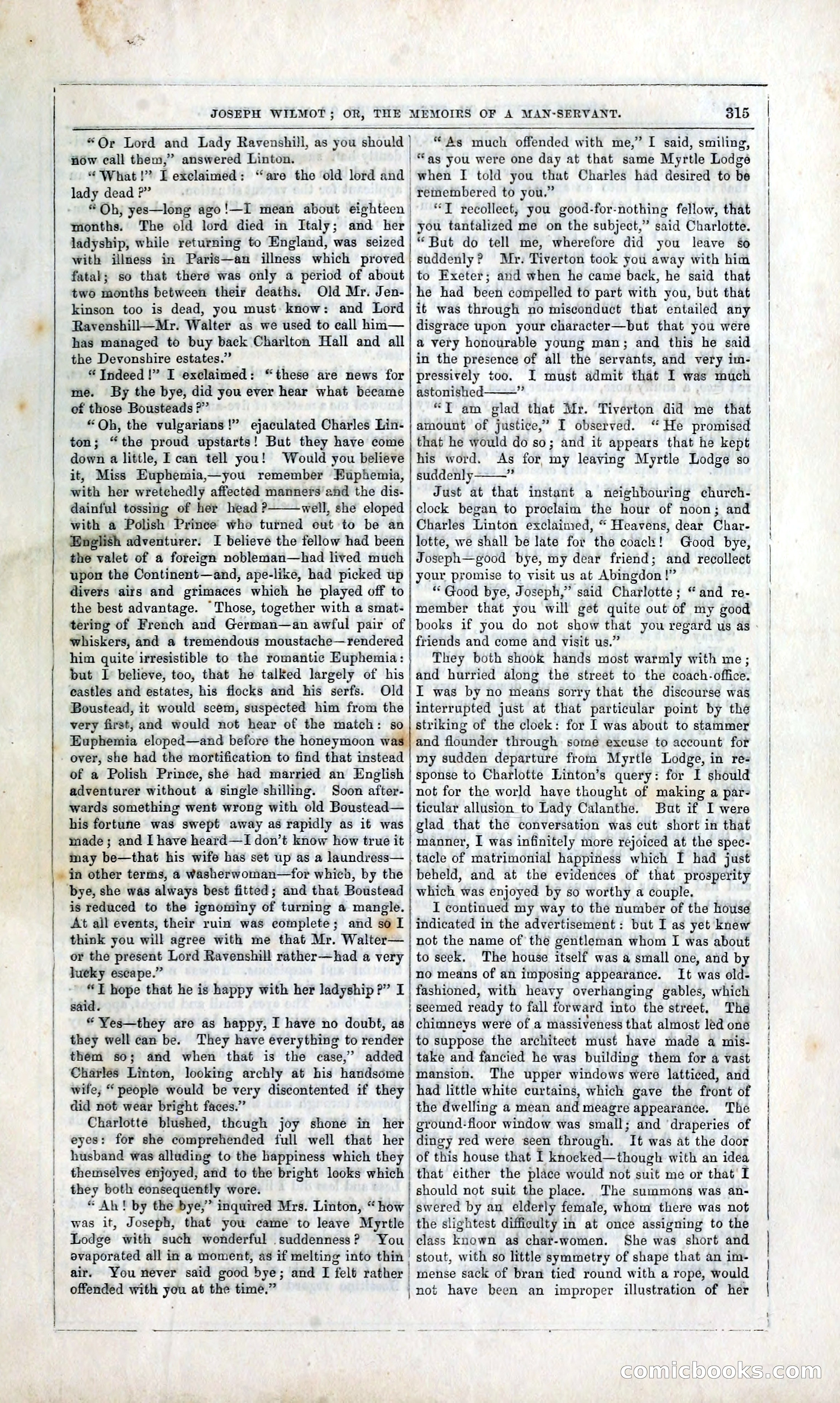
A restored page from Penny Dreadfuls, 1854. Page through the whole issue in the reader above.
📄 Transcribed text from this page (OCR, searchable)
Machine-transcribed from the original scan — historical spelling and the odd misread are preserved.
_ over, she had the mortification to find that instead as ee re wees > JOSEPH WILMOT; OR, THE MEMOIRS OF A MAN-SERVANT. “Or Lord and Lady Ravenshill, as you should How call them,” answered Linton. “What!” L exclaimed: “are the old lord and | | remembered to you.” ® Oh, yes—long ago!—I mean about eighteen | lady dead ?” months. The old lord died in Italy; and her ladyship, while returning to England, was seized with illness in Paris—an illness which proved fatal; so that there was only a period of about two months between their deaths, Old Mr. Jen- kinson too is dead, you must know: and Lord Ravenshill—Mr. Walter as we used to call him— has managed to buy back Charlton Hall and all the Devonshire estates.” “ Indeed!” I exclaimed: “these are news for me. By the bye, did you ever hear what became of those Bousteads ?” “Qh, the vulgarians!” ejaculated Charles Lin- ton; “the proud upstarts! But they have come down a little, I can tell you! Would you believe it, Miss Euphemia,—you remember Fuphemia, with her wretchedly affected manners and the dis- dainful tossing of her head? well, she eloped with a Polish Prince who turned out to be an Pnelish adventurer. I believe the fellow had been the valet of a foreign nobleman—had lived much upon the Continent—and, ape-like, had picked up divers airs and grimaces which he played off to the best advantage. “Those, together with a smat- tering of French and German—an awful pair of whiskers, and a tremendous moustache—rendered him quite irresistible to the romantic Euphemia: but I believe, too, that he talked largely of his castles and estates, his flocks and his serfs. Old Boustead, it would seem, suspected him from the very first, and would not hear of the match: so Euphemia eloped—and before the honeymoon w of a Polish Prince, she had married an English adventurer without a single shilling. Soon after- wards something went wrong with old Boustead— his fortune was swept away as rapidly as it was made; and I have heard—I don’t know how true it may be—that his wife has set up as a laundress— . in other terms, a4 Washerwoman—for which, by the ee —— —— bye, she was always best fitted; and that Boustead is reduced to the ignominy of turning a mangle. At all events, their ruin was complete; and sol think you will agree with me that Mr. Walter— or the present Lord Ravenshill rather—had a very lueky escape.” “T hope that he is happy with her ladyship ?” I said. “ Yes—they are as happy, I have no doubt, as they well can be. They have everything to render thém so; and when that is the case,’ added Charles Linton, looking archly at his handsome wife, “ people would be very discontented if they did not wear bright faces.” Charlotte blushed, theugh joy shone in her eyes: for she comprehended full well that her husband was alluding to the happiness which they themselves enjoyed, and to the bright looks which they both consequently wore. “Ah! by the bye,” inquired Mrs. Linton, “how —_—_—_—_ 315 “As much offended with me,’ I said, smiling, “as you were one day at that same Myrtle Lodge when I told you that Charles had desired to be “T recollect, you good-for-nothing fellow, that you tantalized me on the subject,” said Charlotte. * But do tell me, wherefore did you leave §&0 suddenly? Mr. Tiverton took you away with him to Exeter; and when he came back, he said that he had been compelled to part with you, but that it was through no misconduct that entailed any disgrace upon your character—but that you were a very honourable young man; and this he said in the presence of all the servants, and very im- pressively too. I must admit that I was much astonished 4 “I am glad that Mr. Tiverton did me that amount of justice,” I observed. “He promised that he would do so; and it appears that he kept his word. As for, my leaving Myrtle Lodge so suddenly f Just at that instant a neighbouring church- clock began to proclaim the hour of noon; and Charles Linton exclaimed, “ Heavens, dear Char- lotte, we shall be late for the coach! Good bye, Joseph—good bye, my dear friend; and recollect your promise to visit us at Abingdon!” “ Good bye, Joseph,” said Charlotte; “and re- member that you will get quite out of my good books if you do not show that you regard us as » friends and come and visit us.” They both shook hands most warmly with me; and hurried along the street to the coach-oflfice. I was by no means sorry that the discourse was interrupted just at that particular point by the striking of the cloek: for I was about to stammer and flounder through some excuse to account for my sudden departure from Myrtle Lodge, in re- sponse to Charlotte Linton’s query: for I should not for the world have thought of making a par- ticular allusion to Lady Calanthe. But if I were glad that the conversation was cut short in that manner, I was infinitely more rejoiced at the spec- -tacle of matrimonial happiness which I had just beheld, and at the evidences of that prosperity which was enjoyed by so worthy a couple. I continued my way to the number of the house indicated in the advertisement: but I as yet knew not the name of the gentleman whom I was about to seek. The house itself was a small one, and by no means of an imposing appearance. It was old- fashioned, with heavy overhanging gables, which seemed ready to fall forward into the street. The chimneys were of a massiveness that almost led one to suppose the architect must have made a mis- take and fancied he was building them for a vast mansion. The upper windows were latticed, and had little white curtains, which gave the front of the dwelling a mean and meagre appearance. ‘The ground-floor window was small; and ‘draperies of dingy red were seen through. It was at the door of this house that I knoeked—though with an idea that either the place would not suit me or that I should not suit the place. The summons was an- swered by an elderly female, whom there was not was it, Joseph, that you came to leave Myrtle the slightest difficulty in at once assigning to the Lodge with such wonderful suddenness? ‘You! class known as char-women. She was short and evaporated all in a moment, as if melting into thin! stout, with so little symmetry of shape that an im- air. You never said good bye; and I felt rather mense sack of bran tied round with a rope, would offended with you at the time.” | not have been an improper illustration of her GIOaks (CO) im