
Penny Dreadfuls, 1854 · page 319 of 394
Joseph Wilmot, or, The Memoirs of a Man-Servant — page 319: what you’re looking at
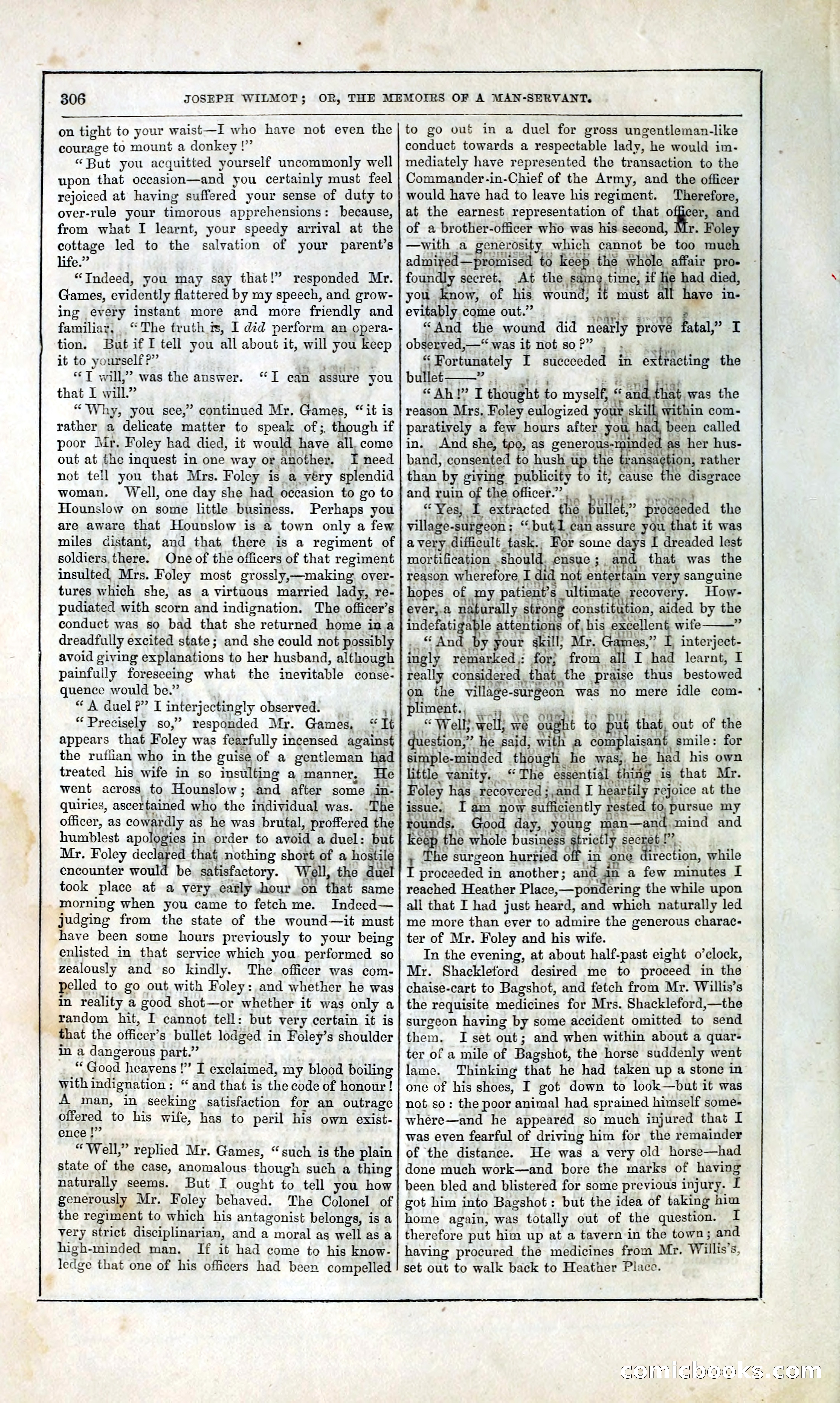
A restored page from Penny Dreadfuls, 1854. Page through the whole issue in the reader above.
📄 Transcribed text from this page (OCR, searchable)
Machine-transcribed from the original scan — historical spelling and the odd misread are preserved.
306 JOSEPH WILMOT; OR, THE MEMOIRS OF A MAN-SERVANT. on tight to your waist—I who have not even the courage to mount a donkey !” «But you acquitted yourself uncommonly well upon that occasion—and you certainly must feel rejoiced at haying suffered your sense of duty to over-rule your timorous apprehensions: because, from what I learnt, your speedy arrival at the cottage led to the salvation of your parent’s life.” “Indeed, you may say that!’ responded Mr. Games, evidently flattered by my speech, and grow- ing every instant more and more friendly and familiar, ‘The truth ts, I did perform an opera- tion. ButifI tell you all about it, will you keep it to yourself P” “‘T will,” was the answer. that I will.” | 4 “ Why, you see,’ continued Mr. Games, “it is rather a delicate matter to speak of;. though if poor Mr, Foley had died, it would have all. come out at the inquest in one way or another. I need not tell you that Mrs. Foley is a very splendid woman. Well, one day she had occasion to go to Hounslow on some little business. Perhaps you are aware that Hounslow is a town only a few miles distant, and that there is a regiment of soldiers,there. One of the officers of that regiment insulted Mrs. Foley most grossly,—making. oyver- tures which she, as a virtuous married lady, re- pudiated with scorn and indignation. The officer’s conduct was so bad that she returned home ina dreadfully excited state; and she could not possibly avoid giving explanations to her husband, although painfully foreseeing what the inevitable conse- quence would be.” “A duel P” I interjectingly observed. +4 “Precisely so,” responded Mr. Games, “It appears that Foley was fearfully incensed against the ruflian who in the guise of a gentleman had}s treated his wife in so insulting a manner, He went across to Hounslow ; and after some in- quiries, ascertained who the individual was. ‘The officer, as cowar diy as he was brutal, proffered the humblest apologies in order to avoid a duel: but Mr. Foley declared that nothing short of a hostile encounter would be. satisfactory. Well, the aut took place at a yery early hour on that same morning when you came to fetch me. Indeed— judging from the state of the wound—it must have been some hours previously to your being enlisted in that service which you. performed so zealously and so kindly. The officer was com- pelled to go out with Foley: and whether he was in reality a good shot—or whether it was only a random hit, I cannot tell: but very certain it is that the officer’ s bullet lodged in Foley’s shoulder in a dangerous part.” “ Good heavens !” I exclaimed, my blood boiling with indignation : “ and that is the code of honour ! A man, in seeking satisfaction for an outrage offered to his wife, has to peril his own exist- ence !” “Well,” replied Mr. Games, “such is the plain state of the case, anomalous though such a thing naturally seems. But I ought to tell you how generously Mr. Foley behaved. The Colonel of the regiment to which his antagonist belongs, is a very strict disciplinarian, and a moral as well as a high-minded man. If it had come to his know- ledge that one of his officers had been compelled “TI can assure you to go out in a duel for gross ungentleman-like conduct towards a respectable lady, he would im- mediately have represented the transaction to the Commander-in-Chief of the Army, and the officer would have had to leave his regiment. Therefore, at the earnest representation of that officer, and of a brother-officer who was his second, Mr. Foley —with a generosity which cannot be too much admired—promised to keep. the whole, affair pro- foundly secret, At the Lie Q i fims th ad died, you know, of his Wound must a it Rave 3 in- evitably come out.” “And the wound did neatly prove fatal, vee | obseryed,—* was it not so ?” 3 ' Fortunately I succeeded in extracting the bullet “Ahr? I thought to my soll a reason Mrs, Foley eulogized your skil ‘and that. was the Ul within com- paratively a few hours after 9H be been called in. And she, tpo, as generous- as her hus- band, consented to hush up. the Hanalttion, rather than by giving publicity to it} cause the disgrace and ruin of the officer.” , “Yes; _ extracted the . bullet; ‘ proc seded the village- -surgeon; “ -butL can assure you that it was avery difficult task. For some days I dreaded lest mortification .should. ensue } ;, and that was the reason wher efore I id not seat am very sanguine hopes of my patient’s ultimate, recovery. How- ever,.2 naturally strong constitution, aided by the indefatigab le attentions of, his excellent wife 4 “ And y your skill; Mr. Games es,’ I interject- ingly remarked ;: for} from all I had learnt, I really considered , that ;, the praise thus bestowed on the village- -surpeon was no mere idle com- et Well}. well; we 0 ee to put that, out of the estion,” he sajd, with a complaisant, smile: for i ath though. he was,, he. had his own tle vanity. “The essential. fig. is that Mr. Foley has recover ed:,and I heartily rejoice at the issue., I am now sufficiently rested £0, pursue my ae . Good day, young man—and.mind and the whole business § rictly secret !” he surgeon hurtied off in one direction, while I proceeded i in another; and an a few minutes I reached Heather Place, —pondering the while upon all that I had just heard, and which naturally led me more than ever to admire the generous charac- ter of Mr. Foley and his wife. In the evening, at about half-past eight o’clock, Mr. Shackleford desired me to proceed in the chaise-cart to Bagshot, and fetch from Mr. Willis’s the requisite medicines for Mrs. Shackleford,—the surgeon having by some accident omitted to send them. I set out; and when within about a quar- ter of a mile of Bagshot, the horse suddenly went lame. Thinking that he had taken up a stone in one of his shoes, I got down to look—but it was not so: the poor animal had sprained himself some- where—and he appeared so much injured that I was even fearful of driving him for the remainder of the distance. He was a very old horse—had done much work—and bore the marks of having been bled and blistered for some previous injury. I got him into Bagshot: but the idea of taking him home again, was totally out of the question. I therefore put him up at a tavern in the town; and having procured the medicines from Mr. Willis’ S, set out to walk back to Heather Place. OOO) <S (C@) in