
Penny Dreadfuls, 1854 · page 303 of 394
Joseph Wilmot, or, The Memoirs of a Man-Servant — page 303: what you’re looking at
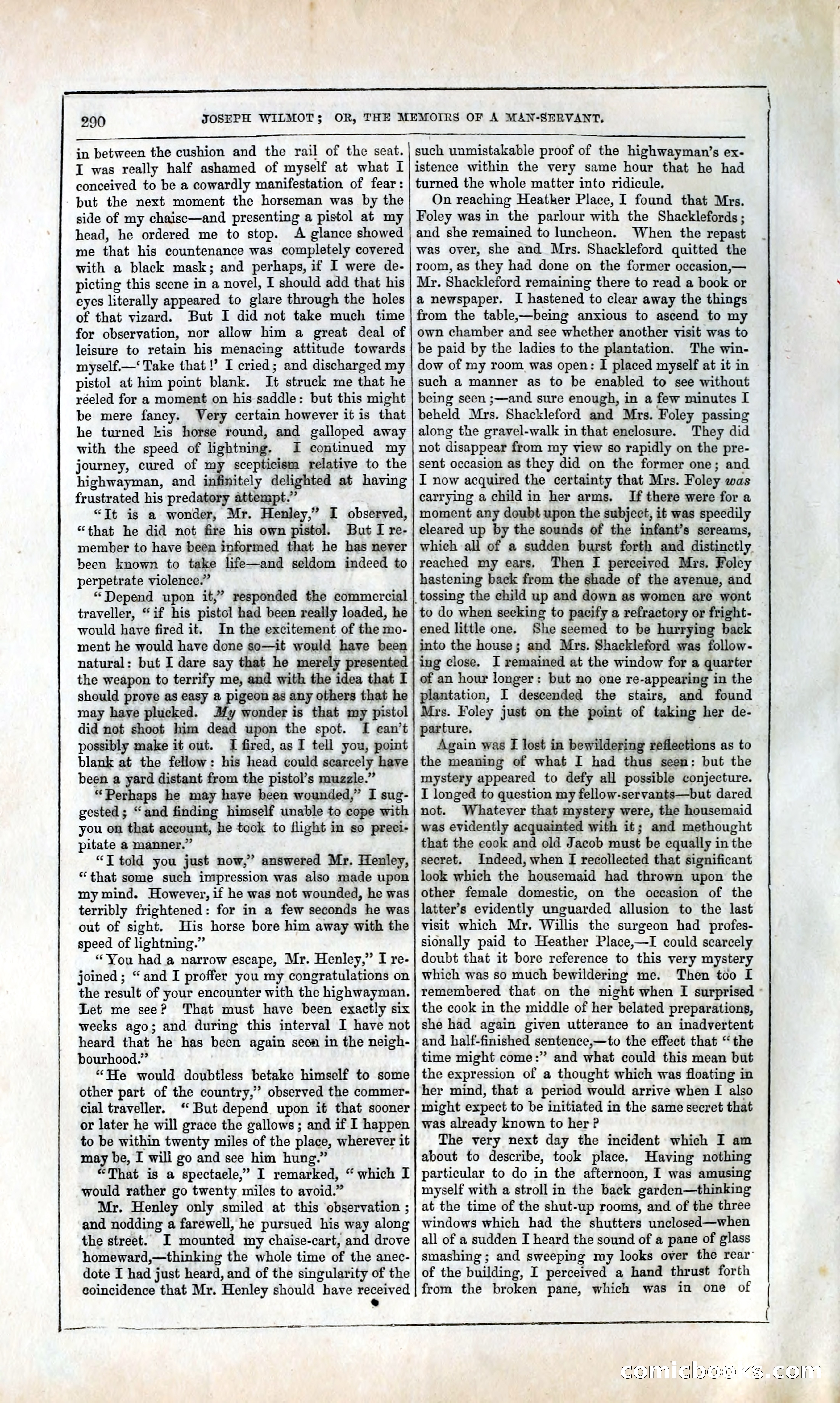
A restored page from Penny Dreadfuls, 1854. Page through the whole issue in the reader above.
📄 Transcribed text from this page (OCR, searchable)
Machine-transcribed from the original scan — historical spelling and the odd misread are preserved.
290 in between the cushion and the rail of the seat. I was really half ashamed of myself at what I conceived to be a cowardly manifestation of fear: but the next moment the horseman was by the side of my chaise—and presenting a pistol at my head, he ordered me to stop. A glance showed me that his countenance was completely covered with a black mask; and perhaps, if I were de- picting this scene in a novel, I should add that his eyes literally appeared to glare through the holes of that vizard. But I did not take much time for observation, nor allow him a great deal of leisure to retain his menacing attitude towards myself.—‘ Take that!’ I cried; and discharged my pistol at him point blank. It struck me that he réeled for a moment on his saddle: but this might be mere fancy. Very certain however itis that he turned kis horse round, and galloped away with the speed of lightning. I continued my journey, cured of my scepticism relative to the highwayman, and infinitely delighted at having frustrated his predatory attempt.” “Tt is a wonder, Mr. Henley,” I observed, “that he did not fire his own pistol. But I re- member to have been informed that he has never been known to take life—and seldom indeed to perpetrate violence.” “Depend upon it,” responded the commercial traveller, “if his pistol had been really loaded, he would have fired it. In the excitement of the mo- ment he would have done so—it would have been natural: but I dare say that he merely presented the weapon to terrify me, and with the idea that I should prove as easy @ pigeon as any others that he may have plucked. My wonder is that my pistol did not shoot him dead upon the spot. [I can’t possibly make it out. I fired, as I tell you, point blank at the fellow: his head could scarcely have been a yard distant from the pistol’s muzzle.” “Perhaps he may have been wounded,” I sug- gested; “and finding himself unable to cope with you on that account, he took to flight in so preci- pitate a manner.” “T told you just now,’ answered Mr. Henley, “that some such impression was also made upon my mind. However, if he was not wounded, he was terribly frightened: for in a few seconds he was out of sight. His horse bore him away with the speed of lightning.” “You had a narrow escape, Mr. Henley,” I re- joined; “and I proffer you my congratulations on the result of your encounter with the highwayman. Let me see? That must have been exactly six weeks ago; and during this interval I have not heard that he has been again seen in the neigh- bourhood.” “He would doubtless betake himself to some other part of the country,” observed the commer- cial traveller. “ But depend upon if that sooner or later he will grace the gallows; and if I happen to be within twenty miles of the place, wherever it may be, I will go and see him hung.” “That is a spectacle,” I remarked, “ which I would rather go twenty miles to avoid.” Mr. Henley only smiled at this observation ; and nodding a farewell, he pursued his way along the street. I mounted my chaise-cart, and drove homeward,—thinking the whole time of the anec- dote I had just heard, and of the singularity of the coincidence that Mr. Henley should have 6 phen er JOSEPH WILMOT; OR, THE MEMOIRS OF A MAN-SERVANT. such unmistakable proof of the highwayman’s ex- istence within the very same hour that he had turned the whole matter into ridicule. On reaching Heather Place, I found that Mrs. Foley was in the parlour with the Shacklefords ; and she remained to luncheon. When the repast was over, she and Mrs. Shackleford quitted the room, as they had done on the former occasion,— Mr. Shackleford remaining there to read a book or a newspaper. I hastened to clear away the things from the table,—being anxious to ascend to my own chamber and see whether another visit was to be paid by the ladies to the plantation. The win- dow of my room was open: I placed myself at it in such a manner as to be enabled to see without being seen ;—and sure enough, in a few minutes I beheld Mrs. Shackleford and Mrs. Foley passing along the gravel-walk in that enclosure. They did not disappear from my view so rapidly on the pre- sent occasion as they did on the former one; and I now acquired the certainty that Mrs. Foley was carrying a child in her arms. If there were for a moment any doubt upon the subject, it was speedily eleared up by the sounds of the infant’s screams, whieh all of a sudden burst forth and distinctly reached my ears. Then I perceived Mrs. Foley hastening back from the shade of the avenue, and tossing the child up and down as women are wont to do when seeking to pacify a refractory or fright- ened little one. She seemed to be hurrying back into the house; and Mrs. Shackleford was follow- ing close. I remained at the window for a quarter of an hour longer: but no one re-appearing in the plantation, I descended the stairs, and found Mrs. Foley just on the point of taking her de- parture, Again was I lost in bewildering reflections as to the meaning of what I had thus seen: but the mystery appeared to defy all possible conjecture. I longed to question my fellow-servants—but dared not. Whatever that mystery were, the housemaid was evidently acquainted with it; and methought that the eook and old Jacob must be equally in the secret. Indeed, when I recollected that significant look which the housemaid had thrown upon the other female domestic, on the occasion of the latter’s evidently unguarded allusion to the last visit which Mr. Willis the surgeon had profes- sionally paid to Heather Place,—I could scarcely doubt that it bore reference to this very mystery which was so much bewildering me. Then too I remembered that on the night when I surprised ° the cook in the middle of her belated preparations, she had again given utterance to an inadvertent and half-finished sentence,—to the effect that “ the time might come:” and what could this mean but the expression of a thought which was floating in her mind, that a period would arrive when I also might expect to be initiated in the same secret that was already known to her P The very next day the incident which I am about to describe, took place. Having nothing particular to do in the afternoon, I was amusing myself with a stroll in the back garden—thinking at the time of the shut-up rooms, and of the three windows which had the shutters unclosed—when all of a sudden I heard the sound of a pane of glass smashing; and sweeping my looks over the rear of the building, I perceived a hand thrust forth from the broken pane, which was in one of OOO) SS}