
Penny Dreadfuls, 1854 · page 301 of 394
Joseph Wilmot, or, The Memoirs of a Man-Servant — page 301: what you’re looking at
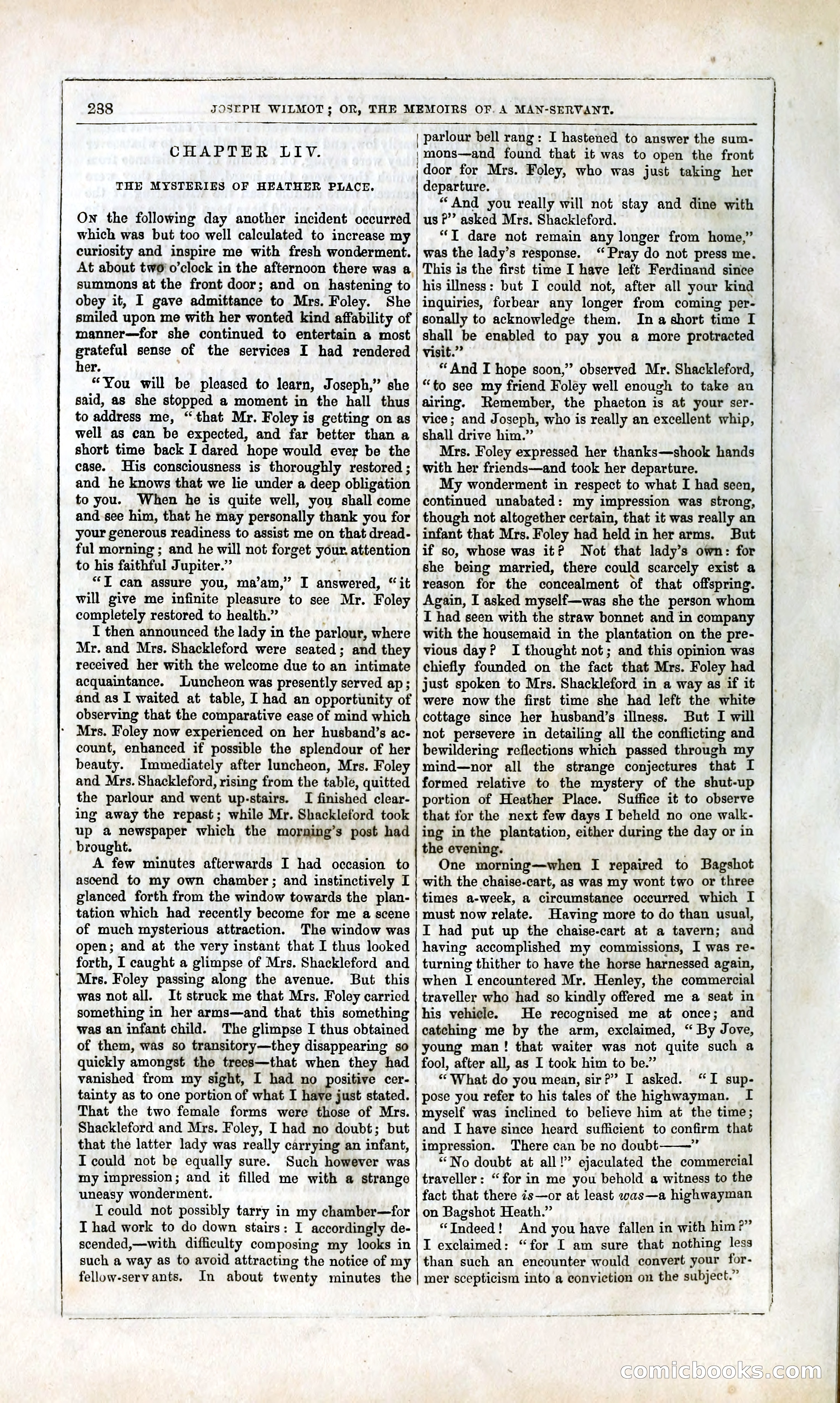
A restored page from Penny Dreadfuls, 1854. Page through the whole issue in the reader above.
📄 Transcribed text from this page (OCR, searchable)
Machine-transcribed from the original scan — historical spelling and the odd misread are preserved.
« . —— 288 CHAPTER LIV. THE MYSTERIES OF HEATHER PLACE. On the following day another incident occurred which was but too well calculated to increase my curiosity and inspire me with fresh wonderment. At about two'o’clock in the afternoon there was a. summons at the front door; and on hastening to obey it, I gave admittance to Mrs. Foley. She smiled upon me with her wonted kind affability of manner—for she continued to entertain a most grateful sense of the services I had rendered her. “You will be pleased to learn, Joseph,” she said, as she stopped a moment in the hall thus to address me, “that Mr. Foley is getting on as well as can be expected, and far better than a short time back I dared hope would ever be the case. His consciousness is thoroughly restored ; and he knows that we lie under a deep obligation to you. When he is quite well, yoy shall come and see him, that he may personally thank you for your generous readiness to assist me on that dread- ful morning ; and he will not forget your attention to his faithful Jupiter.” “IT can assure you, ma’am,” I answered, “it will give me infinite pleasure to see Mr. Foley completely restored to health.” ' I then announced the lady in the parlour, where Mr. and Mrs. Shackleford were seated; and they received her with the welcome due to an intimate acquaintance. Luncheon was presently served ap; and as I waited at table, I had an opportunity of observing that the comparative ease of mind which ‘ Mrs. Foley now experienced on her husband’s ac- count, enhanced if possible the splendour of her beauty. Immediately after luncheon, Mrs. Foley and Mrs. Shackleford, rising from the table, quitted the parlour and went up-stairs. I finished clear- ing away the repast; while Mr. Shackleford took up 2 newspaper which the morning’s post had brought. A few minutes afterwards I had occasion to ascend to my own chamber ; and instinctively I glanced forth from the window towards the plan- tation which had recently become for me a scene of much mysterious attraction. The window was open; and at the very instant that I thus looked forth, I caught a glimpse of Mrs. Shackleford and Mrs. Foley passing along the avenue. But this was not all. It struck me that Mrs. Foley carried something in her arms—and that this something was an infant child. The glimpse I thus obtained of them, was so transitory—they disappearing so quickly amongst the trees—that when they had vanished from my sight, I had no positive cer- tainty as to one portion of what I have just stated. That the two female forms were those of Mrs. Shackleford and Mrs. Foley, I had no doubt; but that the latter lady was really carrying an infant, I could not be equally sure. Such however was my impression; and it filled me with a strange uneasy wonderment. IT could not possibly tarry in my chamber—for T had work to do down stairs: I accordingly de- scended,—with difficulty composing my looks in such a way as to avoid attracting the notice of my fellow-serv ants. In about twenty minutes the ee ae eee SE - -e JOSEPH WILMOT; OR, THE MEMOIRS OF. A MAN-SERVANT. | mons—and found that it was to open the front | door for Mrs. Foley, who was just taking her departure. “And you really will not stay and dine with us P”’ asked Mrs. Shackleford. “T dare not remain any longer from home,” was the lady’s response. “Pray do not press me. This is the first time I have left Ferdinand since his illness: but I could not, after all your kind inquiries, forbear any longer from coming per- sonally to acknowledge them. In a short time I shall be enabled to pay you a more protracted visit.” “And I hope soon,” observed Mr. Shackleford, “to see my friend Foley well enough to take au airing. Remember, the phacton is at your ser- vice; and Joseph, who is really an excellent whip, shall drive him.” Mrs. Foley expressed her thanks—shook hands with her friends—and took her departure. My wonderment in respect to what I had seen, continued unabated: my impression was strong, though not altogether certain, that it was really an infant that Mrs. Foley had held in her arms. But if so, whose was it? Not that lady’s own: for she being married, there could scarcely exist a reason for the concealment of that offspring. Again, I asked myself—was she the person whom I had seen with the straw bonnet and in company with the housemaid in the plantation on the pre- vious day? I thought not; and this opinion was chiefly founded on the fact that Mrs. Foley had just spoken to Mrs. Shackleford in a way as if it were now the first time she had left the white cottage since her husband’s illness. But I will not persevere in detailing all the conflicting and bewildering reflections which passed through my mind—nor all the strange conjectures that I formed relative to the mystery of the shut-up portion of Heather Place. Suffice it to observe that for the next few days I beheld no one walk- ing in the plantation, either during the day or in the evening. . One morning—when I repaired to Bagshot with the chaise-cart, as was my wont two or three times a-week, a circumstance occurred which I must now relate. Having more to do than usual, I had put up the chaise-cart at a tavern; and having accomplished my commissions, I was re- turning thither to have the horse harnessed again, when I encountered Mr. Henley, the commercial traveller who had so kindly offered me a seat in his vehicle. He recognised me at once; and catching me by the arm, exclaimed, “ By Jove, young man! that waiter was not quite such a fool, after all, as I took him to be.” *“ What do you mean, sir?’ I asked. “I sup- pose you refer to his tales of the highwayman. I myself was inclined to believe him at the time; and I have since heard sufficient to confirm that impression. There can be no doubt ry “No doubt at all!” ejaculated the commercial traveller: “for in me you behold a witness to the fact that there is—or at least was—a highwayman on Bagshot Heath.” “Indeed! And you have fallen in with him?” I exclaimed: “for I am sure that nothing less than such an encounter would convert your for- mer scepticism into a conviction on the subject.” —— | parlour bell rang: I hastened to answer the sum- -—_——*s \ OS OOO S (©)