
Penny Dreadfuls, 1854 · page 293 of 394
Joseph Wilmot, or, The Memoirs of a Man-Servant — page 293: what you’re looking at
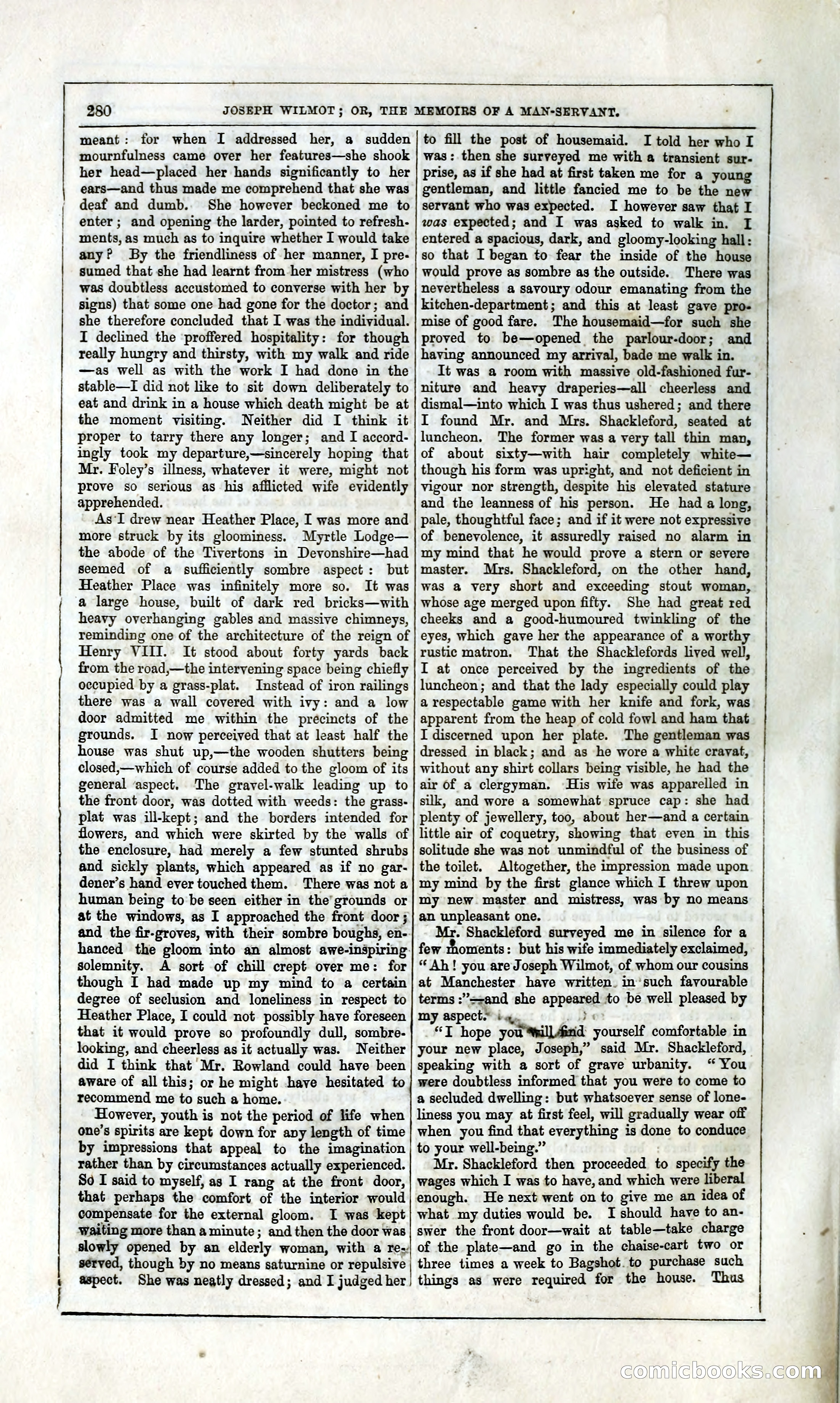
A restored page from Penny Dreadfuls, 1854. Page through the whole issue in the reader above.
📄 Transcribed text from this page (OCR, searchable)
Machine-transcribed from the original scan — historical spelling and the odd misread are preserved.
280 JOSEPH WILMOT; OR, THE MEMOIRS OF A MAN-SERVANT. meant: for when I addressed her, a sudden mournfulness came over her features—she shook her head—placed her hands significantly to her ears—and thus made me comprehend that she was deaf and dumb. She however beckoned me to enter ; and opening the larder, pointed to refresh- ments, as much as to inquire whether I would take any? By the friendliness of her manner, I pre- sumed that she had learnt from her mistress (who was doubtless accustomed to converse with her by signs) that some one had gone for the doctor; and she therefore concluded that I was the individual. I declined the ‘proffered hospitality: for though really hungry and thirsty, with my walk and ride —as well as with the work I had done in the stable—I did not like to sit down deliberately to eat and drink in a house which death might be at the moment visiting. Neither did I think it proper to tarry there any longer; and I accord- ingly took my departure,—sincerely hoping that Mr. Foley’s illness, whatever it were, might not prove so serious as his afflicted wife evidently apprehended. As‘I drew near Heather Place, I was more and more struck by its gloominess. Myrtle Lodge— the abode of the Tivertons in Devonshire—had seemed of a sufficiently sombre aspect: but Heather Place was infinitely more so. It was a large house, built of dark red bricks—with heavy overhanging gables and massive chimneys, reminding one of the architecture of the reign of Henry VIII. It stood about forty yards back from the road,—the intervening space being chiefly occupied by a grass-plat. Instead of iron railings there was a wall covered with ivy: and a low door admitted me within the précincts of the grounds. I now perceived that at least half the house was shut up,—the wooden shutters being closed,—which of course added to the gloom of its general aspect. The gravel-walk leading up to the front door, was dotted with weeds: the grass- plat was ill-kept; and the borders intended for flowers, and which were skirted by the walls of the enclosure, had merely a few stunted shrubs and sickly plants, which appeared as if no gar- dener’s hand ever touched them. There was not a human being to be seen either in the’grounds or at the windows, as I approached the front door ; and the fir-groves, with their sombre boughs, en- hanced the gloom into an almost awe-inspiring. solemnity. A sort of chill crept over me: for though I had made up my mind to a certain degree of seclusion and loneliness in respect to Heather Place, I could not possibly have foreseen that it would prove so profoundly dull, sombre- looking, and cheerless as it actually was. Neither did I think that Mr. Rowland could have been aware of all this; or he might have hesitated to recommend me to such a home. However, youth is not the period of life when one’s spirits are kept down for avy length of time by impressions that appeal to the imagination rather than by circumstances actually experienced. So I said to myself, as I rang at the front door, that perhaps the comfort of the interior would compensate for the external gloom. I was kept waiting more than a minute; and then the door was slowly opened by an elderly woman, with a re- sérved, though by no means saturnine or repulsive aspect. She was neatly dressed; and I judged her to fill the post of housemaid. I told her who I was: then she surveyed me with a transient sur- prise, as if she had at first taken me for a young gentleman, and little fancied me to be the new servant who was expected. I however saw that I was expected; and I was asked to walk in. I entered a spacious, dark, and gloomy-looking hall: so that I began to fear the inside of the house would prove as sombre as the outside. There was nevertheless a savoury odour emanating from the kitchen-department; and this at least gave pro- mise of good fare. The housemaid—for such she proved to be—opened the parlour-door; and having announced my arrival, bade me walk in. It was a room with massive old-fashioned fur- niture and heavy draperies—all cheerless and dismal—into which I was thus ushered; and there I found Mr. and Mrs. Shackleford, seated at luncheon. The former was a very tall thin man, of about sixty—with hair completely white— though his form was upright, and not deficient in vigour nor strength, despite his elevated stature and the leanness of his person. He had a long, pale, thoughtful face; and if it were not expressive of benevolence, it assuredly raised no alarm in my mind that he would prove a stern or severe master. Mrs. Shackleford, on the other hand, was a very short and exceeding stout woman, whose age merged upon fifty. She had great red cheeks and a good-humoured twinkling of the eyes, which gave her the appearance of a worthy rustic matron. That the Shacklefords lived well, I at once perceived by the ingredients of the luncheon; and that the lady especially could play a respectable game with her knife and fork, was apparent from the heap of cold fowl and ham that I discerned upon her plate. The gentleman was dressed in black; and as he wore a white crayat, without any shirt collars being visible, he had the air Of a clergyman. His wife was apparelled in silk, and wore a somewhat spruce cap: she had plenty of jewellery, too, about her—and a certain little air of coquetry, showing that even in this solitude she was not unmindful of the business of the toilet. Altogether, the impression made upon my mind by the first glance which I threw upon my new master and mistress, was by no means an unpleasant one. Mr. Shackleford surveyed me in silence for a few thoments: but his wife immediately exclaimed, “Ah! you areJoseph Wilmot, of whom our cousins at Manchester have written. in’such favourable terms :”=-and she appeared to be well pleased by my aspect.” i«. Lhe “TI hope you “illéind yourself comfortable in your new place, Joseph,” said Mr. Shackleford, speaking with a sort of grave urbanity. “ You were doubtless informed that you were to come to a secluded dwelling: but whatsoever sense of lone- liness you may at first feel, will gradually wear off when you find that everything is done to conduce to your well-being.” Mr. Shackleford then proceeded to specify the wages which I was to have, and which were liberal enough. He next went on to give me an idea of what my duties would be. I should have to an- swer the front door—wait at table—take charge of the plate—and go in the chaise-cart two or three times a week to Bagshot. to purchase such things as were required for the house. Thus =< ~— Goo (c@) m