
Penny Dreadfuls, 1854 · page 280 of 394
Joseph Wilmot, or, The Memoirs of a Man-Servant — page 280: what you’re looking at
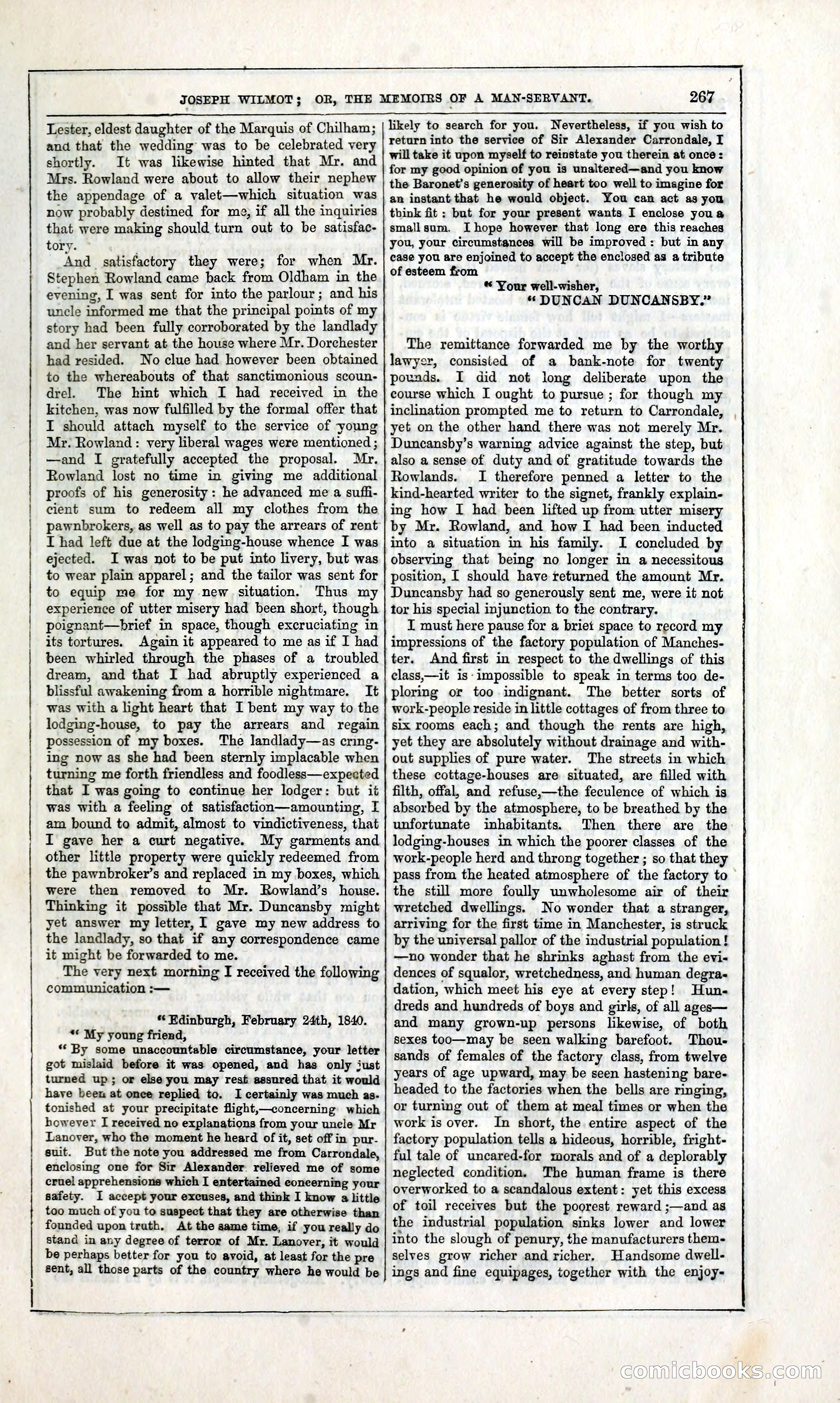
A restored page from Penny Dreadfuls, 1854. Page through the whole issue in the reader above.
📄 Transcribed text from this page (OCR, searchable)
Machine-transcribed from the original scan — historical spelling and the odd misread are preserved.
ea Ee ]-— ee ee JOSEPH WILMOT; Lester, eldest daughter of the Marquis of Chilham; and that the wedding was to be celebrated very shortly. It was likewise hinted that Mr. and Mrs. Rowland were about to allow their nephew the appendage of a valet—which situation was now probably destined for me, if all the inquiries that were making should turn out to be satisfac- tory. And satisfactory they were; for when Mr. Stephen Rowland came back from Oldham in the evening, I was sent for into the parlour; and his uncle informed me that the principal points of my story had been fully corroborated by the landlady and her servant at the house where Mr. Dorchester had resided. No clue had however been obtained to the whereabouts of that sanctimonious scoun- drel. The hint which I had received in the kitchen, was now fulfilled by the formal offer that I should attach myself to the service of young Mr. Rowland: very liberal wages were mentioned ; —and I gratefully accepted the proposal. Mr. Rowland lost no time in giving me additional proofs of his generosity: he advanced me a sufh- cient sum to redeem all my clothes from the pawnbrokers, as well as to pay the arrears of rent I had left due at the lodging-house whence I was ejected. I was not to be put into livery, but was to wear plain apparel; and the tailor was sent for to equip me for my new situation. Thus my experience of utter misery had been short, though poignant—brief in space, though excruciating in its tortures. Again it appeared to me as if I had been whirled through the phases of a troubled dream, and that I had abruptly experienced a blissful awakening from a horrible nightmare. It was with a light heart that I bent my way to the lodging-house, to pay the arrears and regain possession of my boxes. The landlady—as cring- ing now as she had been sternly implacable when turning me forth friendless and foodless—expeected that I was going to continue her lodger: but it was with a feeling of satisfaction—amounting, I am bound to admit, almost to vindictiveness, that I gave her a curt negative. My garments and other little property were quickly redeemed from the pawnbroker’s and replaced in my boxes, which were then removed to Mr. Rowland’s house. Thinking it possible that Mr. Duncansby might yet answer my letter, I gave my new address to the landlady, so that if any correspondence came it might be forwarded to me. The very next morning I received the following communication :— Edinburgh, February 24th, 1840. ** My young friend, ** By some unaccountable circumstance, your letter got mislaid before it was opened, and has only iust turned up; or else you may rest assured that it would have been at onee replied to. I certainly was much as- tonished at your precipitate flight,—concerning which however I received no explanations from your uncle Mr Lanover, who the moment he heard of it, set off in pur- suit. But the note you addressed me from Carrondale, enclosing one for Sir Alexander. relieved me of some cruel apprehensions which I entertained eoncerning your safety. I accept your excuses, and think I know a little too much of you to suspect that they are otherwise than founded upon truth. At the same time, if you really do stand in any degree of terror of Mr. Lanover, it would be perhaps better for you to avoid, at least for the pre sent, all those parts of the country where he would be OR, THE MEMOIRS OF A MAN-SERVANT. 267 likely to search for you. Nevertheless, if you wish to return into the service of Sir Alexander Carrondale, I will take it upon myself to reinstate you therein at once : for my good opinion of you is unaltered—and you know the Baronet’s generosity of heart too well to imagine for an instant that he would object. You can act as you think fit : but for your present wants I enclose youa smallsum. I hope however that long ere this reaches you, your circumstances will be improved : but in any case you are enjoined to accept the enclosed as a tribute of esteem from * Your well-wisher, *“ DUNCAN DUNCANSBY.” The remittance forwarded me by the worthy lawyer, consisted of a bank-note for twenty pounds. I did not long deliberate upon the course which I ought to pursue; for though my inclination prompted me to return to Carrondale, yet on the other hand there was not merely Mr. Duncansby’s warning advice against the step, but also a sense of duty and of gratitude towards the Rowlands. I therefore penned a letter to the kind-hearted writer to the signet, frankly explain- ing how I had been lifted up from utter misery by Mr. Rowland, and how I had been inducted into a situation in his family. I concluded by observing that being no longer in a necessitous position, I should have returned the amount Mr. Duncansby had so generously sent me, were it not tor his special injunction to the contrary. I must here pause for a briet space to record my impressions of the factory population of Manches- ter. And first in respect to the dwellings of this class,—it is-impossible to speak in terms too de- ploring or too indignant. The better sorts of work-people reside in little cottages of from three to six rooms each; and though the rents are high, yet they are absolutely without drainage and with- out supplies of pure water. The streets in which these cottage-houses are situated, are filled with filth, offal, and refuse,—the feculence of which is absorbed by the atmosphere, to be breathed by the unfortunate inhabitants. Then there are the lodging-houses in which the poorer classes of the work-people herd and throng together ; so that they pass from the heated atmosphere of the factory to the still more foully unwholesome air of their wretched dwellings. No wonder that a stranger, arriving for the first time in Manchester, is struck by the universal pallor of the industrial population ! —no wonder that he shrinks aghast from the evi- dences of squalor, wretchedness, and human degra« dation, which meet his eye at every step! Hun- dreds and hundreds of boys and girls, of all ages— and many grown-up persons likewise, of both sexes too—may be seen walking barefoot. Thou- sands of females of the factory class, from twelve years of age upward, may be seen hastening bare- headed to the factories when the bells are ringing, or turning out of them at meal times or when the work is over. In short, the entire aspect of the factory population tells a hideous, horrible, fright- ful tale of uncared-for morals and of a deplorably neglected condition. The human frame is there overworked to a scandalous extent: yet this excess of toil receives but the poorest reward ;—and as the industrial population sinks lower and lower into the slough of penury, the manufacturers them- selves grow richer and richer, Handsome dwell- ings and fine equipages, together with the enjoy- ue OS COM Ghoo <S) co iin