
Penny Dreadfuls, 1854 · page 271 of 394
Joseph Wilmot, or, The Memoirs of a Man-Servant — page 271: what you’re looking at
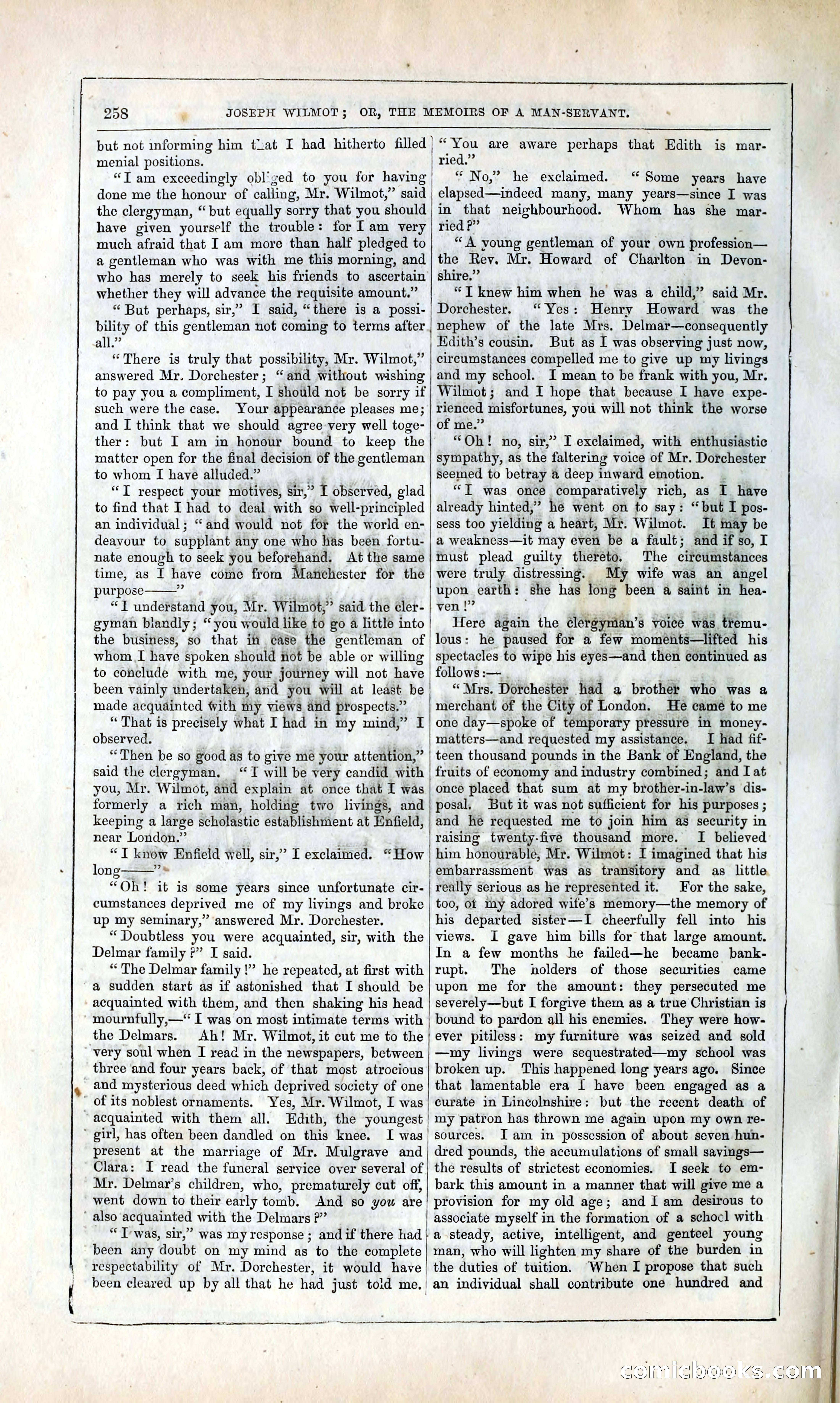
A restored page from Penny Dreadfuls, 1854. Page through the whole issue in the reader above.
📄 Transcribed text from this page (OCR, searchable)
Machine-transcribed from the original scan — historical spelling and the odd misread are preserved.
258 JOSEPH WILMOT ; OR, THE MEMOIRS OF A MAN-SERVANT. but not informing him tat I had hitherto filled menial positions. “Tam exceedingly obliged to you for having done me the honour of calling, Mr. Wilmot,” said the clergyman, “but equally sorry that you should have given yourself the trouble: for Iam very much afraid that I am more than half pledged to a gentleman who was with me this morning, and who has merely to seek his friends to ascertain whether they will advance the requisite amount.” “ But perhaps, sir,’ I said, “there is a possi- bility of this gentleman not coming to terms after all.” “There is truly that possibility, Mr. Wilmot,” answered Mr. Dorchester; “and without wishing to pay you a compliment, I should not be sorry if such were the case. Your appearance pleases me; and I think that we should agree very well toge- ther: but I am in honour bound to keep the matter open for the final decision of the gentleman to whom [I have alluded.” a “T respect your motives, sir,” I observed, glad to find that I had to deal with so well-principled an individual; ‘‘and would not for the world en- deayour to supplant any one who has been fortu- nate enough to seek you beforehand. At the same time, as I have come from Manchester for the purpose x “T understand you, Mr. Wilmot,” said the eler- gyman blandly; “you would like to go a little into the business, so that ih case the gentleman of whom I have spoken should not be able or willing to conclude with me, your journey will not have been vainly undertaken, and you will at least be made acquainted with my views and prospects.” “That is precisely what I had in my mind,” I observed. “Then be so good as to give me your attention,” said the clergyman. “TI will be very candid with you, Mr. Wilmot, and explain at once that I was formerly a rich man, holding two livings, and keeping a large scholastic establishment at Enfield, near London.” af) “1 know Enfield well, sir,” I exclaimed. long “a “Oh! if is some years since unfortunate cir- cumstances deprived me of my livings and broke up my seminary,” answered Mr. Dorchester. “Doubtless you were acquainted, sir, with the Delmar family ?” I said. “The Delmar family !” he repeated, at first with 'a sudden start as if astonished that I should be acquainted with them, and then shaking his head mournfully,—* I was on most intimate terms with the Delmars. Ah! Mr. Wilmot, it cut me to the very soul when I read in the newspapers, between three ‘and four years back, of that most atrocious and mysterious deed which deprived society of one ' of its noblest ornaments. Yes, Mr. Wilmot, I was “acquainted with them all. Edith, the youngest ’ girl, has often been dandled on this knee. I was present at the marriage of Mr. Mulgrave and Clara: I read the funeral service over several of Mr. Delmar’s children, who, prematurely cut off, went down to their early tomb. And so yow are also acquainted with the Delmars ?” “Twas, sir,” was my response; andif there had been any doubt on my mind as to the complete respectability of Mr. Dorchester, it would have been cleared up by all that he had just toid me. “How a ee oe ee ee Se “You are aware perhaps that Edith is mar- ried.” “No,” he exclaimed. ‘“ Some years have elapsed—indeed many, many years—since I was in that neighbourhood. Whom has she mar- ried P” “A young gentleman of your own profession— the Rev. Mr. Howard of Charlton in Devon- shire,” : “T knew him when he was a child,” said Mr. Dorchester. ‘“ Yes: Henry Howard was the nephew of the late Mrs. Delmar—consequently Edith’s cousin. But as I was observing just now, circumstances compelled me to give up my livings and my school. I mean to be frank with you, Mr. Wilmot; and I hope that because I have expe- rienced misfortunes, you will not think the worse of me.” “Oh! no, sir,” I exclaimed, with enthusiastic sympathy, as the faltering voice of Mr. Dorchester seemed to betray a deep inward emotion. | “TI was once comparatively rich, as I have already hinted,” he went on to say: “but I pos- sess too yielding a heart, Mr. Wilmot. It may be a weakness—it may even be a fault; and if so, I must plead guilty thereto. The citeumstances were truly distressing. My wife was an angel upon earth: she has long been a saint in hea- ven !” Here again the élergyman’s voice was tremu- lous: he paused for a few moments—lifted his spectacles to wipe his eyes—and then continued as follows :— “Mrs. Dorchester had a brother who was a merchant of the City of London. He camé to me one day—spoke of temporary pressure in money- matters—and requested my assistance, I had fif- teen thousand pounds in the Bank of England, the fruits of economy and industry combined; and I at once placed that sum at my btother-in-law’s dis- posal, But it was not sufficient for his purposes ; and he requested me to join him as security in raising twenty-five thousand more. I believed him honourable, Mr. Wilmot: I imagined that his embarrassment was as transitory and as little really serious as he represented it. For the sake, too, of my adored wife’s memory—the memory of his departed sister—I cheerfully fell into his views. I gave him bills for that large amount. In a few months he failed—he became bank- rupt. The holders of those securities came upon me for the amount: they persecuted me severely—but I forgive them as a true Christian is bound to pardon all his enemies. They were how- ever pitiless: my furniture was seized and sold —my livings were sequestrated—my school was broken up. This happened long years ago. Since that lamentable era 1 have been engaged as a curate in Lincolnshire: but the recent death of my patron has thrown me again upon my own re- sources. I am in possession of about seven hun- dred pounds, the accumulations of small savings— the results of strictest economies. I seek to em- bark this amount in a manner that will give me a provision for my old age; and I am desirous to associate myself in the formation of a schocl with a steady, active, intelligent, and genteel young man, who will lighten my share of the burden in the duties of tuition. "When I propose that such an individual shall contribute one hundred and OOO) <S (C@)