
Penny Dreadfuls, 1854 · page 253 of 394
Joseph Wilmot, or, The Memoirs of a Man-Servant — page 253: what you’re looking at
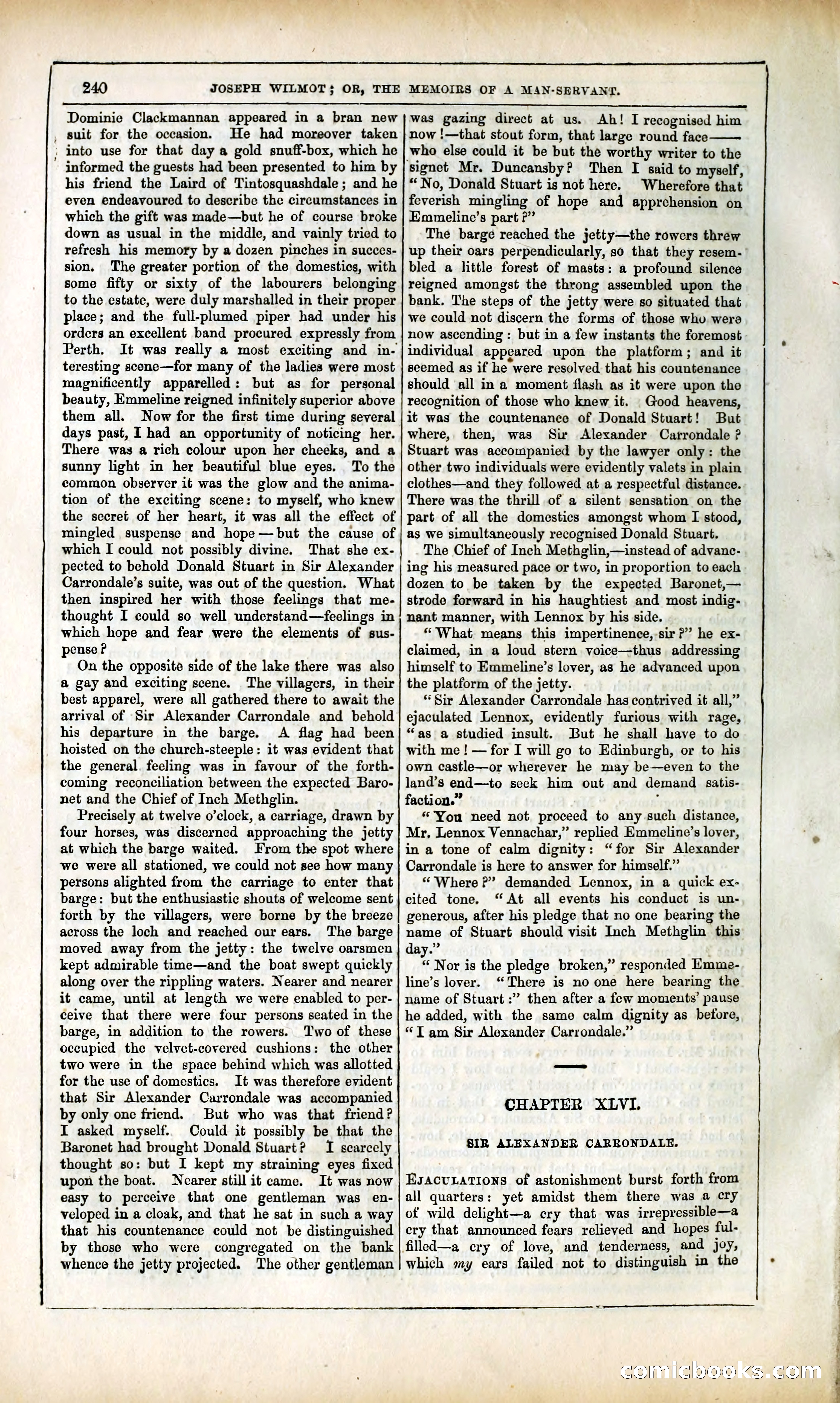
A restored page from Penny Dreadfuls, 1854. Page through the whole issue in the reader above.
📄 Transcribed text from this page (OCR, searchable)
Machine-transcribed from the original scan — historical spelling and the odd misread are preserved.
240 Dominie Clackmannan appeared in a bran new , suit for the occasion. He had moreover taken : into use for that day a gold snuff-box, which he informed the guests had been presented to him by his friend the Laird of Tintosquashdale; and he even endeavoured to describe the circumstances in which the gift was made—but he of course broke down as usual in the middle, and vainly tried to refresh his memory by a dozen pinches in succes- sion. The greater portion of the domestics, with some fifty or sixty of the labourers belonging to the estate, were duly marshalled in their proper place; and the full-plumed piper had under his orders an excellent band procured expressly from Perth. It was really a most exciting and in- teresting scene—for many of the ladies were most magnificently apparelled: but as for personal beauty, Emmeline reigned infinitely superior above them all. Now for the first time during several days past, I had an opportunity of noticing her. There was a rich colour upon her cheeks, and a sunny light in her beautiful blue eyes. To the common observer it was the glow and the anima- tion of the exciting scene: to myself, who knew the secret of her heart, it was all the effect of mingled suspense and hope—but the cause of which I could not possibly divine. That she ex- pected to behold Donald Stuart in Sir Alexander Carrondale’s suite, was out of the question. What then inspired her with those feelings that me- thought I could so well understand—feelings in which hope and fear were the elements of sus- pense ? On the opposite side of the lake there was also a gay and exciting scene. The villagers, in their best apparel, were all gathered there to await the arrival of Sir Alexander Carrondale and behold his departure in the barge. A flag had been _ hoisted on the church-steeple: it was evident that the general. feeling was in favour of the forth- coming reconciliation between the expected Baro- net and the Chief of Inch Methglin. Precisely at twelve o'clock, a carriage, drawn by four horses, was discerned approaching the jetty at which the barge waited. From the spot where we were all stationed, we could not see how many persons alighted from the carriage to enter that barge: but the enthusiastic shouts of welcome sent forth by the villagers, were borne by the breeze across the loch and reached our ears. The barge moved away from the jetty: the twelve oarsmen kept admirable time—and the boat swept quickly along over the rippling waters. Nearer and nearer it came, until at length we were enabled to per- ceive that there were four persons seated in the barge, in addition to the rowers. Two of these occupied the velvet-covered cushions: the other two were in the space behind which was allotted for the use of domestics. It was therefore evident that Sir Alexander Carrondale was accompanied by only one friend. But who was that friend? I asked myself.. Could it possibly be that the Baronet had brought Donald Stuart? I scarcely thought so: but I kept my straining eyes fixed upon the boat. Nearer stillit came. It was now easy to perceive that one gentleman was en- veloped in a cloak, and that he sat in such a way that his countenance could not be distinguished by those who were congregated on the bank whence the jetty projected. The other gentleman te ee ee ee - SS sss eS SSSI JOSEPH WILMOT; OR, THE MEMOIRS OF A MAN-SERVANT. was gazing direct at us. now !—that stout form, that large round face who else could it be but the worthy writer to the signet Mr. Duncansby? Then I said to myself, “No, Donald Stuart is not here. Wherefore that feverish mingling of hope and apprehension on Emmeline’s part ?” The barge reached the jetty—the rowers threw bled a little forest of masts: a profound silence reigned amongst the throng assembled upon the bank. The steps of the jetty were so situated that we could not discern the forms of those whu were now ascending: but in a few instants the foremost individual appeared upon the platform; and it seemed as if he were resolved that his countenance should all in a moment flash as it were upon the recognition of those who knew it. Good heavens, it was the countenance of Donald Stuart! But where, then, was Sir Alexander Carrondale ? Stuart was accompanied by the lawyer only: the other two individuals were evidently valets in plain clothes—and they followed at a respectful distance. There was the thrill of a silent sensation on the part of all the domestics amongst whom I stood, as we simultaneously recognised Donald Stuart. The Chief of Inch Methglin,—instead of advanc- ing his measured pace or two, in proportion to each dozen to be taken by the expected Baronet,— strode forward in his haughtiest and most indig- nant manner, with Lennox by his side. ‘What means this impertinence, sir?” he ex- claimed, in a loud stern voice—thus addressing himself to Emmeline’s lover, as he advanced upon the platform of the jetty. “Sir Alexander Carrondale has contrived it all,” ejaculated Lennox, evidently furious with rage, “as a studied insult. But he shall have to do with me! — for I will go to Edinburgh, or to his own castle—or wherever he may be—even to the land’s end—to seek him out and demand satis- faction.” “You need not proceed to any such distance, Mr, Lennox Vennachar,” replied Emmeline’s lover, in a tone of calm dignity: “for Sir Alexander Carrondale is here to answer for himself.” * Where P”? demanded Lennox, in a quick ex- cited tone. “At all events his conduct is un- generous, after his pledge that no one bearing the name of Stuart should visit Inch Methglin this day.” ‘ Nor is the pledge broken,” responded Emme- line’s lover. “There is no one here bearing the name of Stuart :” then after a few moments’ pause he added, with the same calm dignity as betore, “T am Sir Alexander Carrondale.” CHAPTER XLVI. SIR ALEXANDER CARBONDALE. EJACULATIONS of astonishment burst forth from all quarters: yet amidst them there was a cry of wild delight—a cry that was irrepressible—a cry that announced fears relieved and hopes ful- filled—a cry of love, and tenderness, and joy, which my ears failed not to distinguish in the = Ah! I recognised him up their oars perpendicularly, so that they resem-' “S (E(0) 0)(0 0) im —_—_—— — dias