
Penny Dreadfuls, 1854 · page 251 of 394
Joseph Wilmot, or, The Memoirs of a Man-Servant — page 251: what you’re looking at
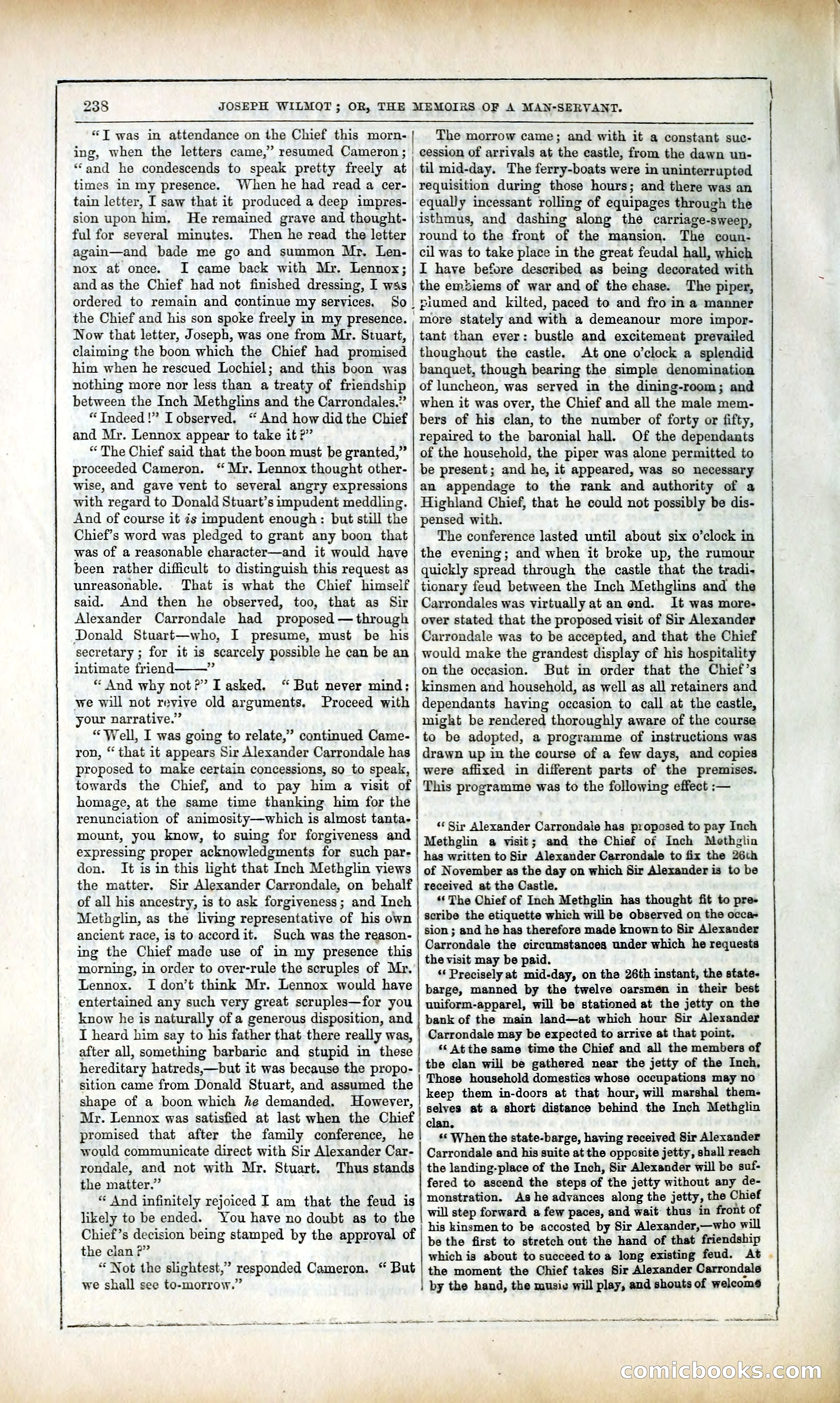
A restored page from Penny Dreadfuls, 1854. Page through the whole issue in the reader above.
📄 Transcribed text from this page (OCR, searchable)
Machine-transcribed from the original scan — historical spelling and the odd misread are preserved.
238 JOSEPH WILMOT; OR, THE MEMOIRS OF A MAN-SERVANT. “T was in attendance on the Chief this morn- ing, when the letters came,” resumed Cameron; | ‘‘and he condescends to speak pretty freely at | times in my presence. When he had read a cer- tain letter, I saw that it produced a deep impres- sion upon him, He remained grave and thought- ful for several minutes. Then he read the letter again—and bade me go and summon Mr. Len- nox at once. I came back with Mr. Lennox; and as the Chief had not finished dressing, I was ordered to remain and continue my services. So the Chief and his son spoke freely in my presence. | Now that letter, Joseph, was one from Mr. Stuart, claiming the boon which the Chief had promised him when he rescued Lochiel; and this boon was nothing more nor less than a treaty of friendship between the Inch Methglins and the Carrondales.” “Indeed!” ITobserved, “And how did the Chief and Mr. Lennox appear to take it ?” “ The Chief said that the boon must be granted,” proceeded Cameron. “ Mr. Lennox thought other- wise, and gave vent to several angry expressions with regard to Donald Stuart’s impudent meddling. And of course it is impudent enough : but still the | Chief’s word was pledged to grant any boon that was of a reasonable character—and it would have been rather difficult to distinguish this request as | unreasonable. That is what the Chief himseif said. And then he observed, too, that as Sir | Alexander Carrondale had proposed — through | Donald Stuart—who, I presume, must be his secretary ; for it is scarcely possible he can be an intimate friend 3 “ And why not?’ Tasked. “ But never mind; we will not revive old arguments. Proceed with your narrative.” “Well, I was going to relate,” continued Came- ron, “ that it appears Sir Alexander Carrondale has proposed to make certain concessions, so to speak, towards the Chief, and to pay him a visit of homage, at the same time thanking him for the renunciation of animosity—which is almost tanta- mount, you know, to suing for forgiveness and expressing proper acknowledgments for such par- don. It is in this light that Inch Methglin views the matter. Sir Alexander Carrondale, on behalf of all his ancestry, is to ask forgiveness; and Inch Metheglin, as the living representative of his own ancient race, is to accordit. Such was the reason- ing the Chief made use of in my presence this morning, in order to over-rule the scruples of Mr. Lennox. I don’t think Mr. Lennox would have entertained any such very great scruples—for you know he is naturally of a generous disposition, and I heard him say to his father that there really was, after all, something barbaric and stupid in these hereditary hatreds,—but it was because the propo- sition came from Donald Stuart, and assumed the shape of a boon which he demanded. However, Mr. Lennox was satisfied at last when the Chief | promised that after the family conference, he would communicate direct with Sir Alexander Car- rondale, and not with Mr. Stuart. Thus stands the matter.” “ And infinitely rejoiced I am that the feud is likely to be ended. You have no doubt as to the Chief’s decision being stamped by the approval of the clan ?” : “‘ Not the slightest,” responded Cameron. “ But we shall see to-morrow.” — i —— ee — . in The morrow came; and with it a constant sue- cession of arrivals at the castle, from the dawn un- til mid-day. The ferry-boats were in uninterrupted requisition during those hours; and there was an equalJy incessant rolling of equipages through the isthmus, and dashing along the carriage-sweep, round to the front of the mansion. The coun- cil was to take place in the great feudal hall, which I have before described as being decorated with the eméiems of war and of the chase. The piper, pniumed and kilted, paced to and fro in a manner more stately and with a demeanour more impor- tant than ever: bustle and excitement prevailed thoughout the castle. At one o’clock a splendid | banquet, though bearing the simple denomination of luncheon, was served in the dining-room; and when it was over, the Chief and all the male mem- bers of his clan, to the number of forty or fifty, repaired to the baronial hall. Of the dependants of the household, the piper was alone permitted to be present; and he, it appeared, was so necessary an appendage to the rank and authority of a Highland Chief, that he could not possibly be dis- pensed with. The conference lasted until about six o’clock in the evening; and when it broke up, the rumour quickly spread through the castle that the tradi. tionary feud between the Inch Methglins and the Carrondales was virtually at an end. It was more- over stated that the proposed visit of Sir Alexander Carrondale was to be accepted, and that the Chief would make the grandest display cf his hospitality on the occasion. But in order that the Chief’s kinsmen and household, as well as all retainers and dependants having occasion to call at the castle, might be rendered thoroughly aware of the course to be adopted, a programme of instructions was drawn up in the course of a few days, and copies were affixed in different parts of the premises. This programme was to the following effect :— ‘* Sir Alexander Carrondale has proposed to pay Inch Methglin a visit; and the Chief of Inch Methglin has written to Sir Alexander Carrondale to fix the 26th of November as the day on which Sir Alexander is to be received at the Castle. ‘‘ The Chief of Inch Methglin has thought fit to pre- scribe the etiquette which will be observed on the occa sion ; and he has therefore made known to Sir Alexander Carrondale the circumstances under which he requests the visit may be paid. ‘‘ Precisely at mid-day, on the 26th instant, the state- barge, manned by the twelve oarsmen in their best uuiform-apparel, will be stationed at the jetty on the bank of the main land—at which hour Sir Alexander Carrondale may be expected to arrive at that point. ‘< At the same time the Chief and all the members of the clan will be gathered near the jetty of the Inch, Those household domestics whose occupations may no keep them in-doors at that hour, will marshal them. selves at a short distance behind the Inch Methglin clan. ‘¢ When the state-barge, having received Sir Alexander Carrondale and his suite at the opposite jetty, shall reach the landing-place of the Inch, Sir Alexander will be suf- fered to ascend the steps of the jetty without any de- monstration. Ashe advances along the jetty, the Chief will step forward a few paces, and wait thus in front of his kinsmen to be accosted by Sir Alexander,—who will be the first to stretch out the hand of that friendship which is about to succeed to a long existing feud. At . the moment the Chief takes Sir Alexander Carrondale by the hand, the musie will play, and shouts of weleoms Doo Ss) (E(0) im