
Penny Dreadfuls, 1854 · page 248 of 394
Joseph Wilmot, or, The Memoirs of a Man-Servant — page 248: what you’re looking at
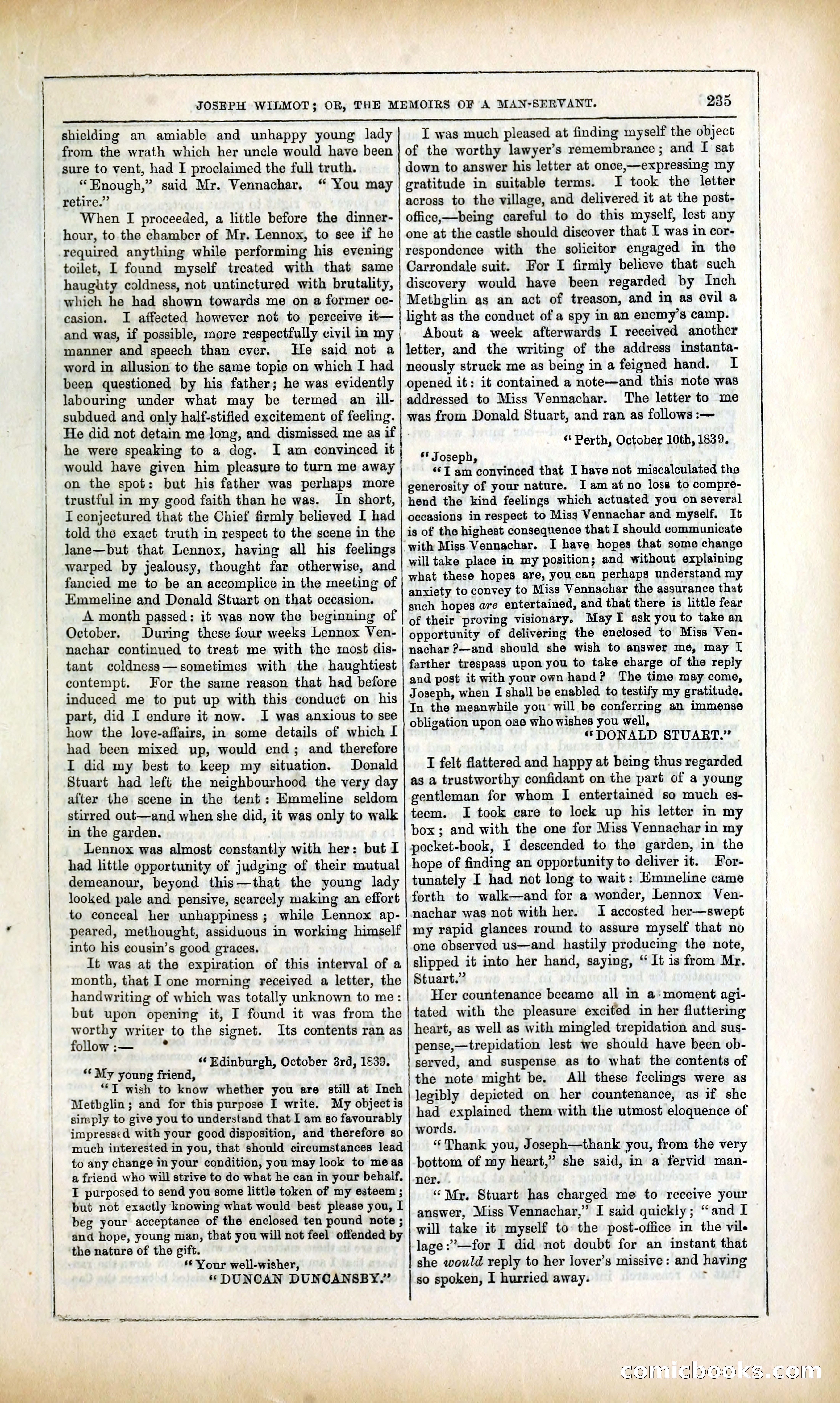
A restored page from Penny Dreadfuls, 1854. Page through the whole issue in the reader above.
📄 Transcribed text from this page (OCR, searchable)
Machine-transcribed from the original scan — historical spelling and the odd misread are preserved.
~~ ee ee Ter JOSEPH WILMOT; OR, THE MEMOIRS OF A MAN-SERVANT. shielding an amiable and unhappy young lady from the wrath which her uncle would have been sure to vent, had I proclaimed the full truth. “Enough,” said Mr. Vennachar. “ You may retire.” When I proceeded, a little before the dinner- hour, to the chamber of Mr. Lennox, to see if he required anything while performing his evening toilet, I found myself treated with that same haughty coldness, not untinctured with brutality, which he had shown towards me on a former oc- casion. I affected however not to perceive it— and was, if possible, more respectfully civil in my manner and speech than ever. He said not a word in allusion to the same topic on which I had been questioned by his father; he was evidently labouring under what may be termed an ill- subdued and only half-stified excitement of feeling. he were speaking to a dog. I am convinced it would have given him pleasure to turn me away on the spot: but his father was perhaps more trustful in my good faith than he was. In short, I conjectured that the Chief firmly believed I had told the exact truth in respect to the scene in the lane—but that Lennox, having all his feelings warped by jealousy, thought far otherwise, and fancied me to be an accomplice in the meeting of Emmeline and Donald Stuart on that occasion. A month passed: it was now the beginning of October. During these four weeks Lennox Ven- nachar continued to treat me with the most dis- tant coldness—sometimes with the haughtiest contempt. For the same reason that had before induced me to put up with this conduct on his part, did I endure it now. I was anxious to see how the love-affairs, in some details of which I had been mixed up, would end; and therefore I did my best to keep my situation. Donald Stuart had left the neighbourhood the very day after the scene in the tent: Emmeline seldom stirred out—and when she did, it was only to walk in the garden. Lennox was almost constantly with her: but I had little opportunity of judging of their mutual demeanour, beyond this—that the young lady looked pale and pensive, scarcely making an effort to conceal her unhappiness; while Lennox ap- peared, methought, assiduous in working himself into his cousin’s good graces. lt was at the expiration of this interval of a month, that I one morning received a letter, the handwriting of which was totally unknown to me: but upon opening it, I found it was from the worthy writer to the signet. Its contents ran as follow:— ° «‘ Edinburgh, October 3rd, 1839. ‘* My young friend, “T wish to know whether you are still at Inch Methglin; and for this purpose I write. My objectis simply to give you to understand that I am so favourably impressed with your good disposition, and therefore so much interested in you, that should circumstances lead to any change in your condition, you may look to meas a friend who will strive to do what he can in your behalf. I purposed to send you some little token of my esteem ; but not exactly knowing what would best please you, I beg your acceptance of the enclosed ten pound note ; and hope, young man, that you will not feel offended by the nature of the gift. ‘© Your well-wisher, ‘DUNCAN DUNCANSBY.” en oe nen nT a ee 235 I was much pleased at finding myself the object of the worthy lawyer’s remembrance ; and I sat down to answer his letter at once,—expressing my gratitude in suitable terms. I took the letter across to the village, and delivered it at the post- office,—being careful to do this myself, lest any one at the castle should discover that I was in cor- respondence with the solicitor engaged in the Carrondale suit. For I firmly believe that such discovery would have been regarded by Inch Methglin as an act of treason, and in as evil a light as the conduct of a spy in an enemy’s camp. About a week afterwards I received another letter, and the writing of the address instanta- neously struck me as being in a feigned hand. I opened it: it contained a note—and this note was addressed to Miss Vennachar. The letter to me | was from Donald Stuart, and ran as follows :— He did not detain me long, and dismissed me as if | | «Perth, October 10th, 1839, ** Joseph, ‘‘T am convinced that I have not miscalculated the generosity of your nature. Iam atno loss to compre- hend the kind feelings which actuated you on several occasions in respect to Miss Vennachar and myself. It is of the highest consequence that I should communicate with Miss Vennachar. I have hopes that some change will take place in my position; and without explaining what these hopes are, you can perhaps understand my anxiety to convey to Miss Vennachar the assurance that such hopes are entertained, and that there is little fear of their proving visionary. May I ask you to take an opportunity of delivering the enclosed to Miss Ven- nachar ?—and should she wish to answer me, may I farther trespass upon you to take charge of the reply and post it with yourown hand? The time may come, Joseph, when I shall be enabled to testify my gratitude. In the meanwhile you will be conferring an immense obligation upon one who wishes you well, “DONALD STUART.” T felt flattered and happy at being thus regarded as a trustworthy confidant on the part of a young gentleman for whom I entertained so much es- teem. I took care to lock up his letter in my box; and with the one for Miss Vennachar in my pocket-book, I descended to the garden, in the hope of finding an opportunity to deliver it. For- tunately I had not long to wait: Emmeline came forth to walk—and for a wonder, Lennox Ven- nachar was not with her. I accosted her—swept my rapid glances round to assure myself that no one observed us—and hastily producing the note, slipped it into her hand, saying, “ It is from Mr. Stuart.” Her countenance became all in a: moment agi- tated with the pleasure excited in her fluttering heart, as well as with mingled trepidation and sus- pense,—trepidation lest we should have been ob- served, and suspense as to what the contents of the note might be. All these feelings were as legibly depicted on her countenance, as if she had explained them with the utmost eloquence of words. “Thank you, Joseph—thank you, from the very bottom of my heart,” she said, in a fervid man- ner. “Mr. Stuart has charged me to receive your answer, Miss Vennachar,” I said quickly; “and I will take it myself to the post-office in the vil- lage :’—for I did not doubt for an instant that she would reply to her lover’s missive: and having so spoken, I hurried away. : EOmichoo cS (C(O) im