
Penny Dreadfuls, 1854 · page 237 of 394
Joseph Wilmot, or, The Memoirs of a Man-Servant — page 237: what you’re looking at
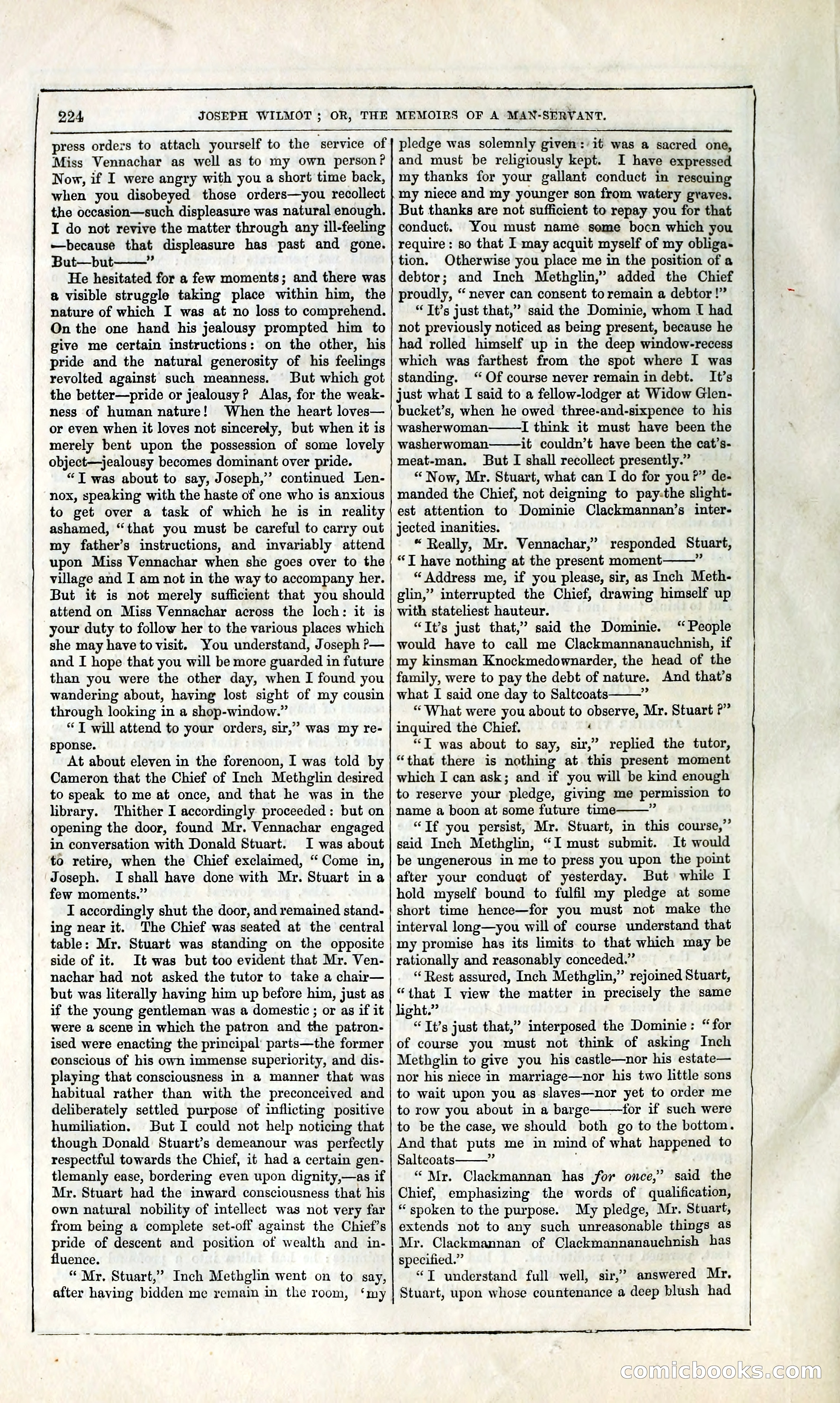
A restored page from Penny Dreadfuls, 1854. Page through the whole issue in the reader above.
📄 Transcribed text from this page (OCR, searchable)
Machine-transcribed from the original scan — historical spelling and the odd misread are preserved.
224 JOSEPH WILMOT; OR, THE MEMOIRS OF A MAN-SERVANT. re LLL press orders to attach yourself to the service of Miss Vennachar as well as to my own person? Now, if I were angry with you a short time back, when you disobeyed those orders—you recollect the occasion—such displeasure was natural enough. I do not revive the matter through any ill-feeling —hbecause that displeasure has past and gone. But—but ig He hesitated for a few moments; and there was @ visible struggle taking place within him, the nature of which I was at no loss to comprehend. On the one hand his jealousy prompted him to give me certain instructions: on the other, his pride and the natural generosity of his feelings revolted against such meanness. But which got the better—pride or jealousy? Alas, for the weak- ness of human nature! When the heart loves— or even when it loves not sincerely, but when it is merely bent upon the possession of some lovely object—jealousy becomes dominant over pride. “Twas about to say, Joseph,’ continued Len- nox, speaking with the haste of one who is anxious to get over a task of which he is in reality ashamed, “that you must be careful to carry out my father’s instructions, and invariably attend upon Miss Vennachar when she goes over to the village and I am not in the way to accompany her. But it is not merely sufficient that you should attend on Miss Vennachar across the loch: it is your duty to follow her to the various places which she may have to visit. You understand, Joseph ?P— and I hope that you will be more guarded in future than you were the other day, when I found you wandering about, having lost sight of my cousin through looking in a shop-window.” “TI will attend to your orders, sir,” was my re- sponse. At about eleven in the forenoon, I was told by Cameron that the Chief of Inch Methglin desired to speak to me at once, and that he was in the library. Thither I accordingly proceeded: but on opening the door, found Mr. Vennachar engaged in conversation with Donald Stuart. I was about to retire, when the Chief exclaimed, “Come in, Joseph. I shall have done with Mr. Stuart ina few moments.” I accordingly shut the door, and remained stand- ing near it. The Chief was seated at the central table: Mr. Stuart was standing on the opposite side of it. It was but too evident that Mr. Ven- nachar had not asked the tutor to take a chair— but was literally having him up before him, just as if the young gentleman was a domestic ; or as if it were a scene in which the patron and the patron- ised were enacting the principal parts—the former conscious of his own immense superiority, and dis- playing that consciousness in a manner that was habitual rather than with the preconceived and deliberately settled purpose of inflicting positive humiliation. But 1 could not help noticing that though Donald Stuart’s demeanour was perfectly respectful towards the Chief, it had a certain gen- tlemanly ease, bordering even upon dignity,—as if Mr. Stuart had the inward consciousness that his own natural nobility of intellect was not very far from being a complete set-off against the Chief’s pride of descent and position of wealth and in- fluence. “ Mr. Stuart,” Inch Methglin went on to say, after having bidden me remain in the room, ‘my pledge was solemnly given::it was a sacred one, and must be religiously kept. I have expressed my thanks for your gallant conduct in rescuing my niece and my younger son from watery graves. But thanks are not sufficient to repay you for that conduct. You must name some bocn which you require: so that I may acquit myself of my obliga- tion. Otherwise you place me in the position of a debtor; and Inch Methglin,” added the Chief proudly, “ never can consent to remain a debtor!” “It’s just that,” said the Dominie, whom If had not previously noticed as being present, because he had rolled himself up in the deep window-recess which was farthest from the spot where I was standing. ‘“ Of course never remain indebt. It’s just what I said to a fellow-lodger at Widow Glen- bucket’s, when he owed three-and-sixpence to his washerwoman I think it must have been the washerwoman it couldn’t have been the cat’s- meat-man. But I shall recollect presently.” “ Now, Mr. Stuart, what can I do for you P” de- manded the Chief, not deigning to pay-the slight- est attention to Dominie Clackmannan’s inter- jected inanities. “ Really, Mr. Vennachar,” responded Stuart, “T have nothing at the present moment ” “ Address me, if you please, sir, as Inch Meth- glin,” interrupted the Chief, drawing himself up with stateliest hauteur. “Tt’s just that,” said the Dominie. “People would have to call me Clackmannanauchnish, if my kinsman Knockmedownarder, the head of the family, were to pay the debt of nature. And that’s what I said one day to Saltcoats a “What were you about to observe, Mr. Stuart ?” inquired the Chief. 4 “IT was about to say, sir,” replied the tutor, “that there is nothing at this present moment which I can ask; and if you will be kind enough to reserve your pledge, giving me permission to name a boon at some future time uy “If you persist, Mr. Stuart, in this course,” seid Inch Methglin, “I must submit. It would be ungenerous in me to press you upon the point after your conduct of yesterday. But while I hold myself bound to fulfil my pledge at some short time hence—for you must not make the interval long—you will of course understand that my promise has its limits to that which may be rationally and reasonably conceded.” “Rest assured, Inch Methglin,” rejoined Stuart, “that I view the matter in precisely the same light.” “ It’s just that,” interposed the Dominie: “for of course you must not think of asking Inch Methglin to give you his castle—nor his estate— nor his niece in marriage—nor his two little sons to wait upon you as slaves—nor yet to order me to row you about in a barge——tor if such were to be the case, we should both go to the bottom. And that puts me in mind of what happened to Saltcoats 5 | “Mr. Clackmannan has for once,’ said the Chief, emphasizing the words of qualification, “spoken to the purpose. My pledge, Mr. Stuart, extends not to any such unreasonable things as Mr. Clackmannan of Clackmannanauchnish has specified.” “T understand full well, sir,’ answered Mr. Stuart, upon whose countenance a deep blush had Glyoo SS (C@) AA