
Penny Dreadfuls, 1854 · page 231 of 394
Joseph Wilmot, or, The Memoirs of a Man-Servant — page 231: what you’re looking at
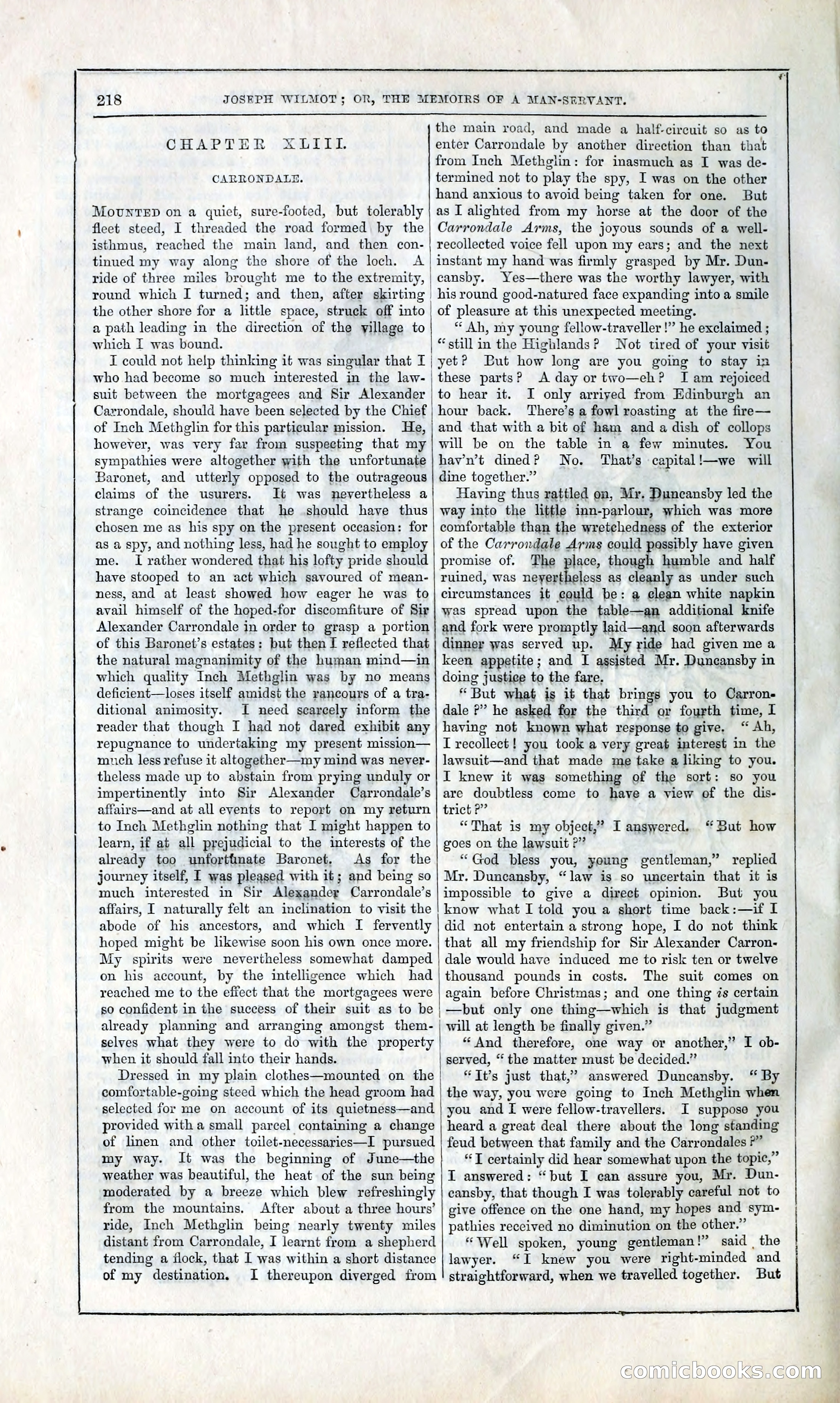
A restored page from Penny Dreadfuls, 1854. Page through the whole issue in the reader above.
📄 Transcribed text from this page (OCR, searchable)
Machine-transcribed from the original scan — historical spelling and the odd misread are preserved.
218 JOSEPH WILMOT; OR, THE MEMOIRS OF A MAN-SERVANT. the main road, and made a half-circuit so as to enter Carrondale by another direction than that from Inch Methglin: for inasmuch as I was de- termined not to play the spy, I was on the other hand anxious to avoid being taken for one. But MovUNTED on a quict, sure-footed, but tolerably | as I alighted from my horse at the door of the fleet steed, I threaded the road formed by the| Carrondale Arms, the joyous sounds of a well- isthmus, reached the main land, and then con- | recollected voice fell upon my ears; and the next tinued my way along the shore of the loch. A | instant my hand was firmly grasped by Mr. Dun- ride of three miles brought me to the extremity, | cansby. Yes—there was the worthy lawyer, with round which I turned; and then, after skirting | hisround good-natured face expanding into a smile CHAPTER XLIII. CARRONDALEZ. the other shore for a little space, struck off into | of pleasure at this unexpected meeting. a path leading in the direction of the yillage to which I was bound. “ Ah, my young fellow-traveller!” he exclaimed ; “stillin the Highlands? Not tired of your visit I could not help thinking it was singular that Ij yet? Dut how long are you going to stay in who had become so much interested in the law- | these parts ? suit between the mortgagees and Sir Alexander Carrondale, should have been selected by the Chief of Inch Metheglin for this particular mission. He, however, was very far from suspecting that my sympathies were altogether with the unfortunate Baronet, and utterly opposed to the outrageous claims of the usurers. It was nevertheless a strange coincidence that he should have thus chosen me as his spy on the present occasion: for as a spy, and nothing less, had he sought to employ me. I rather wondered that his lofty pride should have stooped to an act which savoured of mean- ness, and at least showed how eager he was to avail himself of the hoped-for discomfiture of Sir Alexander Carrondale in order to grasp a portion of this Baronet’s estates: but then I reflected that the natural magnanimity of the human mind—in which quality Inch Methglin was by no means deficient—loses itself amidst the rancours of a tra- ditional animosity. I need scarcely inform the reader that though I had not dared exhibit any repugnance to undertaking my present misslon— much less refuse it altogether—my mind was neyer- theless made up to abstain from prying unduly or impertinently into Sir Alexander Carrondale’s affairs—and at all events to report on my return to Inch Methglin nothing that I might happen to learn, if at all prejudicial to the interests of the already too wunfortfinate Baronet. As for the journey itself, I was pleased with if; and being so much interested in Sir Alexander Carrondale’s affairs, I naturally felt an inclination to visit the abode of his ancestors, and which I fervently hoped might be likewise soon his own once more. My spirits were nevertheless somewhat damped on his account, by the intelligence which had reached me to the effect that the mortgagees were so confident in the success of their suit as to be already planning and arranging amongst them- selves what they were to do with the property when it should fall into their hands. Dressed in my plain clothes—mounted on the comfortable-going steed which the head groom had selected for me on account of its quietness—and provided with a small parcel containing a change of lnen and other toilet-necessaries—I pursued my way. It was the beginning of June—the weather was beautiful, the heat of the sun being moderated by a breeze which blew refreshingly from the mountains. After about a three hours’ ride, Inch Methglin being nearly twenty miles distant from Carrondale, I learnt from a shepherd tending a flock, that 1 was within a short distance of my destination. I thereupon diverged from A day or two—eh? Iam rejoiced to hear it. JI only arriyed from Edinburgh an hour back. There’s a fowl roasting at the fire— and that with a bit of ham anda dish of collops will be on the table in a few minutes. You hav’n’t dined? No. That’s capital!—we will dine together.” . Having thus rattled on, Mr. Duncansby led the way into the little inn-parlour, which was more comfortable than the wretehedness of the exterior of the Carrondale Arms could passibly have given promise of. The place, though humble and half ruined, was Ryn! oP as cleanly as under such circumstances it could be: a elean white napkin was spread upon the table—an additional knife and fork were promptly laid—and soon afterwards dinner was served up. My ride had given mea keen appetite; and I assisted Mr. Duncansby in doing justiee to the fare. * But what is it that brings you to Carron- dale P’’ he asked for the third or fourth time, I having not known what response to give. “ Ah, I recollect! you took a very great interest in the lawsuit—and that made me take a liking to you. J knew it was something of the sort: so you are doubtless come to have a view of the dis- trict P” “That is my object,” I answered. goes on the lawsuit ?” “God bless you, yeung gentleman,” replied Mr. Duncanshy, “law is so uncertain that it is impossible to give a direcé opinion. But you know what I told you a short time back:—if I did not entertain a strong hope, I do not think that all my friendship for Sir Alexander Carron- dale would have induced me to risk ten or twelve thousand pounds in costs. The suit comes on again before Christmas; and one thing 7s certain “But how '—but only one thing—which is that judgment | will at length be finally given.” “And therefore, one way or another,” I ob- served, “ the matter must be decided.” “It’s just that,” answered Duncansby. “ By the way, you were going to Inch Methglin when you and I were fellow-travellers. I suppose you heard a great deal there about the long standing feud between that family and the Carrondales ?” “T certainly did hear somewhat upon the topic,” I answered: “but I can assure you, Mr. Dun- cansby, that though I was tolerably careful not to give offence on the one hand, my hopes and sym- pathies received no diminution on the other.” “Well spoken, young gentleman!” said the lawyer. “I knew you were right-minded and straightforward, when we travelled together. But EORNIECLOOO S ower (CO) im