
Penny Dreadfuls, 1854 · page 212 of 394
Joseph Wilmot, or, The Memoirs of a Man-Servant — page 212: what you’re looking at
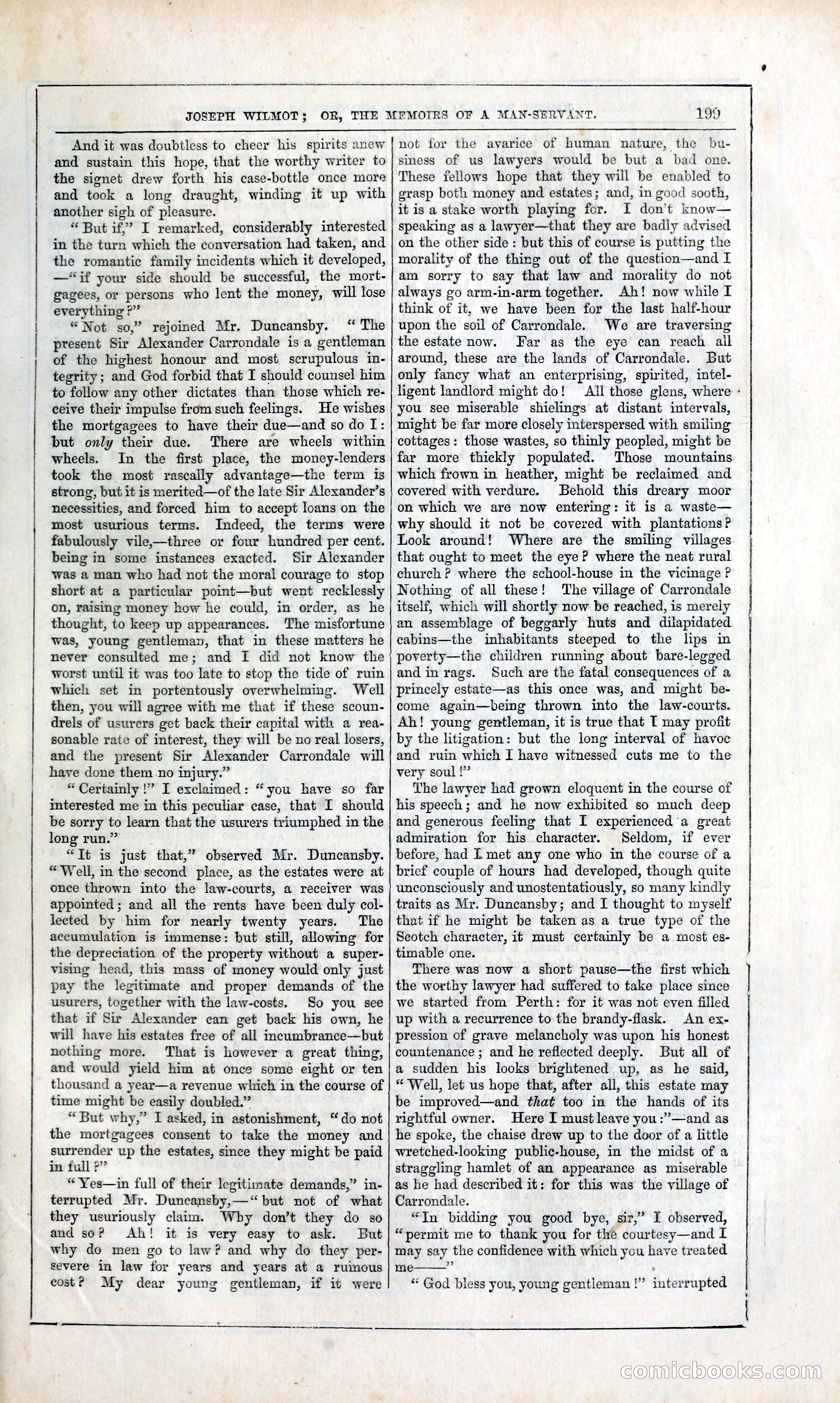
A restored page from Penny Dreadfuls, 1854. Page through the whole issue in the reader above.
📄 Transcribed text from this page (OCR, searchable)
Machine-transcribed from the original scan — historical spelling and the odd misread are preserved.
JOSEPH WILMOT ; And it was doubtless to cheer his spirits anew and sustain this hope, that the worthy writer to the signet drew forth his case-bottle once more and took a long draught, winding it up with another sigh of pleasure. “ But if”? I remarked, considerably interested in the turn which the conversation had taken, and the romantic family incidents which it developed, —if your side should be successful, the mort- gagees, or persons who lent the money, will lose everything ?” “Not so,” rejoined Mr. Duncansby. “ The present Sir Alexander Carrondale is a gentleman of the highest honour and most scrupulous in- tegrity ; and God forbid that I should counsel him to follow any other dictates than those which re- ceive their impulse from such feelings. He wishes the mortgagees to have their due—and so do I: but only their due. There are wheels within wheels. In the first place, the money-lenders took the most rascally advantage—the term is strong, but it is merited—of the late Sir Alexander’s necessities, and forced him to accept loans on the most usurious terms. Indeed, the terms were fabulously vile,—three or four hundred per cent. being in some instances exacted. Sir Alexander was a man who had not the moral courage to stop short at a particular point—but went recklessly on, raising money how he could, in order, as he thought, to keep up appearances. The misfortune was, young gentleman, that in these matters he never consulted me; and I did not know the worst until it was too late to stop the tide of ruin which set in portentously overwhelming. Well then, you will agree with me that if these scoun- drels of usurers get back their capital with a rea- sonable rate of interest, they will be no real losers, and the present Sir Alexander Carrondale will have done them no injury.” “ Certainly !” I exclaimed: “you have so far interested me in this peculiar case, that I should be sorry to learn that the usures triumphed in the long run.” “Tt is just that,” observed Mr. Duncansby. “Well, in the second place, as the estates were at once thrown into the law-courts, a receiver was appointed; and all the rents have been duly col- lected by him for nearly twenty years. The accumulation is immense: but still, allowing for the depreciation of the property without a super- vising head, this mass of money would only just pay the legitimate and proper demands of the usurers, together with the law-costs. So you see that if Sir Alexander can get back his own, he will have his estates free of all incumbrance—but nothing more. That is however a great thing, and would yield him at once some eight or ten thousand a year—a revenue which in the course of time might be easily doubled.” “But why,” I asked, in astonishment, “ do not the mortgagees consent to take the money and surrender up the estates, since they might be paid in full ?” “ Yes—in full of their legitimate demands,” in- terrupted Mr. Duncansby,—“ but not of what they usuriously claim. Why don’t they do so and soP Ah! it is very easy to ask. But why do men go to law? and why do they per- severe in law for years and years at a ruinous cost? My dear young gentleman, if it were OR, THE MEMOIRS OF A MAN-SERVANT. 199 not for the avarice of human nature, the bu- siness of us lawyers would be but a bad one. These fellows hope that they will be enabled to grasp both money and estates; and, in good sooth, it is a stake worth playing for. I don’t know— speaking as a lawyer—that they are badly advised on the other side : but this of course is putting the morality of the thing out of the question—and I am sorry to say that law and morality do not always go arm-in-arm together. Ah! now while I think of it, we have been for the last half-hour upon the soil of Carrondale. We are traversing the estate now. Far as the eye can reach ail around, these are the lands of Carrondale. But only faney what an enterprising, spirited, intel- ligent landlord might do! Atl those glens, where - you see miserable shielings at distant intervals, might be far more closely interspersed with smiling cottages: those wastes, so thinly peopled, might be far more thickly populated. Those mountains which frown in heather, might be reclaimed and covered with verdure. Behold this dreary moor on which we are now entering: it is a waste— why should it not be covered with plantations ?P Look around! Where are the smiling villages that ought to meet the eye? where the neat rural church P where the school-house in the vicinage ? Nothing of all these! The village of Carrondale itself, which will shortly now be reached, is merely an assemblage of begearly huts and dilapidated cabins—the inhabitants steeped to the lips in poverty—the children running about bare-legged and in rags. Such are the fatal consequences of a princely estate—as this once was, and might be- come again—being thrown into the law-couris. Ah! young gentleman, it is true that [ may profit by the litigation: but the long interval of havoc and ruin which I have witnessed cuts me to the very soul !” The lawyer had grown eloquent in the course of his speech; and he now exhibited so much deep and generous feeling that I experienced a great admiration for his character. Seldom, if ever before, had I met any one who in the course of a brief couple of hours had developed, though quite unconsciously and unostentatiously, so many kindly traits as Mr. Duncansby; and I thought to myself that if he might be taken as a true type of the Seotch character, it must certainly be a most es- timable one. There was now a short pause—the first which the worthy lawyer had suffered to take place since we started from Perth: for it was not even filled up with a recurrence to the brandy-flask. An ex- pression of graye melancholy was upon his honest countenance ; and he reflected deeply. But all of a sudden his looks brightened up, as he said, “Well, let us hope that, after all, this estate may be improved—and that too in the hands of its rightful owner. Here I must leave you :”—and as he spoke, the chaise drew up to the door of a little wretched-looking public-house, in the midst of a straggling hamlet of an appearance as miserable as he had described it: for this was the village of Carrondale. “In bidding you good bye, sir,” I observed, “permit me to thank you for the courtesy—and I may say the confidence with which you have treated me “ God bless you, young gentleman !” interrupted Glyoo cS (CO in