
Penny Dreadfuls, 1854 · page 209 of 394
Joseph Wilmot, or, The Memoirs of a Man-Servant — page 209: what you’re looking at
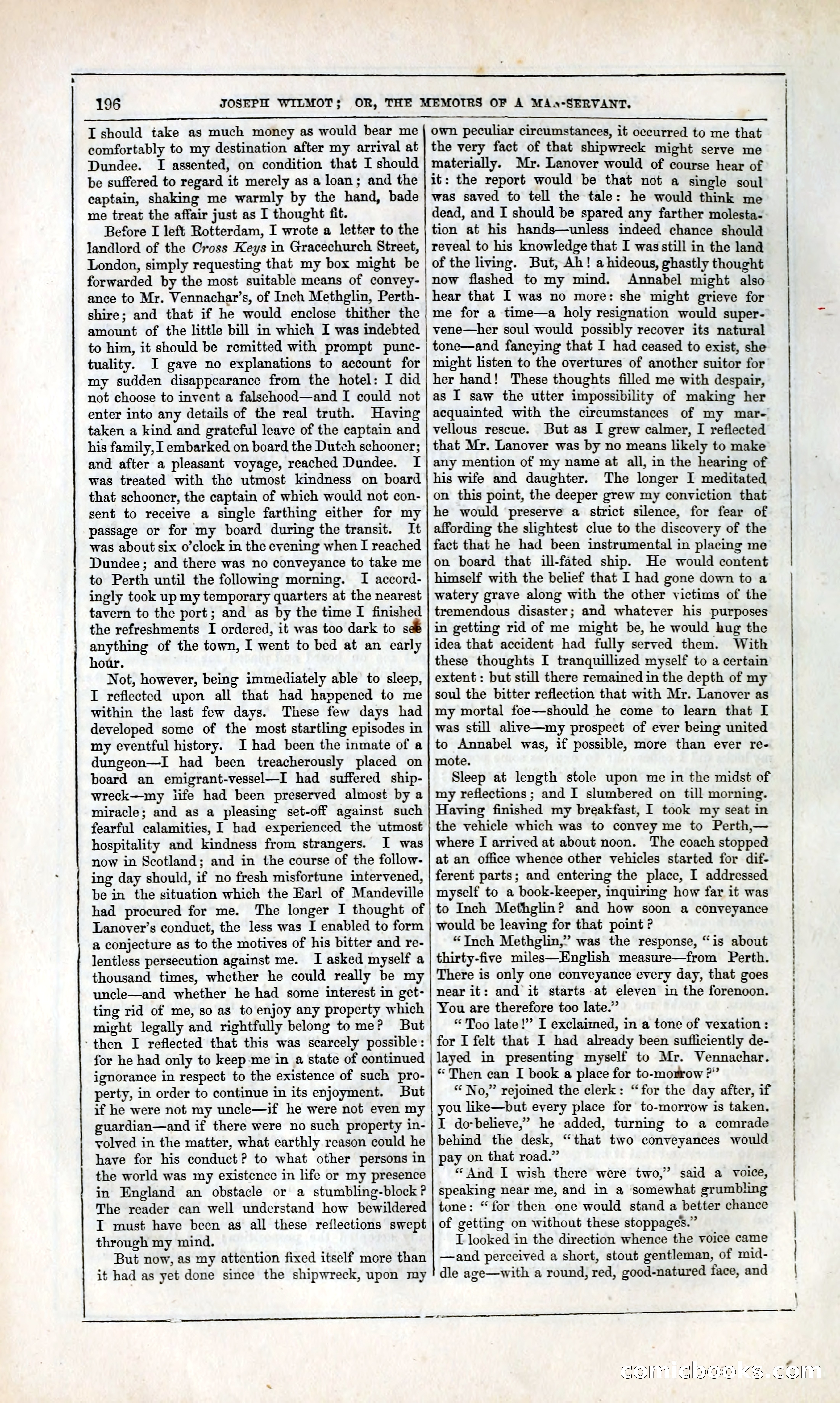
A restored page from Penny Dreadfuls, 1854. Page through the whole issue in the reader above.
📄 Transcribed text from this page (OCR, searchable)
Machine-transcribed from the original scan — historical spelling and the odd misread are preserved.
= 196 JOSEPH WILMOT; OR, THE MEMOIRS OF A MAsa-SERVANT. I should take as much money as would bear me comfortably to my destination after my arrival at Dundee. I assented, on condition that I should be suffered to regard it merely as a loan; and the captain, shaking me warmly by the hand, bade me treat the affair just as I thought fit. Before I left Rotterdam, I wrote a letter to the landlord of the Cross Keys in Gracechurch Street, London, simply requesting that my box might be forwarded by the most suitable means of convey- ance to Mr. Vennachar’s, of Inch Methglin, Perth- shire; and that if he would enclose thither the amount of the little bill in which I was indebted to him, it should be remitted with prompt punc- tuality. I gave no explanations to account for my sudden disappearance from the hotel: I did not choose to invent a falsehood—and I could not enter into any details of the real truth. Having taken a kind and grateful leave of the captain and his family, I embarked on board the Dutch schooner; and after a pleasant voyage, reached Dundee. I was treated with the utmost kindness on board that schooner, the captain of which would not con- sent to receive a single farthing either for my passage or for my board during the transit. It was about six o’clock in the evening when I reached Dundee; and there was no conveyance to take me to Perth until the following morning. I accord- ingly took up my temporary quarters at the nearest tavern to the port; and as by the time I finished the refreshments I ordered, it was too dark to sd anything of the town, I went to bed at an early hour. Not, however, being immediately able to sleep, I reflected upon all that had happened to me within the last few days. These few days had developed some of the most startling episodes in my eventful history. I had been the inmate of a dungeon—I had been treacherously placed on board an emigrant-vessel—I had suffered ship- wreck—my iife had been preserved almost by a miracle; and as a pleasing set-off against such fearful calamities, I had experienced “the utmost hospitality and kindness from strangers. I was now in Scotland; and in the course of the follow- ing day should, if no fresh misfortune intervened, be in the situation which the Earl of Mandeville had procured for me. The longer I thought of Lanover’s conduct, the less was I enabled to form a conjecture as to the motives of his bitter and re- lentless persecution against me. I asked myself a thousand times, whether he could really be my uncle—and whether he had some interest in get- ting rid of me, so as to enjoy any property which micht legally and rightfully belong tome? But ‘then I reflected that this was scarcely possible : for he had only to keep me in a state of continued ignorance in respect to the existence of such pro- perty, in order to continue in its enjoyment. But if he were not my uncle—if he were not even my guardian—and if there were no such property in- volved in the matter, what earthly reason could he have for his conduct? to what other persons in the world was my existence in life or my presence in England an obstacle or a stumbling-block? The reader can well understand how bewildered I must have been as all these reflections swept through my mind. But now, as my attention fixed itself more than it had as yet done since the shipwreck, upon my own peculiar circumstances, it occurred to me that the very fact of that shipwreck might serve me materially. Mr. Lanover would of course hear of it: the report would be that not a single soul was saved to tell the tale: he would think me dead, and I should be spared any farther molesta- tion at his hands—unless indeed chance should reveal to his knowledge that I was still in the land of the living. But, Ah! a hideous, ghastly thought now flashed to my mind. Annabel might also hear that I was no more: she might grieve for me for a time—a holy resignation would super- vene—her soul would possibly recover its natural tone—and fancying that I had ceased to exist, she might listen to the overtures of another suitor for her hand! These thoughts filled me with despair, as I saw the utter impossibility of making her acquainted with the circumstances of my mar- vellous rescue. But as I grew calmer, I reflected that Mr. Lanover was by no means likely to make any mention of my name at all, in the hearing of his wife and daughter. The longer I meditated on this point, the deeper grew my conviction that he would preserve a strict silence, for fear of affording the slightest clue to the discovery of the fact that he had been instrumental in placing me on board that ill-fated ship. He would content himself with the belief that I had gone down to a watery grave along with the other victims of the tremendous disaster; and whatever his purposes in getting rid of me might be, he would hug the idea that accident had fully served them. With these thoughts I tranquillized myself to a certain extent: but still there remained in the depth of my soul the bitter reflection that with Mr. Lanover as my mortal foe—should he come to learn that I was still alive—my prospect of ever being united to Annabel was, if possible, more than ever re- mote. Sleep at length stole upon me in the midst of my reflections; and I slumbered on till morning. Having finished my breakfast, I took my seat in the vehicle which was to convey me to Perth,— where I arrived at about noon. The coach stopped at an office whence other vehicles started for dif- ferent parts; and entering the place, I addressed myself to a book-keeper, inquiring how far it was to Inch Methglin? and how soon a conveyance would be leaving for that point? “Inch Methglin,” was the response, “is about thirty-five miles—English measure—from Perth. There is only one conveyance every day, that goes near it: and it starts at eleven in the forenoon. You are therefore too late.” “Too late!’ I exclaimed, in a tone of vexation: for I felt that I had already been sufficiently de- layed in presenting myself to Mr. Vennachar. ‘Then can I book a place for to-morrow ?” “ No,” rejoined the clerk: “for the day after, if you like—but every place for to-morrow is taken. I do-believe,” he added, turning to a comrade behind the desk, “that two conveyances would pay on that road.” “And I wish there were two,” said a voice, speaking near me, and in a somewhat grumbling tone: “for then one would stand a better chance of getting on without these stoppages.” I looked in the direction whence the voice came —and perceived a short, stout gentleman, of mid- dle age—with a round, red, good-natured face, and — ee ee ee EE Se Ore CORNICE LOO <S GO fin