
Penny Dreadfuls, 1854 · page 194 of 394
Joseph Wilmot, or, The Memoirs of a Man-Servant — page 194: what you’re looking at
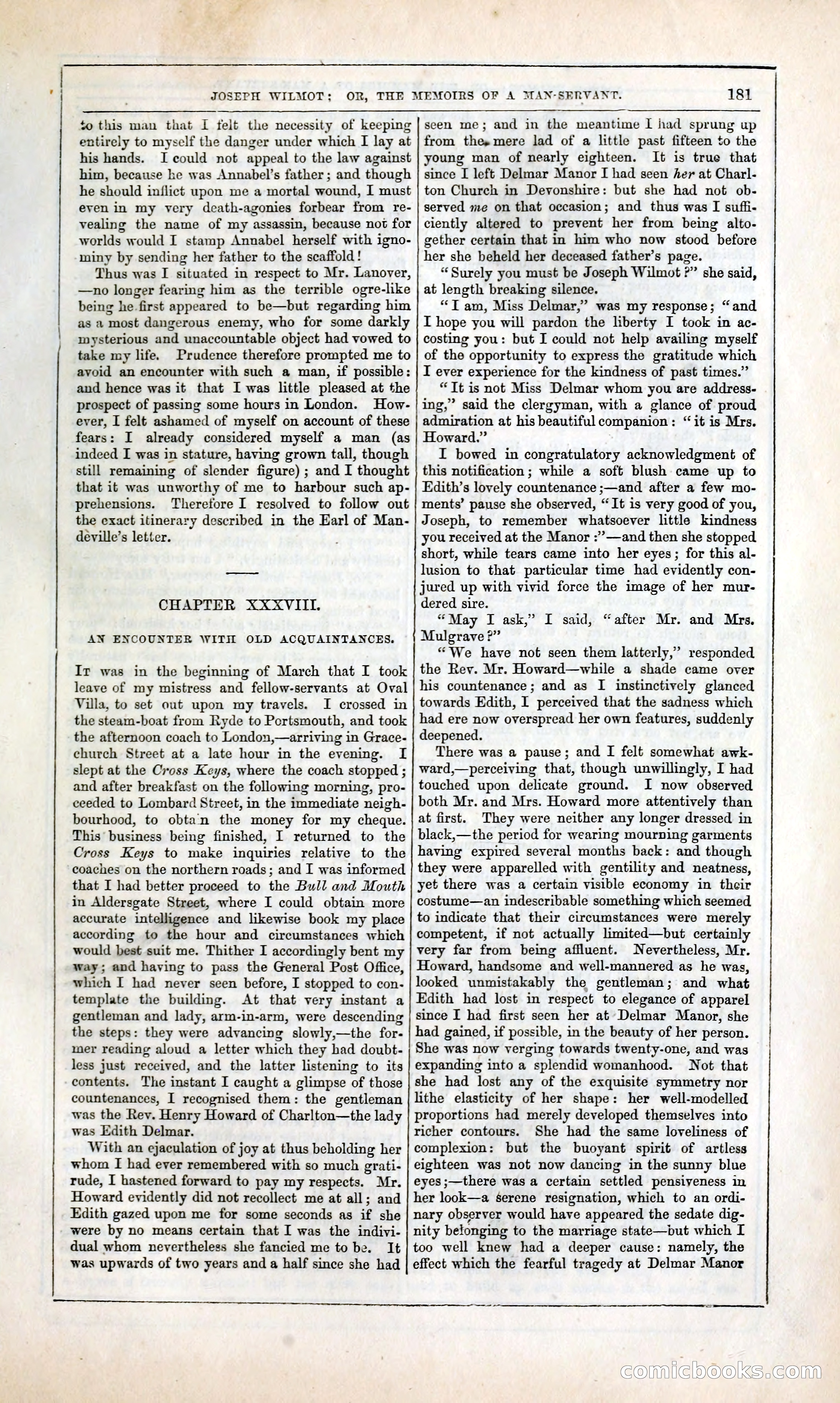
A restored page from Penny Dreadfuls, 1854. Page through the whole issue in the reader above.
📄 Transcribed text from this page (OCR, searchable)
Machine-transcribed from the original scan — historical spelling and the odd misread are preserved.
ann LL LLL LLL A LLB DLL LLL LLL I tt ttt cat te, JOSEPH WILMOT ; fo this man that I felt the necessity of keeping entirely to myself the danger under which I lay at his hands. I could not appeal to the law against him, because he was Annabel’s father; and though he should inflict upon me a mortal wound, I must eyen in my very death-agonies forbear from re- vealing the name of my assassin, because not for worlds would I stamp Annabel herself with igno- miny by sending her father to the scaffold! Thus was I situated in respect to Mr. Lanover, —no longer fearing him as the terrible ogre-like being he first appeared to be—but regarding him as a most dangerous enemy, who for some darkly mysterious and unaccountable object had vowed to take my life. Prudence therefore prompted me to avoid an encounter with such a man, if possible: and hence was it that I was little pleased at the prospect of passing some hours in London. How- ever, I felt ashamed of myself on account of these fears: I already considered myself a man (as indeed I was in stature, having grown tall, though still remaining of slender figure) ; and I thought that it was unworthy of me to harbour such ap- prehensions. Therefore I resolved to follow out the exact itinerary described in the Earl of Man- deville’s letter. ‘ —————— CHAPTER XXXVIILI AN ENCOUNTER WITH OLD ACQUAINTANCES. Ir was in the beginning of March that I took leave of my mistress and fellow-servants at Oval Villa, to set out upon my travels. I crossed in the steam-boat from Ryde to Pertsmouth, and took the afternoon coach to London,—arriving in Grace- church Street at a late hour in the evening. I slept at the Cross Keys, where the coach stopped ; and after breakfast on the following morning, pro- ceeded to Lombard Street, in the immediate neigh- bourhood, to obtan the money for my cheque. This business being finished, I returned to the Cross Keys to make inquiries relative to the coaches on the northern roads; and I was informed that I had better proceed to the Bull and Mouth in Aldersgate Street, where I could obtain more accurate intelligence and likewise book my place according to the hour and circumstances which would best suit me. Thither I accordingly bent my way; and haying to pass the General Post Office, which I had never seen before, I stopped to con- template the building. At that very instant a gentleman and lady, arm-in-arm, were descending the steps: they were advancing slowly,—the for- mer reading aloud a letter which they had doubt- less just received, and the latter listening to its contents. The instant I caught a glimpse of those countenances, I recognised them: the gentleman was the Rev. Henry Howard of Charlton—the lady was Edith Delmar. With an ejaculation of joy at thus beholding her whom I had ever remembered with so much grati- rude, I hastened forward to pay my respects. Mr. Howard evidently did not recollect me at all; and Edith gazed upon me for some seconds as if she were by no means certain that I was the indivi- dual whom nevertheless she fancied me to be. It was upwards of two years and a half since she had ee Se aaa ca ——- OR, THE MEMOIRS OF A MAN-SERVANT. 181 seen me; and in the meantime I had sprung up from thes mere lad of a little past fifteen to the young man of nearly eighteen. It is true that since I left Delmar Manor I had seen her at Charl- ton Church in Devonshire: but she had not ob- served me on that occasion; and thus was I suffi- ciently altered to prevent her from being alto- gether certain that in him who now stood before her she beheld her deceased father’s page. “Surely you must be Joseph Wilmot ?” she said, at length breaking silence. “T am, Miss Delmar,’ was my response; “and I hope you will pardon the liberty I took in ac- costing you: but I could not help availing myself of the opportunity to express the gratitude which I ever experience for the kindness of past times.” “Tt is not Miss Delmar whom you are address- ing,’ said the clergyman, with a glance of proud admiration at his beautiful companion: “it is Mrs. Howard.” I bowed in congratulatory acknowledgment of this notification; while a soft blush came up to Edith’s lovely countenance ;—and after a few mo- ments’ pause she observed, “It is very good of you, Joseph, to remember whatsoever little kindness you received at the Manor :”’—and then she stopped short, while tears came into her eyes; for this al- lusion to that particular time had evidently con- jured up with vivid force the image of her mur- dered sire. “May I ask,’ I said, “after Mr. and Mrs. Mulgrave ?” “We have not seen them latterly,’ responded the Rev. Mr. Howard—while a shade came over his countenance; and as I instinctively glanced towards Edith, I perceived that the sadness which had ere now overspread her own features, suddenly deepened. There was a pause; and I felt somewhat awk- ward,—perceiving that, though unwillingly, I had touched upon delicate ground. I now observed both Mr. and Mrs. Howard more attentively than at first. They were neither any longer dressed in black,—the period for wearing mourning garments having expired several months back: and though they were apparelled with gentility and neatness, yet there was a certain visible economy in their costume—an indescribable something which seemed to indicate that their circumstances were merely competent, if not actually limited—but certainly very far from being affluent. Nevertheless, Mr. Howard, handsome and well-mannered as he was, looked unmistakably the gentleman; and what Edith had lost in respect to elegance of apparel since I had first seen her at Delmar Manor, she had gained, if possible, in the beauty of her person. She was now verging towards twenty-one, and was expanding into a splendid womanhood. Not that she had lost any of the exquisite symmetry nor lithe elasticity of her shape: her well-modelled proportions had merely developed themselves into richer contours. She had the same loveliness of complexion: but the buoyant spirit of artless eighteen was not now dancing in the sunny blue eyes ;—there was a certain settled pensiyeness in her look—a serene resignation, which to an ordi- nary observer would have appeared the sedate dig- nity belonging to the marriage state—but which I too well knew had a deeper cause: namely, the effect which the fearful tragedy at Delmar Manor Ghoo cS (c@ im