
Penny Dreadfuls, 1854 · page 18 of 394
Joseph Wilmot, or, The Memoirs of a Man-Servant — page 18: what you’re looking at
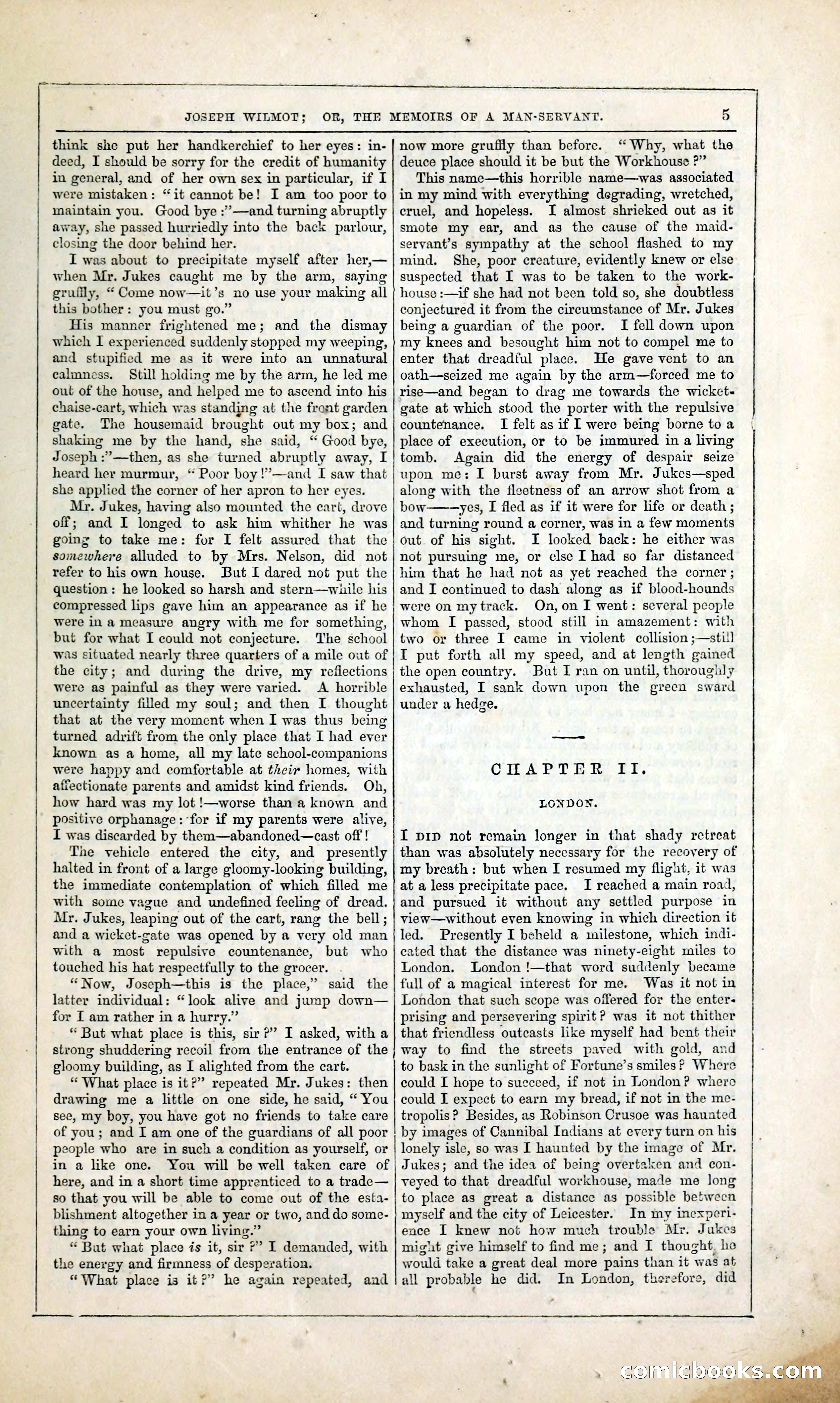
A restored page from Penny Dreadfuls, 1854. Page through the whole issue in the reader above.
📄 Transcribed text from this page (OCR, searchable)
Machine-transcribed from the original scan — historical spelling and the odd misread are preserved.
JOSEPH WILMOT; OR, THE MEMOIRS OF A MAN-SERVANT. 5 think she put her handkerchief to her eyes: in- | now more gruffly than before. deed, I should be sorry for the credit of humanity in general, and of her own sex in particular, if I were mistaken: “it cannot be! I am too poor to maintain you. Good bye :’—and turning abruptly away, she passed hurriedly into the back parlour, closing the door behind her. I was about to precipitate myself after her,— when Mr. Jukes caught me by the arm, saying grufily, “ Come now—it’s no use your making all this bother: you must go.” His manner frightened me; and the dismay which I experienced suddenly stopped my weeping, and stupified me as it were into an unnatural calmness. Still holding me by the arm, he led me out of the house, and helped me to ascend into his chaise-cart, which was standing at the frant garden gate. The housemaid brought out my box; and shaking me by the hand, she said, “ Good bye, Joseph :’—then, as she turned abruptly away, I heard her murmur, “ Poor boy !’—and I saw that she applied the corner of her apron to her eyes. Mr. Jukes, having also mounted the cart, drove off; and I longed to ask him whither he was going to take me: for I felt assured that the somewhere alluded to by Mrs. Nelson, did not refer to his own house. But I dared not put the question : he looked so harsh and stern—wiuile his compressed lips gave him an appearance as if he were in a measure angry with me for something, but for what I could not conjecture. The school was situated nearly three quarters of a mile out of the city; and during the drive, my reflections were as painful as they were varied. <A horrible uncertainty filled my soul; and then I thought that at the very moment when I was thus being turned adrift from the only place that I had ever known as a home, all my late school-companions were happy and comfortable at their homes, with affectionate parents and amidst kind friends. Oh, how hard was my lot !—worse than a known and positive orphanage: for if my parents were alive, I was discarded by them—abandoned—cast off! Tne vehicle entered the city, and presently halted in front of a large gloomy-looking building, the immediate contemplation of which filled me with some vague and undefined feeling of dread. Mr. Jukes, leaping out of the cart, rang the bell; and a wicket-cate was opened by a very old man with a most repulsive countenance, but who touched his hat respectfully to the grocer. “Now, Joseph—this is the place,” said the latter individual: “look alive and jump down— for I am rather in a hurry.” “ But what place is this, sir?’ I asked, with a strong shuddering recoil from the entrance of the gloomy building, as I alighted from the cart. “What place is it?” repeated Mr. Jukes: then drawing me a little on one side, he said, “ You see, my boy, you have got no friends to tale care of you; and I am one of the guardians of all poor people who are in such a condition as yourself, or in a like one. You will be well taken care of here, and in a short time apprenticed to a trade— so that you will be able to come out of the esta- blishment altogether in a year or two, and do some- thing to earn your own living.” * But what place is it, sir ?’ I demanded, with the energy and firmness of desperation. “What place is it?” he again repeated, and ee ———————— —— — “Why, what the deuce place should it be but the Workhouse ?” This name—this horrible name—was associated in my mind with everything degrading, wretched, cruel, and hopeless. I almost shrieked out as it smote my ear, and as the cause of the maid- servant’s sympathy at the school flashed to my mind. She, poor creature, evidently knew or else suspected that I was to be taken to the work- house :—if she had not been told so, she doubtless conjectured it from the circumstance of Mr. Jukes being a guardian of the poor. I fell down upon my knees and besought him not to compel me to enter that dreadful place. He gave vent to an oath—seized me again by the arm—forced me to rise—and began to drag me towards the wickct- gate at which stood the porter with the repulsive countenance. I felt as if I were being borne to a place of execution, or to be immured in a living tomb. Again did the energy of despair seize upon me: I burst away from Mr. Jukes—sped along with the fleetness of an arrow shot from a bow———yes, I fled as if it were for life or death ; and turning round a corner, was in a few moments out of his sight. I looked back: he either was not pursuing me, or else I had so far distanced him that he had not as yet reached the corner ; and I continued to dash along as if blood-hounds were on mytrack. On,on I went: several people whom I passed, stood still in amazement: with two or three I came in violent collision ;—sti!] I put forth all my speed, and at length gained the open country. But I ran on until, thoroughly exhausted, I sank down upon the green sward under a hedge. eer CHAPTER II. LONDON. I pip not remain longer in that shady retreat than was absolutely necessary for the recovery of my breath: but when I resumed my flight, it was at a less precipitate pace. I reached a main road, and pursued it without any settled purpose in view—without even knowing in which direction it led. Presently I beheld a milestone, which indi- cated that the distance was ninety-eight miles to London. London !—that word suddenly became full of a magical interest for me. Was it not in London that such scope was offered for the enter- prising and persevering spirit P was it not thither that friendless outcasts like myself had bent their way to find the streets paved with gold, and to bask in the sunlight of Fortune’s smiles? Where could [ hope to succeed, if not in London? where could I expect to earn my bread, if not in the me- tropolis P Besides, as Robinson Crusoe was haunted by images of Cannibal Indians at every turn on his lonely isle, so was I haunted by the image of Mr. Jukes; and the idea of being overtaken and con- veyed to that dreadful workhouse, made me long to place as great a distance as possible between myself and the city of Leicester. In my inexpert- ence I knew not how much trouble Mr. Jukes might give himself to find me; and I thought, he would take a great deal more pains than it was at all probable he did. In London, therefore, did boo - 2. ie