
Penny Dreadfuls, 1854 · page 177 of 394
Joseph Wilmot, or, The Memoirs of a Man-Servant — page 177: what you’re looking at
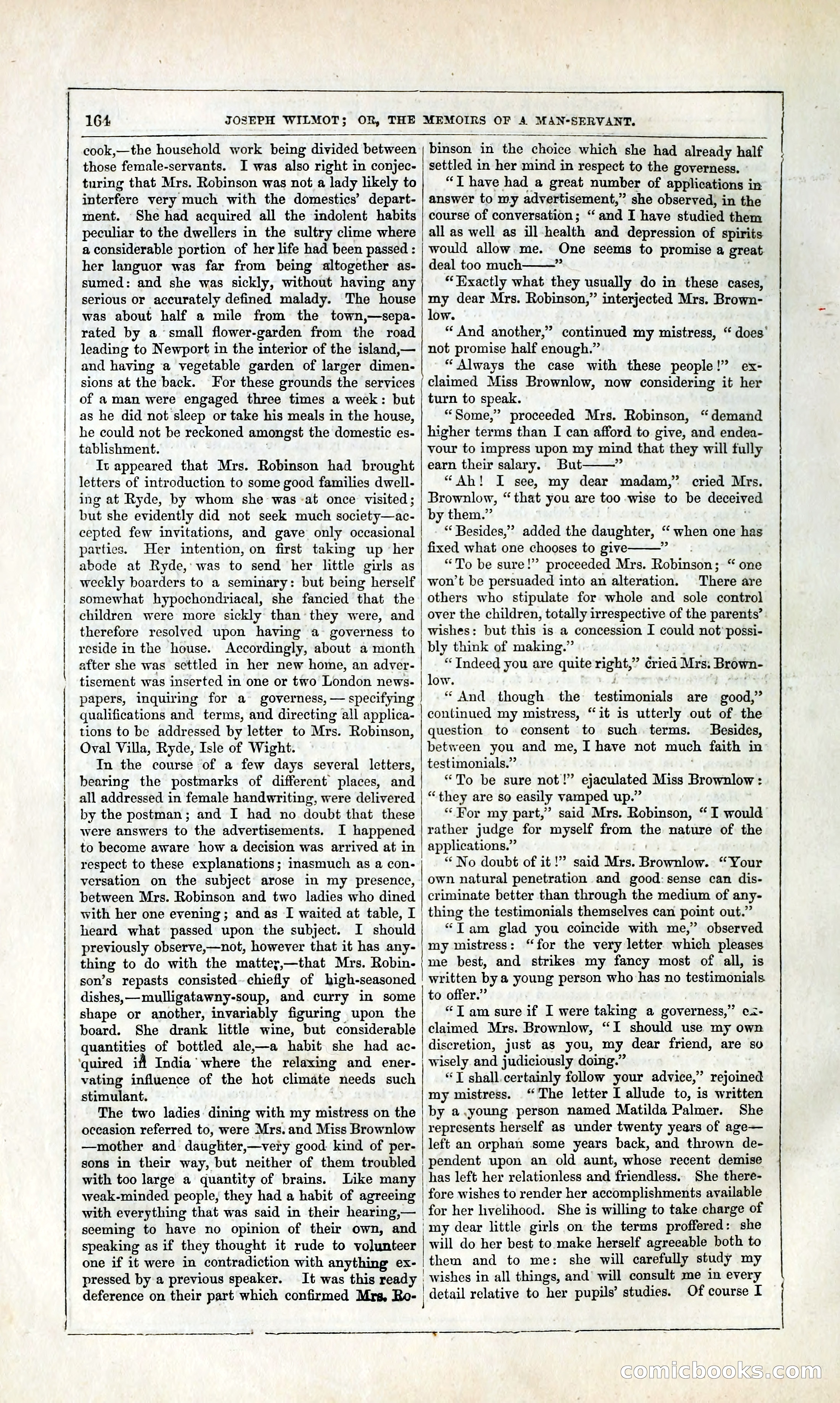
A restored page from Penny Dreadfuls, 1854. Page through the whole issue in the reader above.
📄 Transcribed text from this page (OCR, searchable)
Machine-transcribed from the original scan — historical spelling and the odd misread are preserved.
———— eS en inn ~ ‘ 5 — ‘quired i 164 cook,—the household work being divided between those female-servants. I was also right in conjec- turing that Mrs. Robinson was not a lady likely to interfere very much with the domestics’ depart- ment. She had acquired all the indolent habits peculiar to the dwellers in the sultry clime where a considerable portion of her life had been passed : her languor was far from being altogether as- sumed: and she was sickly, without having any serious or accurately defined malady. The house was about half a mile from the town,—sepa- rated by a small flower-garden from the road leading to Newport in the interior of the island,— and having a vegetable garden of larger dimen- sions at the back. For these grounds the services of a man were engaged three times a week: but as he did not sleep or take his meals in the house, he could not be reckoned amongst the domestic es- tablishment. 3 It appeared that Mrs. Robinson had brought letters of introduction to some good families dwell- ing at Ryde, by whom she was at once visited ; but she evidently did not seek much society—ac- cepted few invitations, and gave only occasional parties. Her intention, on first taking up her abode at Ryde, was to send her little girls as weckly boarders to a seminary: but being herself somewhat hypochondriacal, she fancied that the children were more sickly than they were, and therefore resolved upon having a governess to reside in the house. Accordingly, about a month after she was scttled in her new home, an adver- tisement was inserted in one or two London news- papers, inquiring for a governess, — specifying qualifications and terms, and directing all applica- tions to be addressed by letter to Mrs. Robinson, Oval Villa, Ryde, Isle of Wight. In the course of a few days several letters, bearing the postmarks of different places, and all addressed in female handwriting, were delivered by the postman; and I had no doubt that these were answers to the advertisements. I happened to become aware how a decision was arrived at in respect to these explanations; inasmuch as a con- versation on the subject arose in my presence, between Mrs. Robinson and two ladies who dined with her one evening; and as I waited at table, I heard what passed upon the subject. I should previously observe,—not, however that it has any- thing to do with the mattey,—that Mrs. Robin- son’s repasts consisted-chiefly of high-seasoned dishes,—mulligatawny-soup, and curry in some shape or another, invariably figuring upon the board. She drank little wine, but considerable quantities of bottled ale,—a habit she had ac- India where the relaxing and ener- vating influence of the hot climate needs such stimulant. ) The two ladies dining with my mistress on the occasion referred to, were Mrs. and Miss Brownlow —mother and daughter,—very good. kind of per- sons in their way, but neither of them troubled with too large a quantity of brains. Like many weak-minded people, they had a habit of agreeing with everything that was said in their hearmg,— seeming to have no opinion of their own, and speaking as if they thought it rude to volunteer one if it were in contradiction with anything ex- pressed by a previous speaker. —— ee binson in the choice which she had already half settled in her mind in respect to the governess. “T have had a great number of applications in answer to my advertisement,” she observed, in the course of conversation; “ and I have studied them all as well as ill-health and depression of spirits would allow me. One seems to promise a great. deal too much = “Exactly what they usually do in these cases, my dear Mrs. Robinson,” interjected Mrs. Brown- low. “And another,” continued my mistress, “ does’ not promise half enough.” “ Always the case with these people!” ex- claimed Miss Brownlow, now considering it her turn to speak. “Some,” proceeded Mrs. Robinson, “demand higher terms than I can afford to give, and endea- vour to impress upon my mind that they will fully earn their salary. But ¥ “Ah! I see, my dear madam,” cried Mrs. Brownlow, “that you are too wise to be deceived by them.” “Besides,” added the daughter, “‘ when one has fixed what one chooses to give ak “To be sure!” proceeded Mrs. Robinson; “ one won’t be persuaded into an alteration. There are others who stipulate for whole and sole contro} over the children, totally irrespective of the parents’ wishes: but this is a concession I could not’ possi- bly think of making.” wre jieON “Indeed you are quite right,” cried Mrs: Brown- low. Je p Are “And though the testimonials are good,” continued my mistress, “it is utterly out of the question to consent to such terms. Besides, between you and me, I have not much faith in testimonials.” “To be sure not!” ejaculated Miss Brownlow : “they are so easily vamped up.” “For my part,” said Mrs. Robinson, “I would rather judge for myself from the nature of the applications.” : “No doubt of it !”” said Mrs. Brownlow. “Your own natural penetration and good: sense can dis- criminate better than through the medium of any- thing the testimonials themselves can point out.” “Tam glad you coincide with me,” observed my mistress: “for the very letter which pleases me best, and strikes my fancy most of all, is written by a young person who has no testimonials to offer.” | “Tam sure if I were taking a governess,” ei- claimed Mrs. Brownlow, “I should use my own discretion, just as you, my dear friend, are so wisely and judiciously doing.” “T shall.certainly follow your advice,” rejoined my mistress. “The letter I allude to, is written by a.young person named Matilda Palmer. She represents herself as under twenty years of age— left an orphan some years back, and thrown de- pendent upon an old aunt, whose recent demise has left her relationless and friendless.. She there- fore wishes to render her accomplishments available for her livelihood. She is willing to take charge of Ny) ‘my dear little girls on the terms proffered: she will do her best to make herself agreeable both to them and to me: she will carefully study my It was this ready | wishes in all things, and’ will consult me in every deference on their part which confirmed Mrs, Ro- | detail relative to her pupils’ studies. Of course I —_~-- -——---- ——_— —_—— a JOSEPH WILMOT; OR, THE MEMOIRS OF A MAN-SERVANT. < Doo SS (C@) im