
Penny Dreadfuls, 1854 · page 169 of 394
Joseph Wilmot, or, The Memoirs of a Man-Servant — page 169: what you’re looking at
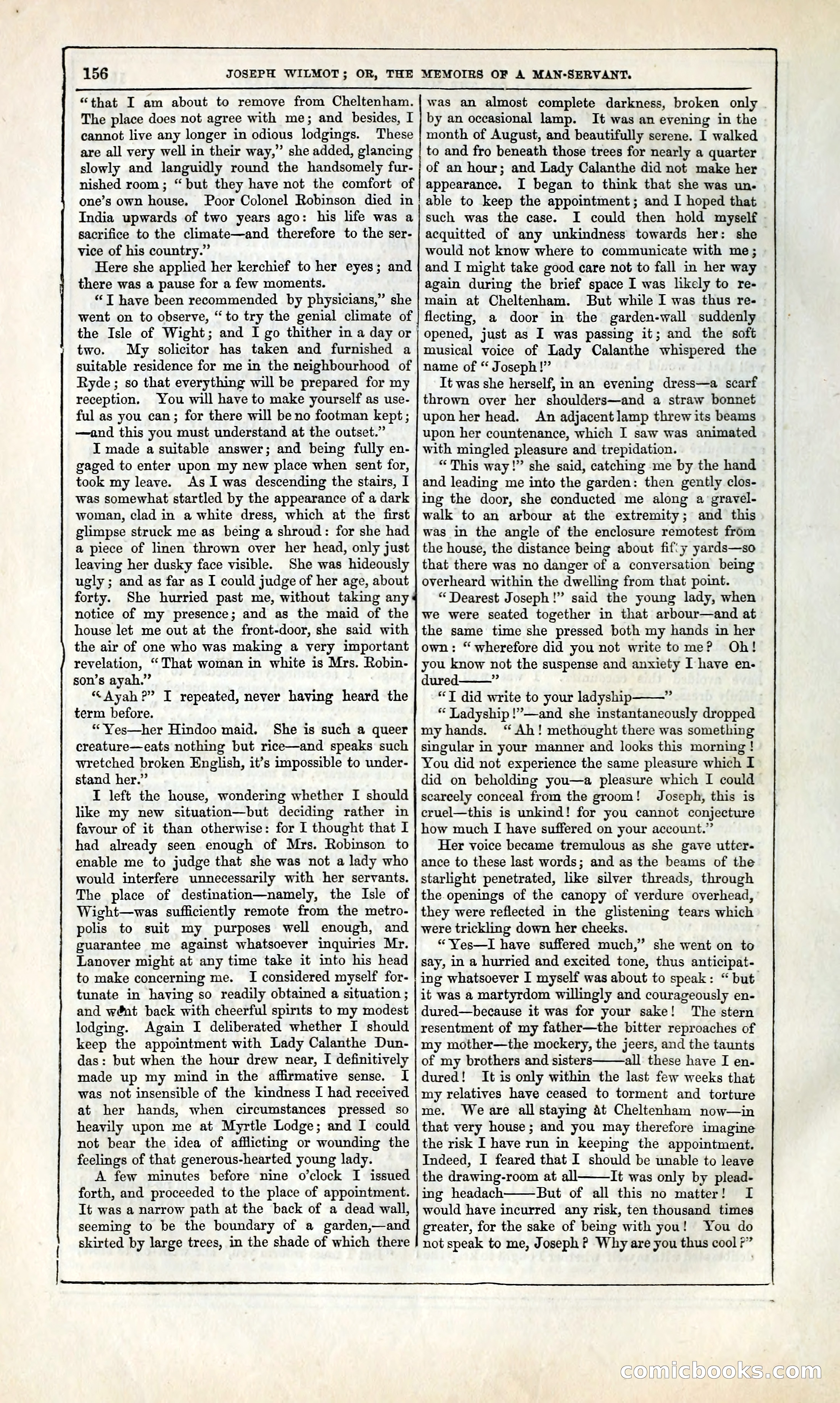
A restored page from Penny Dreadfuls, 1854. Page through the whole issue in the reader above.
📄 Transcribed text from this page (OCR, searchable)
Machine-transcribed from the original scan — historical spelling and the odd misread are preserved.
156 JOSEPH WILMOT; OR, THE MEMOIRS OF A MAN-SERVANT. “that I am about to remove from Cheltenham. The place does not agree with me; and besides, I cannot live any longer in odious lodgings. These are all very well in their way,” she added, glancing slowly and languidly round the handsomely fur- nished room; “but they have not the comfort of one’s own house. Poor Colonel Robinson died in India upwards of two years ago: his life was a sacrifice to the climate—and therefore to the ser- vice of his country.” Here she applied her kerchief to her eyes; and there was a pause for a few moments. “‘T have been recommended by physicians,” she went on to observe, “to try the genial climate of the Isle of Wight; and I go thither in a day or two. My solicitor has taken and furnished a suitable residence for me in the neighbourhood of Ryde ; so that everything will be prepared for my reception. You will have to make yourself as use- ful as you can; for there will be no footman kept; —and this you must understand at the outset.” I made a suitable answer; and being fully en- gaged to enter upon my new place when sent for, took my leave. As I was descending the stairs, I was somewhat startled by the appearance of a dark woman, clad in a white dress, which at the first glimpse struck me as being a shroud: for she had a piece of linen thrown over her head, only just leaving her dusky face visible. She was hideously ugly ; and as far as I could judge of her age, about forty. She hurried past me, without taking any notice of my presence; and as the maid of the house let me out at the front-door, she said with the air of one who was making a very important revelation, “That woman in white is Mrs. Robin- son’s ayah.” “Ayah P”? I repeated, never having heard the term before. *Yes—her Hindoo maid. She is such a queer creature—eats nothing but rice—and speaks such wretched broken English, it’s impossible to under- stand her.” I left the house, wondering whether I should like my new situation—but deciding rather in favour of it than otherwise: for I thought that I had already seen enough of Mrs. Robinson to enable me to judge that she was not a lady who would interfere unnecessarily with her servants. The place of destination—namely, the Isle of Wight—was sufficiently remote from the metro- polis to suit my purposes well enough, and guarantee me against whatsoever inquiries Mr. Lanover might at any time take it into his head to make concerning me. I considered myself for- tunate in having so readily obtained a situation ; and wént back with cheerful spirits to my modest lodging. Again I deliberated whether I should keep the appointment with Lady Calanthe Dun- das: but when the hour drew near, I definitively made up my mind in the affirmative sense. I was not insensible of the kindness I had received at her hands, when circumstances pressed so heavily upon me at Myrtle Lodge; and I could not bear the idea of afflicting or wounding the feelings of that generous-hearted young lady. A few minutes before nine o’clock I issued forth, and proceeded to the place of appointment. It was a narrow path at the back of a dead wall, seeming to be the boundary of a garden,—and skirted by large trees, in the shade of which there nn en ee EE nE En IEEENEEEEEEEEEEEEemnd was an almost complete darkness, broken only by an occasional lamp. It was an evening in the month of August, and beautifully serene. I walked to and fro beneath those trees for nearly a quarter of an hour; and Lady Calanthe did not make her appearance. I began to think that she was un. able to keep the appointment; and I hoped that such was the case. I could then hold myself acquitted of any unkindness towards her: she would not know where to communicate with me; and I might take good care not to fall in her way again during the brief space I was likely to re- main at Cheltenham. But while I was thus re- flecting, a door in the garden-wall suddenly opened, just as I was passing it; and the soft musical voice of Lady Calanthe whispered the name of “ Joseph!” It was she herself, in an evening dress—a scarf thrown over her shoulders—and a straw bonnet upon her head. An adjacentlamp threw its beams upon her countenance, which I saw was animated with mingled pleasure and trepidation. “This way!” she said, catching me by the hand and leading me into the garden: then gently clos- ing the door, she conducted me along a gravel- walk to an arbour at the extremity; and this was in the angle of the enclosure remotest from the house, the distance being about fifty yards—so that there was no danger of a conversation being overheard within the dwelling from that point. “ Dearest Joseph!” said the young lady, when we were seated together in that arbour—and at the same time she pressed both my hands in her own: “wherefore did you not write tome? Oh! you know not the suspense and anxiety I have en- dured. nt “T did write to your ladyship “ Ladyship!”—and she instantaneously dropped my hands. “Ah! methought there was something singular in your manner and looks this morning! You did not experience the same pleasure which I did on beholding you—a pleasure which I could scarcely conceal from the groom! Joseph, this is cruel—this is unkind! for you cannot conjecture how much I have suffered on your account.” Her voice became tremulous as she gave utter- ance to these last words; and as the beams of the starlight penetrated, like silver threads, through the openings of the canopy of verdure overhead, they were reflected in the glistening tears which were trickling down her cheeks. “"Yes—I have suffered much,” she went on to say, in a hurried and excited tone, thus anticipat- ing whatsoever I myself was about to speak: “ but it was a martyrdom willingly and courageously en- dured—because it was for your sake! The stern resentment of my father—the bitter reproaches of my mother—the mockery, the jeers, and the taunts of my brothers and sisters all these have I en- dured! It is only within the last few weeks that my relatives have ceased to torment and torture me. Weare all staying at Cheltenham now—in that very house; and you may therefore imagine the risk I have run in keeping the appointment. Indeed, I feared that I should be unable to leave the drawing-room at all It was only by plead- ing headach But of all this no matter! I would have incurred any risk, ten thousand times greater, for the sake of being with you! You do not speak to me, Joseph ? Why are you thus cool ?” 33 <S OOO) (C() im