
Penny Dreadfuls, 1854 · page 162 of 394
Joseph Wilmot, or, The Memoirs of a Man-Servant — page 162: what you’re looking at
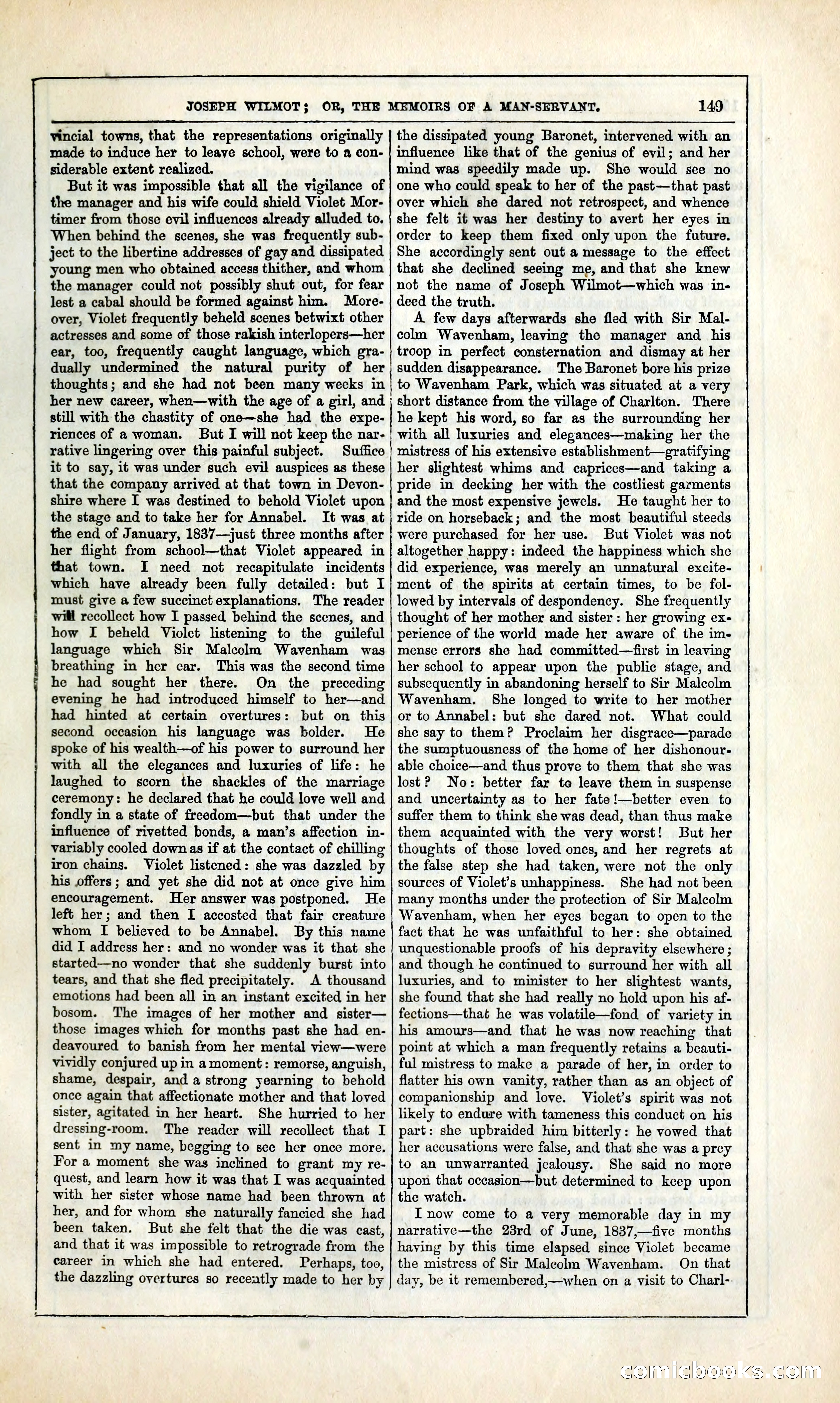
A restored page from Penny Dreadfuls, 1854. Page through the whole issue in the reader above.
📄 Transcribed text from this page (OCR, searchable)
Machine-transcribed from the original scan — historical spelling and the odd misread are preserved.
JOSEPH WILMOT; vincial towns, that the representations originally made to induce her to leave school, were to a con- siderable extent realized. But it was impossible that all the vigilance of the manager and his wife could shield Violet Mor- timer from those evil influences already alluded to. When behind the scenes, she was frequently sub- ject to the libertine addresses of gay and dissipated young men who obtained access thither, and whom the manager could not possibly shut out, for fear lest a cabal should be formed against him. More- over, Violet frequently beheld scenes betwixt other actresses and some of those rakish interlopers—her ear, too, frequently caught language, which gra- dually undermined the natural purity of her thoughts ; and she had not been many weeks in her new career, when—with the age of a girl, and j still with the chastity of one—she had the expe- riences of a woman. But I will not keep the nar- rative lingering over this painful subject. Suffice it to say, it was under such evil auspices as these that the company arrived at that town in Devon- shire where I was destined to behold Violet upon the stage and to take her for Annabel. It was at the end of January, 1837—just three months after her flight from school—that Violet appeared in that town. I need not recapitulate incidents which have already been fully detailed: but I must give a few succinct explanations. The reader will recollect how I passed behind the scenes, and how I beheld Violet listening to the guileful language which Sir Malcolm Wavenham was breathing in her ear. This was the second time he had sought her there. On the preceding evening he had introduced himself to her—and had hinted at certain overtures: but on this second occasion his language was bolder. He spoke of his wealth—of his power to surround her with all the elegances and luxuries of life: he laughed to scorn the shackles of the marriage ceremony: he declared that he could love well and fondly in a state of freedom—but that under the influence of rivetted bonds, a man’s affection in- variably cooled down as if at the contact of chilling iron chains. Violet listened: she was dazzled by his offers; and yet she did not at once give him encouragement. Her answer was postponed. He left her; and then I accosted that fair creature whom I believed to be Annabel. By this name did I address her: and no wonder was it that she started—no wonder that she suddenly burst into tears, and that she fled precipitately. A thousand emotions had been all in an instant excited in her bosom. The images of her mother and sister— those images which for months past she had en- deayoured to banish from her mental view—were vividly conjured up in a moment: remorse, anguish, shame, despair, and a strong yearning to behold once again that affectionate mother and that loved sister, agitated in her heart. She hurried to her dressing- -room. The reader will recollect that I sent in my name, begging to see her once more. For a moment she was inclined to grant my re- quest, and learn how it was that I was acquainted with her sister whose name had been thrown at her, and for whom she naturally fancied she had been taken. But she felt that the die was cast, and that it was impossible to retrograde from the career in which she had entered. Perhaps, too, the dazzling overtures so receatly made to her by OR, THE MEMOIRS OF A MAN-SERVANT. 149 the dissipated young Baronet, intervened with an influence like that of the genius of evil; and her mind was speedily made up. She would see no one who could speak to her of the past—that past over which she dared not retrospect, and whence she felt it was her destiny to avert her eyes in order to keep them fixed only upon the future. She accordingly sent out a message to the effect that she declined seeing me, and that she knew not the name of Joseph Wilmot—which was in- deed the truth. A. few days afterwards she fled with Sir Mal- colm Wavenham, leaving the manager and his troop in perfect consternation and dismay at her sudden disappearance. The Baronet bore his prize to Wavenham Park, which was situated at a very short distance from the village of Charlton. There he kept his word, so far as the surrounding her with all luxuries and elegances—making her the mistress of his extensive establishment—eratifying her slightest whims and caprices—and taking a pride in decking her with the costliest garments and the most expensive jewels. He taught her to ride on horseback; and the most beautiful steeds were purchased for her use. But Violet was not altogether happy: indeed the happiness which she did experience, was merely an unnatural excite- ment of the spirits at certain times, to be fol- lowed by intervals of despondency. She frequently thought of her mother and sister : her growing ex- perience of the world made her aware of the im- mense errors she had committed—first in leaving her school to appear upon the public stage, and subsequently in abandoning herself to Sir Malcolm Wavenham. She longed to write to her mother or to Annabel: but she dared not. What could she say to them? Proclaim her disgrace—parade the sumptuousness of the home of her dishonour- able choice—and thus prove to them that she was lost? No: better far to leave them in suspense and uncertainty as to her fate!—better even to suffer them to think she was dead, than thus make them acquainted with the very worst! But her thoughts of those loved ones, and her regrets at the false step she had taken, were not the only sources of Violet’s unhappiness. She had not been many months under the protection of Sir Malcolm Wavenham, when her eyes began to open to the fact that he was unfaithful to her: she obtained unquestionable proofs of his depravity elsewhere ; and though he continued to surround her with all luxuries, and to minister to her slightest wants, she found that she had really no hold upon his af- fections—that he was volatile—fond of variety in his amours—and that he was now reaching that point at which a man frequently retains a beauti- ful mistress to make a parade of her, in order to flatter his own vanity, rather than as an object of companionship and love. Violet’s spirit was not likely to endure with tameness this conduct on his part: she upbraided him bitterly: he vowed that her accusations were false, and that she was a prey to an unwarranted jealousy. She said no more upon that occasion—but determined to keep upon the watch. I now come to a very memorable day in my narrative—the 23rd of June, 1837,—five months having by this time elapsed since Violet became the mistr ess of Sir Malcolm Wavenham. On that day, be it remembered,—when on a visit to Charl- Ghboo S co AA