
Penny Dreadfuls, 1854 · page 160 of 394
Joseph Wilmot, or, The Memoirs of a Man-Servant — page 160: what you’re looking at
A restored page from Penny Dreadfuls, 1854. Page through the whole issue in the reader above.
📄 Transcribed text from this page (OCR, searchable)
Machine-transcribed from the original scan — historical spelling and the odd misread are preserved.
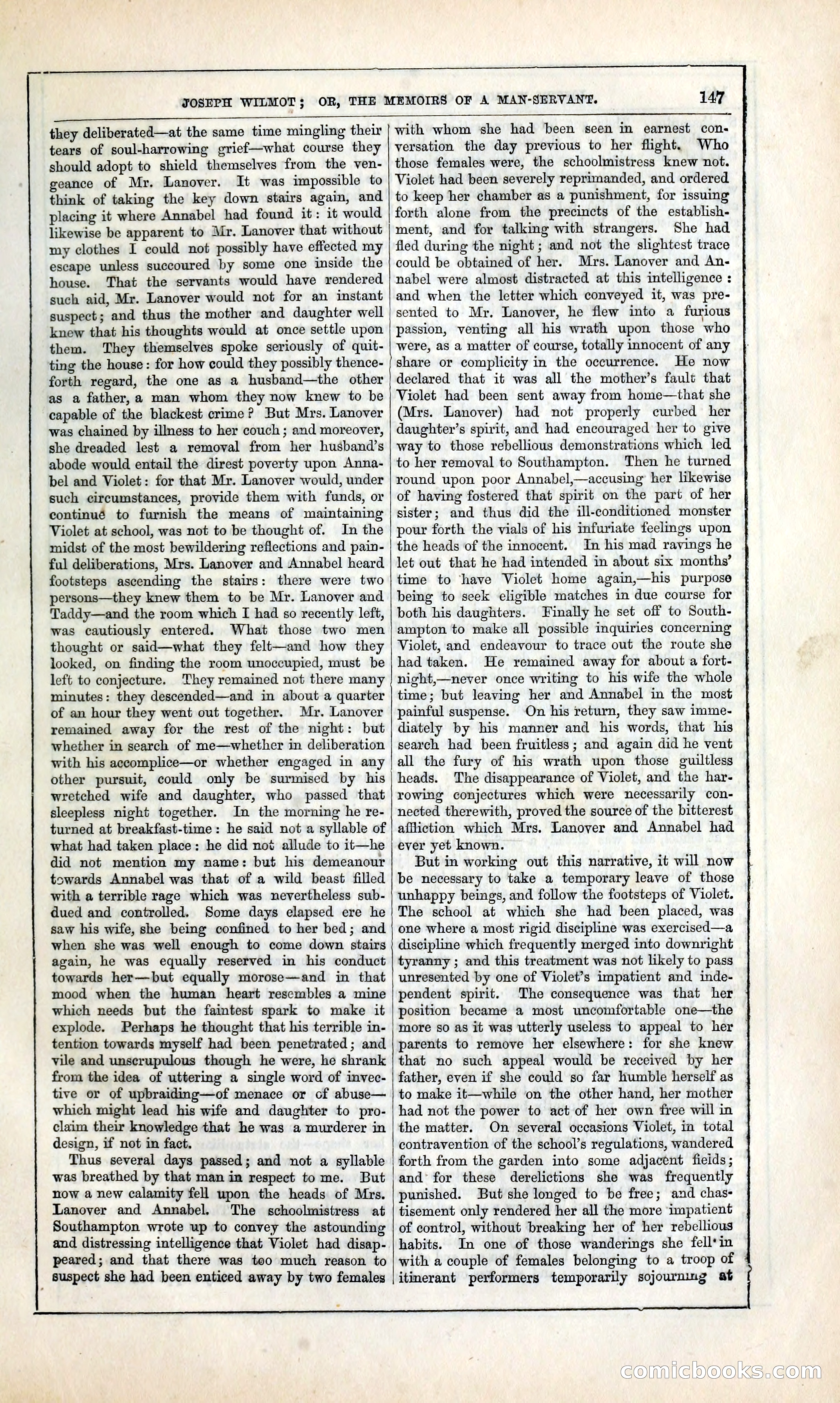
JOSEPH WILMOT; OR, THE MEMOIRS OF A MAN-SERVANT. they deliberated—at the same time mingling their tears of soul-harrowing grief—what course they should adopt to shield themselves from the ven- geance of Mr. Lanover. It was impossible to think of taking the key down stairs again, and placing it where Annabel had found it: it would likewise be apparent to Mr. Lanover that without my clothes I could not possibly have effected my escape unless succoured by some one inside the house. That the servants would have rendered such aid, Mr. Lanover would not for an instant suspect; and thus the mother and daughter well knew that his thoughts would at once settle upon them. They themselves spoke seriously of quit- ting the house: for how could they possibly thence- forth regard, the one as a husband—the other as a father,a man whom they now knew to be capable of the blackest crime? But Mrs. Lanover was chained by illness to her couch ; and moreover, she dreaded lest a removal from her husband’s abode would entail the direst poverty upon Anna- bel and Violet: for that Mr. Lanover would, under such circumstances, provide them with funds, or continué to furnish the means of maintaining Violet at school, was not to be thought of. In the midst of the most bewildering reflections and pain- ful deliberations, Mrs. Lanover and Annabel heard footsteps ascending the stairs: there were two persons—they knew them to be Mr. Lanover and Taddy—and the room which I had so recently left, was cautiously entered. What those two men thought or said—what they felt—and how they looked, on finding the room unoccupied, must be left to conjecture. They remained not there many minutes: they descended—and in about a quarter of an hour they went out together. Mr. Lanover remained away for the rest of the night: but whether in search of me—whether in deliberation with his accomplice—or whether engaged in any other pursuit, could only be surmised by his wretched wife and daughter, who passed that sleepless night together. In the morning he re- turned at breakfast-time: he said not a syllable of what had taken place: he did not allude to it—he did not mention my name: but his demeanour towards Annabel was that of a wild beast filled with a terrible rage which was nevertheless sub- dued and controlled. Some days elapsed ere he saw his wife, she being confined to her bed; and when she was well enough to come down stairs again, he was equally reserved in his conduct towards her—but equally morose—and in that mood when the human heart resembles a mine which needs but the faintest spark to make it explode. Perhaps he thought that his terrible in- tention towards myself had been penetrated; and vile and unscrupulous though he were, he shrank from the idea of uttering a single word of invec- tive or of upbraiding—of menace or of abuse— which might lead his wife and daughter to pro- claim their knowledge that he was a murderer in design, if not in fact. Thus several days passed; and not a syllable was breathed by that man in respect tome. But now a new calamity fell upon the heads of Mrs. Lanover and Annabel. The schoolmistress at Southampton wrote up to convey the astounding and distressing intelligence that Violet had disap- peared; and that there was too much reason to suspect she had heen enticed away by two females 147 with whom she had been seen in earnest con- versation the day previous to her flight. Who those females were, the schoolmistress knew not. Violet had been severely reprimanded, and ordered to keep her chamber as a punishment, for issuing forth alone from the precincts of the establish- ment, and for talking with strangers. She had fled during the night ; and not the slightest trace could be obtained of her. Mrs. Lanover and An- nabel were almost distracted at this intelligence : and when the letter which conveyed it, was pre- sented to Mr. Lanover, he flew into a furious passion, venting all his wrath upon those who were, as a matter of course, totally innocent of any share or complicity in the occurrence. He now declared that it was all the mother’s fault that Violet had been sent away from home—that she (Mrs. Lanover) had not properly curbed her daughter’s spirit, and had encouraged her to give way to those rebellious demonstrations which led to her removal to Southampton. Then he turned round upon poor Annabel,—accusing her likewise of having fostered that spirit on the part of her sister; and thus did the ill-conditioned monster pour forth the vials of his infuriate feelmgs upon the heads of the innocent. In his mad ravings he let out that he had intended in about six months’ time to ‘have Violet home again,—his purpose being to seek eligible matches in due course for both his daughters. Finally he set off to South- ampton to make all possible inquiries concerning Violet, and endeavour to trace out the route she had taken. He remained away for about a fort- night,—never once writing to his wife the whole time; but leaving her and Annabel in the most painful suspense. On his return, they saw imme- diately by his manner and his words, that his search had been fruitless; and again did he vent all the fury of his wrath upon those guiltless heads. The disappearance of Violet, and the har- rowing conjectures which were necessarily con- nected therewith, proved the source of the bitterest affliction which Mrs. Lanover and Annabel had ever yet known. But in working out this narrative, it will now be necessary to take a temporary leave of those unhappy beings, and follow the footsteps of Violet. The school at which she had been placed, was one where a most rigid discipline was exercised—a discipline which frequently merged into downright tyranny ; and this treatment was not likely to pass unresented by one of Violet’s impatient and inde- pendent spirit. The consequence was that her position became a most uncomfortable one—the more so as it was utterly useless to appeal to her parents to remove her elsewhere: for she knew that no such appeal would be received by her father, even if she could so far Humble herself as to make it—while on the other hand, her mother had not the power to act of her own free will in the matter. On several occasions Violet, in total contravention of the school’s regulations, wandered forth from the garden into some adjacent fieids; and’ for these derelictions she was frequently punished. But she longed to be free; and chas- tisement only rendered her all the more impatient of control, without breaking her of her rebellious habits. In one of those wanderings she fell*in with a couple of females belonging to a troop of + itinerant performers temporarily sojournmg at ElO@QO) <S (C(O) im