
Penny Dreadfuls, 1854 · page 16 of 394
Joseph Wilmot, or, The Memoirs of a Man-Servant — page 16: what you’re looking at
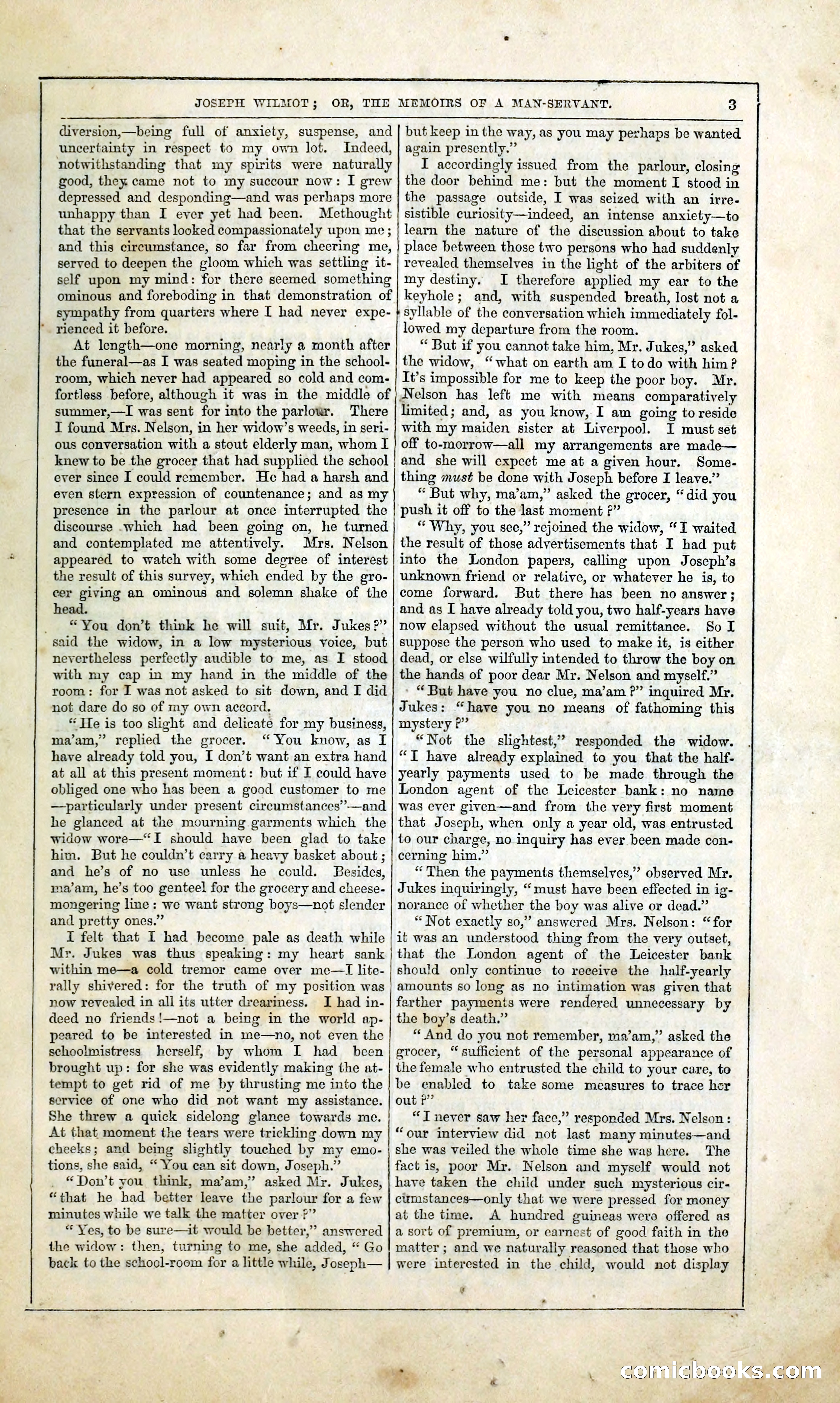
A restored page from Penny Dreadfuls, 1854. Page through the whole issue in the reader above.
📄 Transcribed text from this page (OCR, searchable)
Machine-transcribed from the original scan — historical spelling and the odd misread are preserved.
JOSEPH WILMOT; OR, THE MEMOIRS OF A MAN-SERVANT. 3 diversion,—being full of anxiety, suspense, and uncertainty in respect to my own lot. Indeed, notwithstanding that my spirits were naturally good, they came not to my succour now: I grew depressed and desponding—and was perhaps more unhappy than I ever yet had been. Methought that the servants looked compassionately upon me; and this circumstance, so far from cheering me, served to deepen the gloom which was settling it- self upon my mind: for there seemed something ominous and foreboding in that demonstration of sympathy from quarters where [ had never expe- * rienced it before. At length—one morning, nearly a month after the funeral—as I was seated moping in the school- room, which never had appeared so cold and com- fortless before, although it was in the middle of summer,—I was sent for into the parlowr. There I found Mrs. Nelson, in her widow’s weeds, in seri- ous conversation with a stout elderly man, whom I knew to be the grocer that had supplied the school ever since I could remember. He had a harsh and even stern expression of countenance; and as my presence in the parlour at once interrupted the discourse .which had been going on, he turned and contemplated me attentively. Mrs. Nelson appeared to watch with some degree of interest the result of this survey, which ended by the gro- eer giving an ominous and solemn shake of the head. “You don’t think he will suit, Mr. Jukes?” said the widow, in a low mysterious voice, but nevertheless perfectly audible to me, as I stood with my cap in my hand in the middle of the room: for I was not asked to sit down, and I did not dare do so of my own accord. * He is too slight and delicate for my business, ma’am,” replied the grocer. “ You know, as I have already told you, I don’t want an extra hand at all at this present moment: but if I could have obliged one who has been a good customer to me —particularly under present circumstances’ —and he glanced at the mourning garments which the widow wore—“I should have been glad to take him. But he couldn’t carry a heavy basket about ; and he’s of no use unless he could. Besides, ma’am, he’s too genteel for the grocery and cheese- mongering line: we want strong boys—not slender and pretty oncs.” I felt that I had become pale as death while Mr. Jukes was thus speaking: my heart sank within me—a cold tremor came over me—I lite- rally shivered: for the truth of my position was now revealed in all its utter drearmess. I had in- deed no friends!—not a being in the world ap- peared to be interested in me—no, not even the schoolmistress herself, by whom I had been brought up: for she was evidently making the at- tempt to get rid of me by thrusting me into the service of one who did not want my assistance. She threw a quick sidelong glance towards me. At that, moment the tears were trickling down my cheeks; and being slightly touched by my emo- tions, she said, “ You can sit down, Joseph.” . “Don’t you think, ma’am,”’ asked Mr. Jukes, “that he had better leave the parlour for a few minutes while we talk the matter over ?” “Yes, to be sure—it would be better,” answered the widow: then, turning to me, she added, “ Go back to the school-room for a little while, Joseph— but keep in the way, as you may perhaps be wanted again presently.” I accordingly issued from the parlour, closing the door behind me: but the moment I stood in the passage outside, I was seized with an irre- sistible curiosity—indeed, an intense anxiety—to learn the nature of the discussion about to take place between those two persons who had suddenly revealed themselves in the light of the arbiters of my destiny. I therefore applied my ear to the keyhole; and, with suspended breath, lost not a syllable of the conversation which immediately fol- lowed my departure from the room. “ But if you cannot take him, Mr. Jukes,” asked the widow, “what on earth am I todo with him? It’s impossible for me to keep the poor boy. Mr. Nelson has left me with means comparatively limited; and, as you know, I am going to reside with my maiden sister at Liverpool. I must set off to-morrow—all my arrangements are made— and she will expect me at a given hour. Some- thing must be done with Joseph before I leave.” “ But why, ma’am,” asked the grocer, “did you push it off to the last moment ?” “ Why, you see,” rejoined the widow, “I waited the result of those advertisements that I had put into the London papers, calling upon Joseph’s unknown friend or relative, or whatever he is, to come forward. But there has been no answer; and as I have already told you, two half-years have now elapsed without the usual remittance. So I suppose the person who used to make it, is either dead, or else wilfuliy intended to throw the boy on the hands of poor dear Mr. Nelson and myself.” ' “ But have you no clue, ma’am P” inquired Mr. Jukes: “have you no means of fathoming this mystery P” “Not the slightest,” responded the widow. “TI have already explained to you that the half- yearly payments used to be made through the London agent of the Leicester bank: no name was ever given—and from the very first moment that Joseph, when only a year old, was entrusted to our charge, no inquiry has ever been made con- cerning him.” “Then the payments themselves,” observed Mr. Jukes inquiringly, “must have been effected in ig- norance of whether the boy was alive or dead.” “ Not exactly so,” answered Mrs. Nelson: “for it was an understood thing from the very outset, that the London agent of the Leicester bank should only continue to receive the half-yearly amounts so long as no intimation was given that farther payments were rendered unnecessary by the boy’s death.” ** And do you not remember, ma’am,”’ asked the grocer, “sufficient of the personal appearance of the female who entrusted the child to your care, to be enabled to take some measures to trace her out P” “J never saw her face,” responded Mrs. Nelson: “our interview did not last many minutes—and she was veiled the whole time she was here. The fact is, poor Mr. Nelson and myself would not have taken the child under such mysterious cir- cumstances—only that we were pressed for money at the time. A hundred guineas wero offered as a sort of premium, or earnest of good faith in the matter ; and we naturally reasoned that those who were interested in the child, would not display (eo) oY Rae © comicboo -—- hae 7 ry ‘ay a ie)