
Penny Dreadfuls, 1854 · page 149 of 394
Joseph Wilmot, or, The Memoirs of a Man-Servant — page 149: what you’re looking at
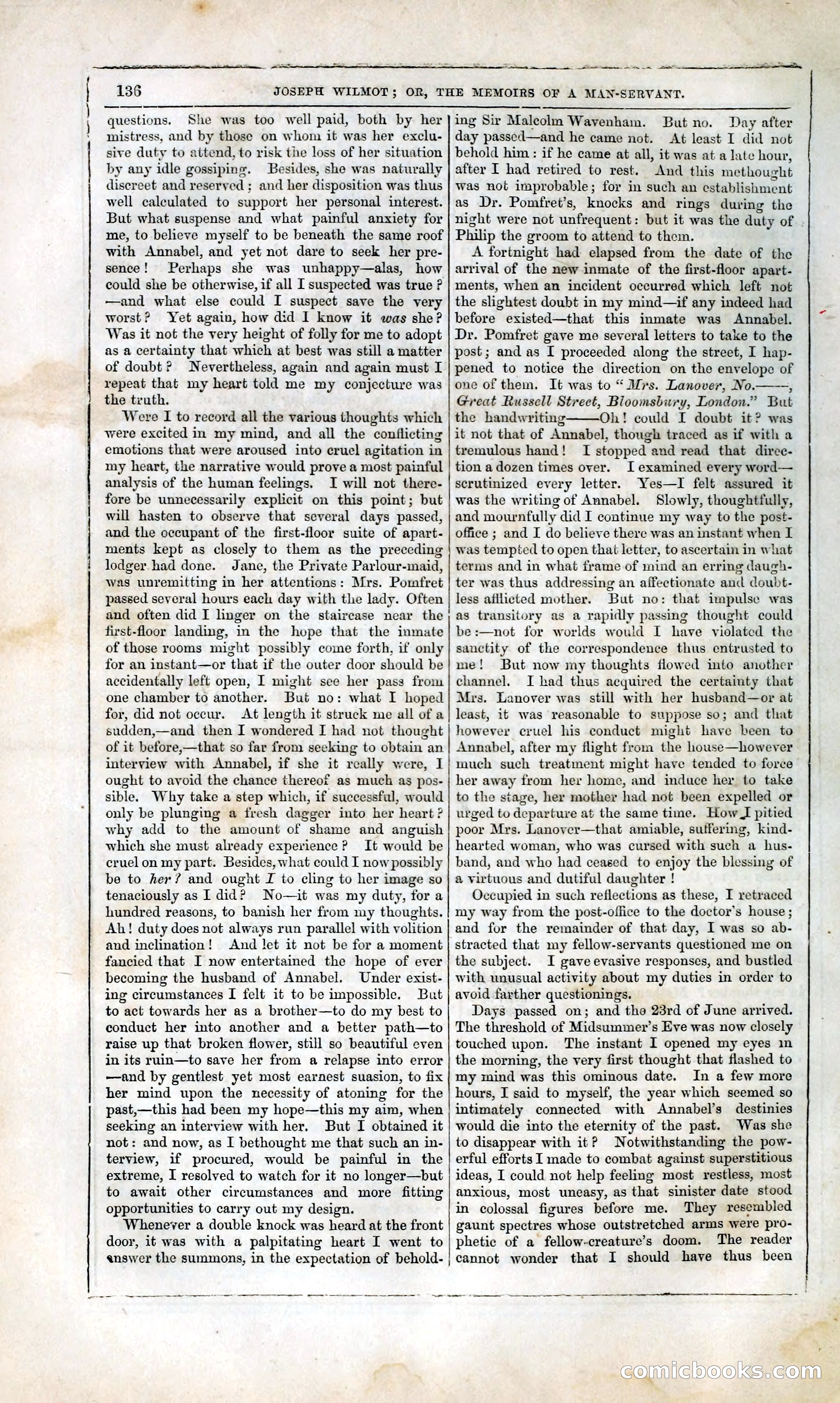
A restored page from Penny Dreadfuls, 1854. Page through the whole issue in the reader above.
📄 Transcribed text from this page (OCR, searchable)
Machine-transcribed from the original scan — historical spelling and the odd misread are preserved.
136 questions. She was too well paid, both by her mistress, and by those on whom it was her exclu- sive duty to attend, to risk the loss of her situation by any idle gossiping. Besides, she was naturally discreet and reserved ; and her disposition was thus well calculated to support her personal interest. But what suspense and what painful anxiety for me, to believe myself to be beneath the same roof with Annabel, and yet not dare to seek her pre- sence! Perhaps she was unhappy—alas, how could she be otherwise, if all I suspected was true P —and what else could I suspect save the very worst? Yet again, how did I know it was she? Was it not the very height of folly for me to adopt as a certainty that which at best was still a matter of doubt? Nevertheless, again and again must I repeat that my heart told me my conjecture was the truth. Were I to record all the various thoughts which were excited in my mind, and all the conflicting emotions that were aroused into cruel agitation in my heart, the narrative would prove a most painful analysis of the human feelings. I will not there- fore be unnecessarily explicit on this point; but will hasten to observe that several days passed, and the occupant of the first-floor suite of apart- ments kept as closely to them as the preceding lodger had done. Jane, the Private Parlour-maid, was unremitting in her attentions: Mrs. Pomfret passed several hours each day with the lady. Often and often did I linger on the staircase near the first-floor landing, in the hope that the inmate of those rooms might possibly come forth, if only for an instant—or that if the outer door should be accidentally left open, I might see her pass from one chamber to another. But no: what I hoped for, did not ocew. At length it struck me all of a sudden,—and then I wondered I had not thought of it before,—that so far from seeking to obtain an interview with Annabel, if she it really were, I ought to avoid the chance thereof as much as pos- sible. Why take a step which, if successful, would only be plunging a fresh dagger into her heart ? why add to the amount of shame and anguish which she must already experience P It would be cruel on my part. Besides, what could I now possibly be to her? and ought J to cling to her image so tenaciously as I did? No—it was my duty, fora hundred reasons, to banish her from my thoughts. Ah! duty does not always run parallel with volition and inclination! And let it not be for a moment fancied that I now entertained the hope of ever becoming the husband of Annabel. Under exist- ing circumstances I felt it to be impossible. But to act towards her as a brother—to do my best to conduct her into another and a better path—to raise up that broken flower, still so beautiful even in its ruin—to save her from a relapse into error —and by gentlest yet most earnest suasion, to fix her mind upon the necessity of atoning for the past,—this had been my hope—this my aim, when seeking an interview with her. But I obtained it not: and now, as I bethought me that such an in- terview, if procured, would be painful in the extreme, I resolved to watch for it no longer—but to await other circumstances and more fitting opportunities to carry out my design. Whenever a double knock was heard at the front door, it was with a palpitating heart I went to LS sss sna —* JOSEPH WILMOT; OR, THE MEMOIRS OF A MAN-SERVANT. (2 ee ing Sir Maleolm Wayenham. But no. Day after day passed—and he came not. At least I did not behold him : if he came at all, it was at a late hour, after I had retired to rest. And this methought was not improbable; for in such an establishment as Dr. Pomfret’s, knocks and rings during the night were not unfrequent: but it was the duty of Philip the groom to attend to them. A fortnight had elapsed from the date of the arrival of the new inmate of the first-floor apart- ments, when an incident occurred which left not the slightest doubt in my mind—if any indeed had before existed—that this inmate was Annabel. Dr. Pomfret gave me several letters to take to the post; and as I proceeded along the street, I hap- pened to notice the direction on the envelope of one of them. It was to “ Mis. Lanover, No. ; Great Russell Street, Bloomsbury, London.” But the handwriting Oh! could I doubt it? was it not that of Annabel, though traced as if with a tremulous hand! I stopped and read that diree- tion adozen times over. I examined every word— scrutinized every letter. Yes—I felt assured it was the writing of Annabel. Slowly, thoughtfully, and mournfully did I continue my way to the post- office ; and I do believe there was an instant when I was tempted to open that letter, to ascertain in what terms and in what frame of mind an erring daugh- ter was thus addressing an affectionate and doubt- less afilicted mother. But no: that impulse was as transitory as a rapidly passing thought could be :—not for worlds would I have violated the sanctity of the correspondence thus entrusted to me! But now my thoughts flowed ito another channel. I had thus acquired the certainty that Mrs. Lanover was still with her husband—or at least, it was reasonable to suppose so; and that however cruel his conduct might have been to Annabel, after my flight from the house—however much such treatment might have tended to force her away from her home, and induce her to take to the stage, her mother had not been expelled or urged to departure at the same time. How J pitied poor Mrs. Lanover—that amiable, suffering, kind- hearted woman, who was cursed with such a hus- band, and who had ceased to enjoy the blessing of a virtuous and dutiful daughter ! Occupied in such reflections as these, I retraced my way from the post-office to the doctor’s house ; and for the remainder of that day, I was so ab- stracted that my fellow-servants questioned me on the subject. I gave evasive responses, and bustled with unusual activity about my duties in order to avoid farther questionings. Days passed on; and the 23rd of June arrived. The threshold of Midsummer’s Eve was now closely touched upon. The instant 1 opened my eyes im the morning, the very first thought that flashed to my mind was this ominous date. In a few more hours, I said to myself, the year which seemed so intimately connected with Amnnabel’s destinies would die into the eternity of the past. Was she to disappear with it? Notwithstanding the pow- erful efforts I made to combat against superstitious ideas, I could not help feeling most restless, most anxious, most uneasy, as that sinister date stood in colossal figures before me. They resembled gaunt spectres whose outstretched arms were pro- phetic of a fellow-creature’s doom. The reader answer the summons, in the expectation of behold- | cannot wonder that I should have thus been = er EE A = — a ——— ee eee eee eer eee Ss OOOLKS 5 (E00) —— a tie lin, <a ee erin hee oe a, a im