
Penny Dreadfuls, 1854 · page 140 of 394
Joseph Wilmot, or, The Memoirs of a Man-Servant — page 140: what you’re looking at
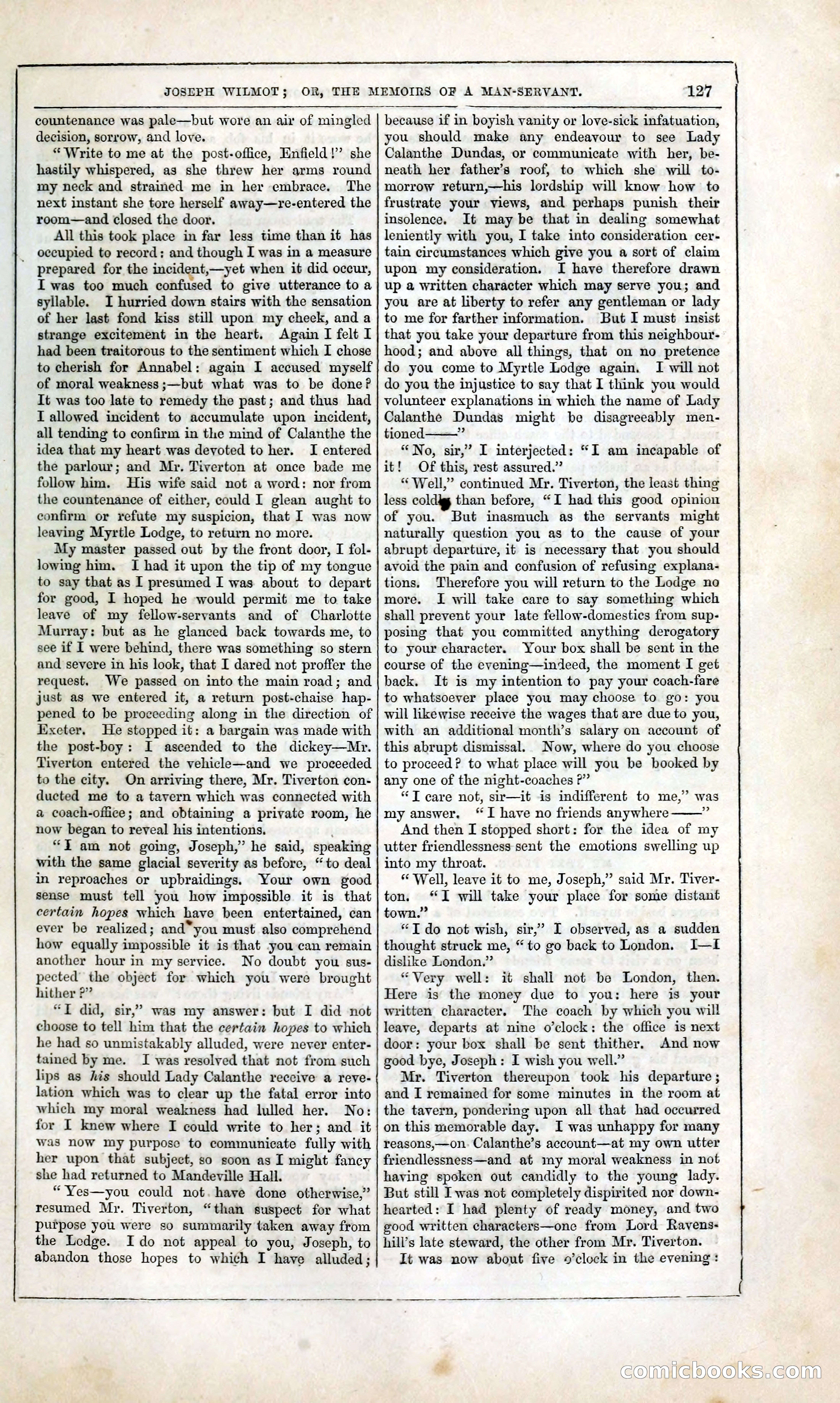
A restored page from Penny Dreadfuls, 1854. Page through the whole issue in the reader above.
📄 Transcribed text from this page (OCR, searchable)
Machine-transcribed from the original scan — historical spelling and the odd misread are preserved.
JOSEPH WILMOT ; countenance was pale—but wore an air of mingled decision, sorrow, and love. “Write to me at the post-office, Enfield!’ she hastily whispered, as she threw her arms round my neck and strained me in her embrace. The next instant she tore herself away—re-entered the room—and closed the door. All this took place in far less time than it has occupied to record; and though I was in a measure prepared for the incident,—yet when it did occur, I was too much confused to give utterance to a syllable. I hurried down stairs with the sensation of her last fond kiss still upon my cheek, and a strange excitement in the heart. Again I felt I had been traitorous to the sentiment which I chose to cherish for Annabel: again I accused myself of moral weakness ;—but what was to be done? It was too late to remedy the past; and thus had I allowed incident to accumulate upon incident, all tending to confirm in the mind of Calanthe the idea that my heart was deyoted to her. I entered the parlour; and Mr. Tiverton at once bade me follow him. His wife said not a word: nor from the countenance of either, could I glean aught to confirm or refute my suspicion, that I was now leaving Myrtle Lodge, to return no more. My master passed out by the front door, I fol- lowing him. I had it upon the tip of my tongue to say that as I presumed I was about to depart for good, I hoped he would permit me to take leave of my fellow-servants and of Charlotte Murray: but as he glanced back towards me, to see if I were behind, there was something so stern and severe in his look, that I dared not proffer the request. We passed on into the main road; and just as we entered it, a return post-chaise hap- pened to be proceeding along in the direction of ixeter, He stopped it: a bargain was made with the post-boy: I ascended to the dickey—Mr. Tiverton entered the vehicle—and we proceeded to the city. On arriving there, Mr. Tiverton con- ducted me to a tavern which was connected with a coach-office; and obtaining a private room, he now began to reveal his intentions, “J am not going, Joseph,” he said, speaking with the same glacial severity as before, “to deal in reproaches or upbraidings. Your own good sense must tell you how impossible it is that certain hopes which have been entertained, can ever be realized; and you must also comprehend how equally impossible it is that you can remain another hour in my service. No doubt you sus- pected the object for which you were brought hither ?” “I did, sir,’ was my answer: but I did not choose to tell him that the certain hopes to which he had so unmistakably alluded, were never enter- tained by me. I was resolved that not from such lips as his should Lady Calanthe receive a reve- lation which was to clear up the fatal error into which my moral weakness had lulled her. No: for I knew where I could write to her; and it was now my purpose to communicate fully with her upon that subject, so soon as I might fancy she had returned to Mandeville Hall. “ Yes—you could not. have done otherwise,” resumed My. Tiverton, “than suspect for what purpose you were so summarily taken away from the Ledge. Ido not appeal to you, Joseph, to abandon those hopes to which I have alluded; OR, THE MEMOIRS OF A MAN-SERVANT. nn nnn nanan nem eee = EE EEE eee 127 because if in boyish vanity or love-sick infatuation, you should make any endeavour to see Lady Calanthe Dundas, or communicate with her, be- neath her father’s roof, to which she will to- morrow return,—his lordship will know how to frustrate your views, and perhaps punish their insolence. It may be that in dealing somewhat leniently with you, I take into consideration cer- tain circumstances which give you a sort of claim upon my consideration. I have therefore drawn up a written character which may serve you; and you are at liberty to refer any gentleman or lady to me for farther information. But I must insist that you take your departure from this neighbour- hood; and above all things, that on no pretence do you come to Myrtle Lodge again. I will not do you the injustice to say that I think you would volunteer explanations in which the name of Lady Calanthe Dundas might be disagreeably men- tioned 2 “No, sir,’ I interjected: “I am incapable of Of this, rest assured.” “Well,” continued Mr. Tiverton, the least thing less cold than before, “I had this good opinion of you. But inasmuch as the servants might naturally question you as to the cause of your abrupt departure, it is necessary that you should avoid the pain and confusion of refusing explana- tions, Therefore you will return to the Lodge no more. I will take care to say something which shall prevent your late fellow-domestics from sup- posing that you committed anything derogatory to your character. Your box shall be sent in the course of the evening—indeed, the moment I get back. It is my intention to pay your coach-fare to whatsoever place you may choose to go: you will likewise receive the wages that are due to you, with an additional month’s salary on account of this abrupt dismissal. Now, where do you choose to proceed? to what place will you be booked by any one of the night-coaches ?” “T care not, sir—it is indifferent to me,” was my answer, “I have no friends anywhere ? And then I stopped short: for the idea of my utter friendlessness sent the emotions swelling up into my throat. * Well, leave it to me, Joseph,” said Mr. Tiver- ton. “I will take your place for some distant town.” , “T do not wish, sir,” I observed, as a sudden thought struck me, “to go back to London. I—f dislike London.” “Very well: it shall not be London, then. Here is the money due to you: here is your written character. The coach by which you wil! leave, departs at nine o’clock: the office is next door: your box shall be sent thither. And now good bye, Joseph: I wish you well.” Mr. Tiverton thereupon took his departure ; and I remained for some minutes in the room at the tavern, pondering upon all that had occurred on this memorable day. I was unhappy for many reasons,—on. Calanthe’s account—at my own utter friendlessness—and at my moral weakness in not having spoken out candidly to the young lady. But still Iwas not completely dispirited nor down- hearted: I had plenty of ready money, and two good written characters—one from Lord Ravens- hill’s late steward, the other from Mr. Tiverton. It was now about five o’clock in the evening : it! ee eee eee es ss CC CC CEORMICLOOC) S (c@) in _ we