
Penny Dreadfuls, 1854 · page 111 of 394
Joseph Wilmot, or, The Memoirs of a Man-Servant — page 111: what you’re looking at
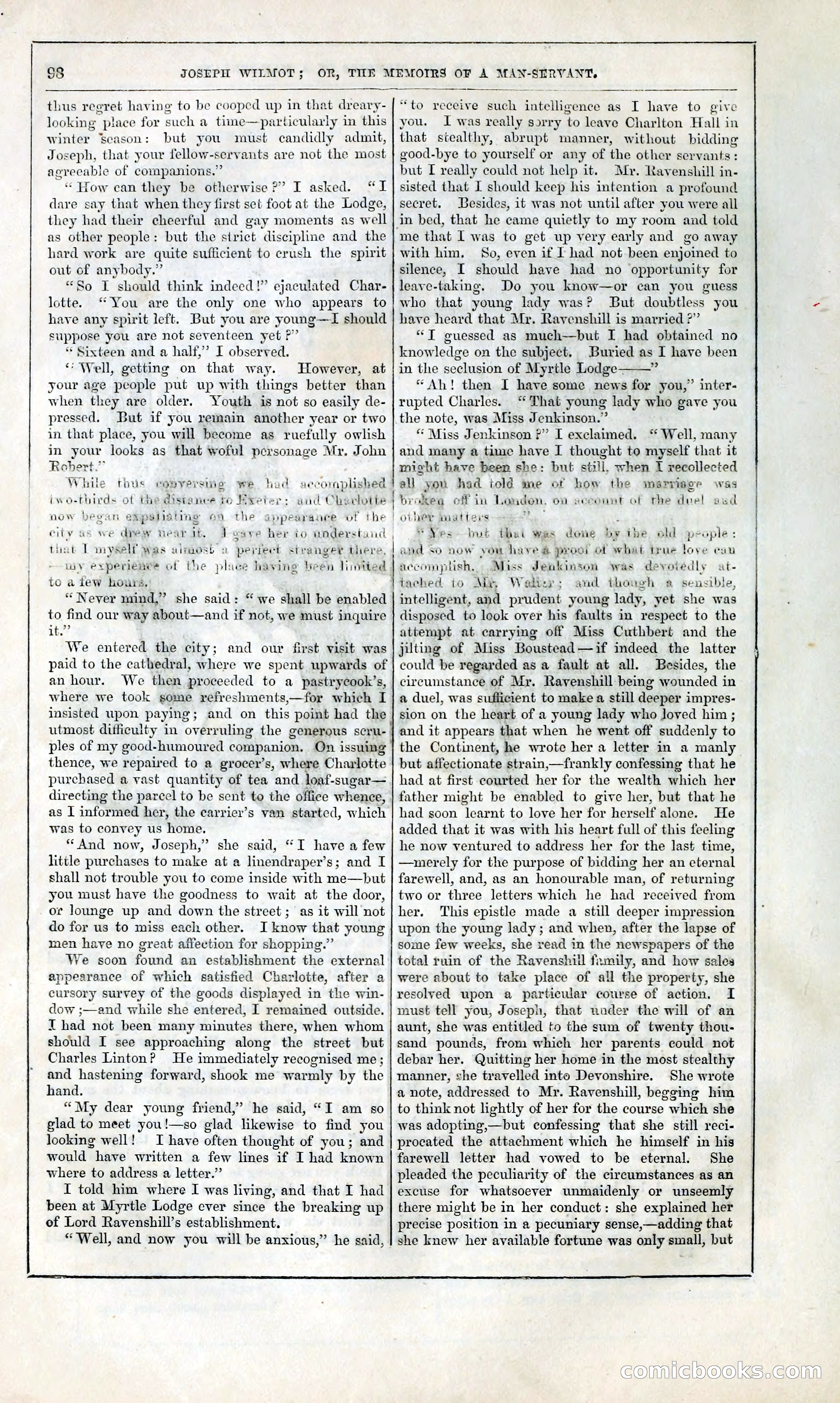
A restored page from Penny Dreadfuls, 1854. Page through the whole issue in the reader above.
📄 Transcribed text from this page (OCR, searchable)
Machine-transcribed from the original scan — historical spelling and the odd misread are preserved.
8 JOSEPH WILMOT ; thus reeret having to be cooped up in that dreary- looking place for such a time—particularly in this winter ‘Season: but you must candidly admit, Joseph, that your fellow-servants are not the most agreeable of companions.” “ How can they be otherwise?” I asked. “I dare say that when they first set foot at the Lodge, they had their cheerful and gay moments as well as other people: but the strict discipline and the hard work are quite sufficient to crush the spirit out of anybody.” “So 1 should think indecd!” ejaculated Char- lotte. “You are the only one who appears to have any spirit left. But you are young—I should suppose you are not seventeen yet P” * Sixteen and a half,’ I observed. “ Well, getting on that way. However, at your age people put up with things better than when they are older. Youth is not so easily de- pressed. But if you remain another year or two in that place, you will become as rucfully owlish in your looks as that woful personage Mr. John Robert.” While thus copyersuie we had oe OY apli shed iwo-thirds ot the distance to Ryreter: and Charlotte now began eapshialing an the Ippearance of the eity as we dpew near ib. | ose ner to nnderstand that Towiyself was ulmuosb a perect stranger there, Lib experience ot the plaee having Ween liintted to a tew hours. “ Never nnnd,” she said: “ we shall be enabled to find our way about—and if not, we must inquire it.” We entered the city; and our first visit was paid to the cathedral, where we spent upwards of an hour. We then proceeded to a pastrycook’s, where we took gome refreshments,—for which I insisted upon paying; and on this point had the utmost difficulty in overruling the generous scru- ples of my good-humoured companion. On issuing thence, we repaired to a grocer’s, where Charlotte purchased a vast quantity of tea and loaf-sugar— directing the parcel to be sent to the office whence, as 1 informed her, the carrier’s van started, which was to convey us home. “And now, Joseph,” she said, “I have a few little purchases to make at a linendraper’s; and I shall not trouble you to come inside with me—but you must have the goodness to wait at the door, orf lounge up and down the street ; as it will not do for us to miss each other. I know that young men have no great affection for shopping.” We soon found an establishment the external appearance of which satisfied Charlotte, after a cursory survey of the goods displayed in the win- dow ;—and while she entered, I remained outside. Thad not been many minutes there, when whom should I see approaching along the street but Charles Linton? He immediately recognised me; and hastening forward, shook me warmly by the hand. “My dear young friend,” he said, “I am so glad to meet you!—so glad likewise to find you looking well! I have often thought of you; and would have written a few lines if I had known where to address a letter.” I told him where I was living, and that I had been at Myrtle Lodge ever since the breaking up of Lord Ravenshill’s establishment. “Well, and now you will be anxious,” he said, OR, THE MEMOIRS OF A MAN-SERVANT,. “to receive such intelligence as I have to give you. J was really sorry to leave Charlton Hall in that stealthy, abrupt manner, without bidding good-bye to yourself or any of the other servants: but I really could not help it. Mo. Ravenshill in- sisted that I should keep his intention a profound secret. Besides, it was not until after you were all in bed, that he came quietly to my room and told me that I was to get up very early and go away with him. So, even if I had not been enjoined to silence, I should have had no opportunity for leave-taking. Do you know—or can you guess who that young lady was? But doubtless you have heard that Ma. Ravenshill is married ?” “JT cuessed as much—but I had obtained no knowledge on the subject. Buried as I have been in the seclusion of Myrtle Lodge——” “Ah! then I have some news for you,” inter- rupted Charles. “That young lady who gave you the note, was Miss Jenkinson.” “ Miss Jenkinson ?” I exclaimed. ‘ Well, many and many a time have I thought to myself that it might have been she: but still. when I recollected all you had told me or how the werriage was | broken of in London. On weoount of rhe duel aud | ot er matters | tached to Ain, W alter: "Nes but that was dove by the old people : and SO nOW Vou hia ve a proor ot what true love cau Miss Jenkinson was devotedly at- and though a sensible, intelligent, and prudent young lady, yet she was disposed to look over his faults in respect to the attempt at carrying off Miss Cuthbert and the julting of Miss Boustead—if indeed the latter could be regarded as a fault at all. Besides, the circumstance of Mr. Ravenshill being wounded in a duel, was sufficient to make a still deeper impres- sion on the heart of a young lady who Joved him ; and it appears that when he went off suddenly to the Continent, he wrote her a letter in a manly but affectionate strain,—frankly confessing that he had at first courted her for the wealth which her father might be enabled to give her, but that he had soon learnt to love her for herself alone. He added that it was with his heart full of this feeling he now ventured to address her for the last time, —nmnierely for the purpose of bidding her an eternal farewell, and, as an honourable man, of returning two or three letters which he had received from her. This epistle made a still deeper impression upon the young lady; and when, after the lapse of some few weeks, she read in the newspapers of the total ruin of the Ravenshill family, and how sales were about to take place of all the property, she resolyed upon a particular course of action. I must tell you, Joseph, that uader the will of an aunt, she was entitled to the sum of twenty thou- sand pounds, from which her parents could not debar her. Quitting her home in the most stealthy manner, she travelled into Devonshire. She wrote a note, addressed to Mr. Ravenshill, begging him to think not lightly of her for the course which she was adopting,—but confessing that she still reci- procated the attachment which he himself in his farewell letter had vowed to be eternal. She pleaded the peculiarity of the circumstances as an excuse for whatsoever unmaidenly or unseemly there might be in her conduct: she explained her precise position in a pecuniary sense,—adding that she knew her available fortune was only small, but aecomptish. ECORMCEOO@ c SS (c@)