
Penny Dreadfuls, 1895 · page 91 of 395
The Island School — page 91: what you’re looking at
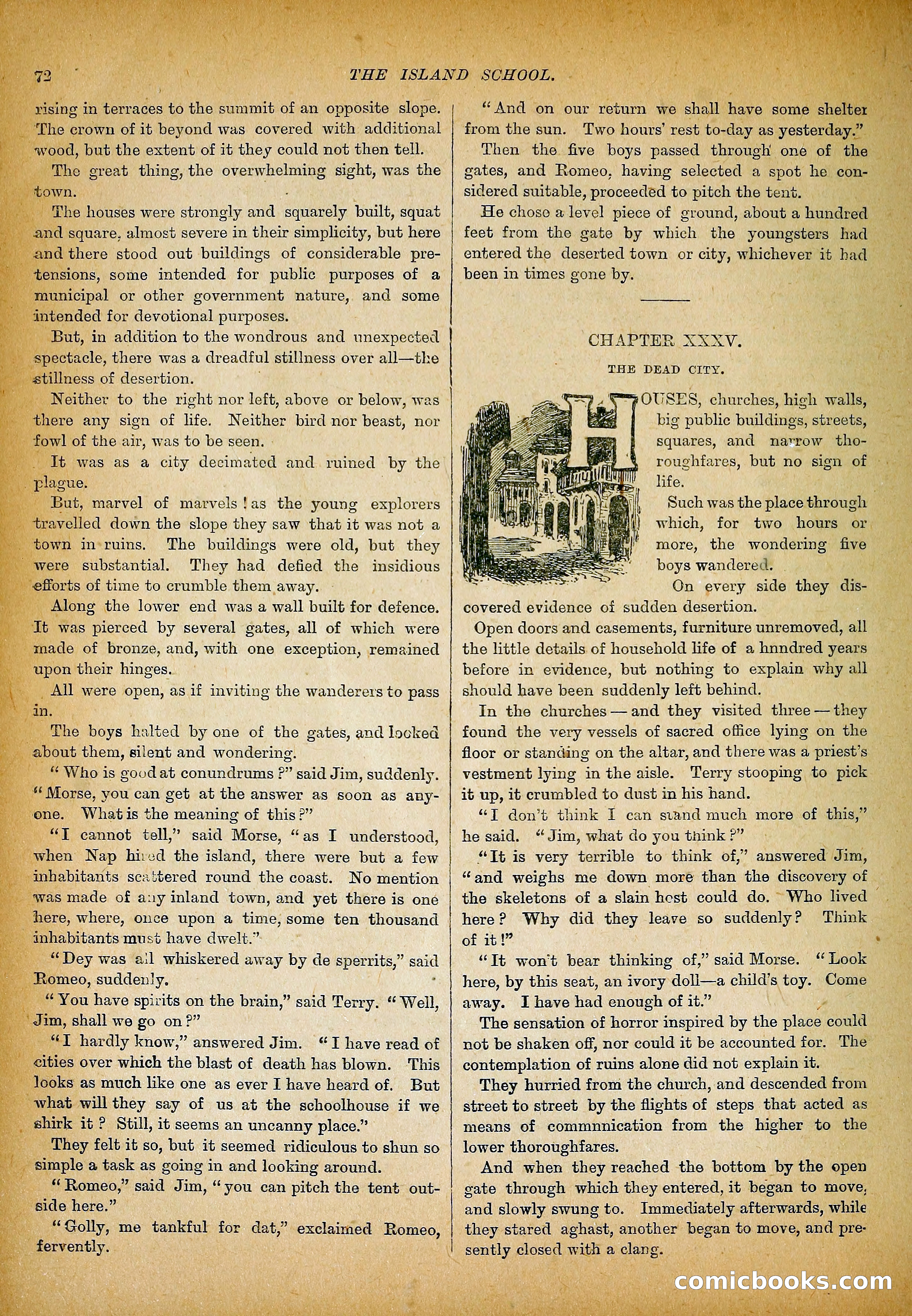
A restored page from Penny Dreadfuls, 1895. Page through the whole issue in the reader above.
📄 Transcribed text from this page (OCR, searchable)
Machine-transcribed from the original scan — historical spelling and the odd misread are preserved.
79 THE rising in terraces to the summit of an opposite slope. ‘The crown of it beyond was covered with additional wood, but the extent of it they could not then tell. The great thing, the overwhelming sight, was the town. The houses were strongly and seninely built, squat and square, almost severe in their simplicity, but here and there stood out buildings of considerable pre- tensions, some intended for public purposes of a municipal or other government nature, and some intended for devotional purposes. But, in addition to the wondrous and unexpected spectacle, there was a dr eadful stillness over all—the stillness of desertion. Neither to the right nor left, above or below, was there any sign of life. Neither bird nor beast, nor fowl of the air, was to be seen. It was as a city decimated and ruined by the plague. But, marvel of marvels!as the young explorers travelled down the slope they saw that it was not a town in-ruins. ‘The buildings were old, but they were substantial. They had defied the imsidious efforts of time to crumble them away. Along the lower end was a wall built for defence. Jt was pierced by several gates, all of which were made of bronze, and, with one exception, remained upon their hinges. All were open, as if inviting the wanderers to pass an. The boys halted by one of the gates, and locked about them, silent and wondering. “ Who is goodat conundrums ?” said Jim, suddenly. ‘Morse, you can get at the answer as soon as any- one. Whatis the meaning of this?” “T cannot tell,” said Morse, “as I understood, when Nap hired the island, there were but a few inhabitants scattered round the coast. No mention was made of any inland town, and yet there is one here, where, once upon a time, some ten thousand inhabitants must have dwelt.” “ Dey was a:l whiskered away by de sperrits,” said Romeo, suddenly, “You have spirits on the brain,” dim, shall we go on?” “T hardly know,” answered Jim. “I have read of cities over which the blast of death has blown. ‘This looks as much like one as ever I have heard of. But what will they say of us at the schoolhouse if we shirk 1? Still, it seems an uncanny place.” They felt it so, but it seemed ridiculous to shun so simple a task as going in and looking around. “Romeo,” said Jim, “you can pitch the tent out- side here.” “Golly, me tankful for dat,” exclaimed Romeo, fervently. said Terry. “ Well, ISLAND SCHOOL. “And on our return we shall have some shelter from the sun. Two hours’ rest to-day as yesterday.” Then the five boys passed through one of the gates, and Romeo, having selected a spot he con- sidered suitable, proceedéd to pitch the tent. He chose a level piece of ground, about a hundred feet from the gate by which the youngsters had entered the deserted town or city, whichever it had been in times gone by. CHAPTER XXXV. THE DEAD CITY. AOUSES, churches, high walls, big public buildings, streets, squares, and narrow tho- roughfares, but no sign of life. which, for two hours or more, the wondering five boys wandered. On every side they dis- covered evidence of sudden desertion. Open doors and casements, furniture unremoved, all the little details of household life of a hnndred years before in evidence, but nothing to explain why all should have been suddenly left behind. In the churches —and they visited three — they found the very vessels of sacred office lying on the floor or standing on the altar, and there was a priest’s vestment lying in the aisle. Terry stooping to pick it up, it crumbled to dust in his hand. “T don’t think I can siand much more of this,” he said. “Jim, what do you think ?” “Tt is very terrible to think of,’ answered Jim, “and weighs me down more than the discovery of the skeletons of a slain hest could do. here? Why did they leave so suddenly? of it!” “Tt won't bear thinking of,’ said Morse. “ Look here, by this seat, an ivory doll—a child's toy. Come away. Ihave had enough of 1t.” The sensation of horror inspired by the place could not be shaken off, nor could it be accounted for. The contemplation of ruins alone did not explain it. They hurried from the church, and descended from street to street by the flichts of steps that acted as means of commnnication from the higher to the lower thoroughfares. And when they reached the bottom by the open gate through which they entered, it began to move, and slowly swung to. Immediately afterwards, while they stared aghast, another began to move, and pre- sently closed with a clang. Think Such was the place through | Who lived > (Ol @ ) nN (Si 900 cS (ei @) mn