
Penny Dreadfuls, 1895 · page 71 of 395
The Island School — page 71: what you’re looking at
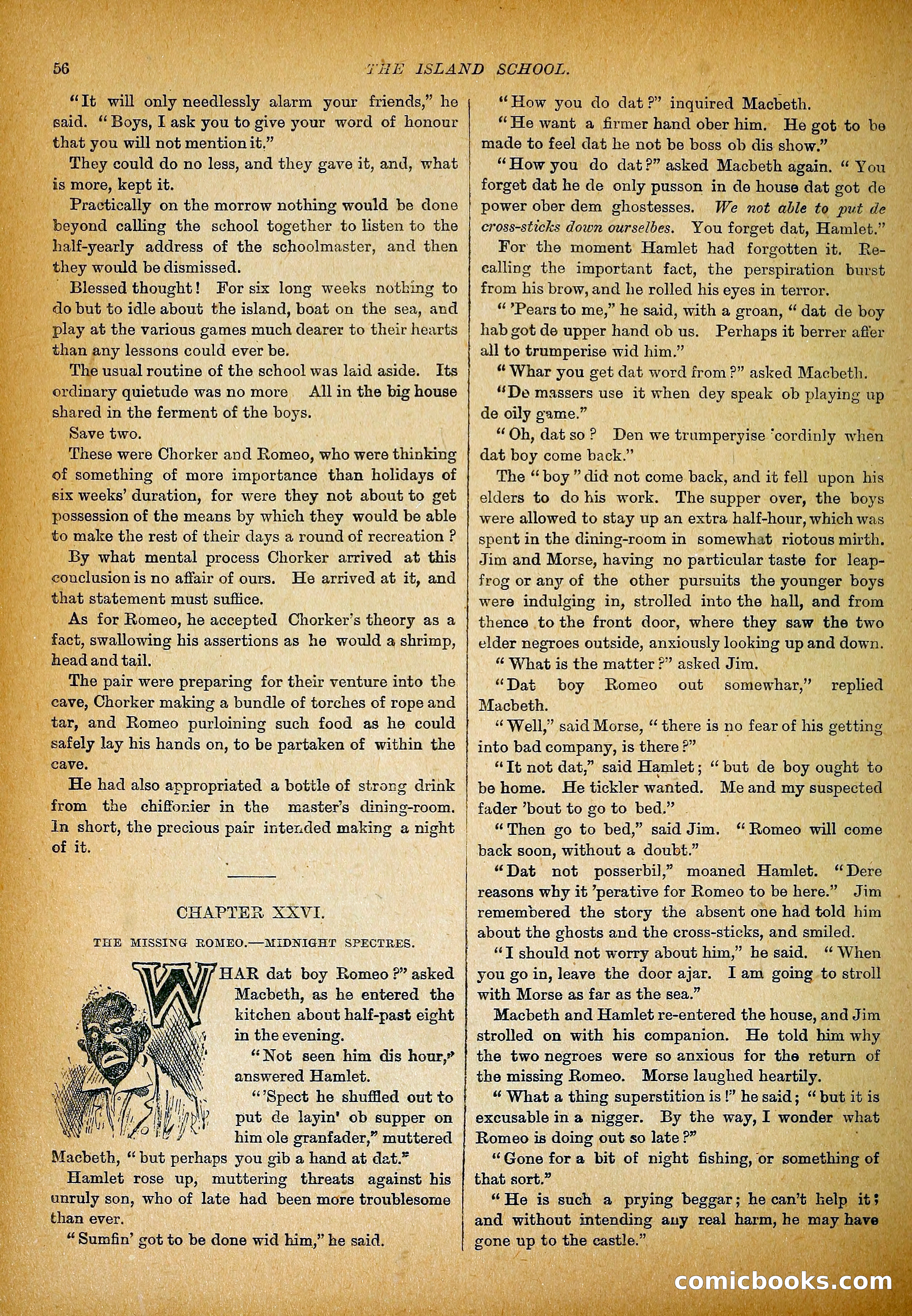
A restored page from Penny Dreadfuls, 1895. Page through the whole issue in the reader above.
📄 Transcribed text from this page (OCR, searchable)
Machine-transcribed from the original scan — historical spelling and the odd misread are preserved.
56 “Tt will only needlessly alarm your friends,” he said. “‘ Boys, L ask you to give your word of honour that you will not mention it.” They could do no less, and they gave it, and, what is more, kept it. Practically on the morrow nothing would be done beyond calling the school together to listen to the half-yearly address of the schoolmaster, and then they would be dismissed. Blessed thought! For six long weeks nothing to do but to idle about the island, boat on the sea, and play at the various games much dearer to their hearts than any lessons could ever be. The usual routine of the school was laid aside. Its ordinary quietude was no more. Allin the big house shared in the ferment of the boys. Save two. These were Chorker and Romeo, who were thinking of something of more importance than holidays of six weeks’ duration, for were they not about to get possession of the means by which they would be able to make the rest of their days a round of recreation P By what mental process Chorker arrived at this conclusion is no affair of ours. He arrived at it, and that statement must suftice. As for Romeo, he accepted Chorker’s theory as a fact, swallowing his assertions as he would a shrimp, head and tail. The pair were preparing for their venture into the eave, Chorker making a bundle of torches of rope and tar, and Romeo purloining such food as he could safely lay his hands on, to be partaken of within the cave. He had also appropriated a botile of strong drink from the chiffonier in the master’s dining-room. in short, the precious pair intended making a night of it. CHAPTHR XXXVI. THE MISSING ROMEO.—MIDNIGHT SPECTRES. Wf HAR dat boy Romeo ?” asked ) Macbeth, as he entered the kitchen about half-past eight in the evening. “Not seen him dis hour,” answered Hamlet. “*Spect he shuffled out to put de layin’ ob supper on him ole granfader,” muttered Macbeth, “ “but perhaps you gib a hand at dat.” Hamlet rose up, muttering threats against his unruly son, who of late had been more troublesome than ever. “Sumfin’ got to be done wid him,” he said. A gna SHE ISLAND SCHOOL. “How you do dat?” inquired Macbeth. “He want a firmer hand ober him. He got to be made to feel dat he not be boss ob dis show.” ‘““How you do dat?” asked Macbeth again. “ You forget dat he de only pusson in de house dat got de power ober dem ghostesses. We not able to put de cross-sticks down ourselbes. You forget dat, Hamlet.” For the moment Hamlet had forgotten it. Re- calling the important fact, the perspiration burst from his brow, and he rolled his eyes in terror, “Pears to me,” he said, with a groan, “ dat de boy hab got de upper hand ob us. Perhaps it berrer after all to trumperise wid him.” “ Whar you get dat word from ?” asked Macbeth. ‘‘De massers use it when dey speak ob playing up de oily game.” “Oh, dat so? Den we trumperyise ‘cordinly when dat boy come back.” | The “boy ” did not come back, and it fell upon his elders to do his work. The supper over, the boys were allowed to stay up an extra half-hour, which was spent in the dining-room in somewhat riotous mirth. Jim and Morse, having no particular taste for leap- frog or any of the other pursuits the younger boys were indulging in, strolled into the hall, and from thence to the front door, where they saw the two elder negroes outside, anxiously looking up and down. What is the matter?” asked Jim. “Dat boy Romeo out somewhar,” replied Macbeth. “Well,” said Morse, ‘“ there is no fear of his getting into bad company, is there Pr” “Tt not dat,” said Hamlet; “but de boy ought to be home. He tickler wanted. Meand my suspected fader ’bout to go to bed.” . “Then go to bed,” said Jim. back soon, without a doubt.” “Dat not posserbil,” moaned Hamlet. ‘ Dere reasons why it ’perative for Romeo to be here.” Jim remembered the story the absent one had told him about the ghosts and the cross-sticks, and smiled. “T should not worry about him,” he said. “ When you go in, leave the doorajar. Iam going to stroll with Morse as far as the sea.” Macbeth and Hamlet re-entered the house, and Jim strolled on with his companion. He told him why the two negroes were so anxious for the return of the missing Romeo. Morse laughed heartily. “What a thing superstition is!” he said; “but 1 is excusable in a nigger. By the way, I werndee what Romeo is doing out so late ?” “Gone fora bit of night fishing, or something of that sort.” “ He is such a prying beggar; he can’t kelp its and without mtending any real harm, he may have — gone up to the castle.” | * Romeo will come ( I @ ) ; e F oe i ' J ast . , a Ph r 5, ” i by Pi, v , Ns ’ i dik ne a 7 s ; r Wey, a st TU) eer ee ’ TAS Va ( tt 1 ' : ure eke sty - Tact hey! al Ope aie rat Ne Sa att hauls) ; i ‘