
Penny Dreadfuls, 1895 · page 40 of 395
The Island School — page 40: what you’re looking at
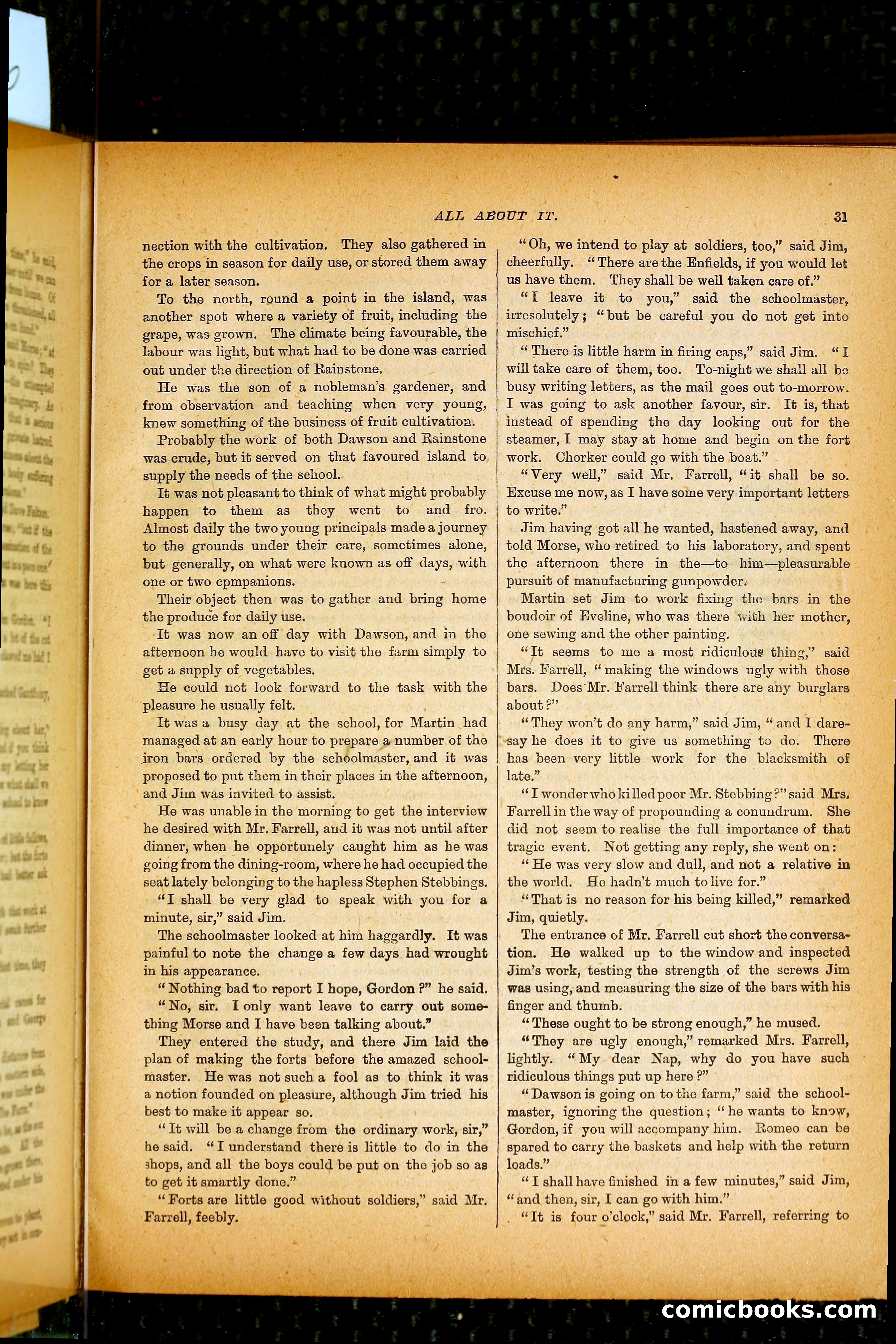
A restored page from Penny Dreadfuls, 1895. Page through the whole issue in the reader above.
📄 Transcribed text from this page (OCR, searchable)
Machine-transcribed from the original scan — historical spelling and the odd misread are preserved.
ALL ABOUT IT. nection with the cultivation. They also gathered in the crops in season for daily use, or stored them away for a later season. To the north, round a point in the island, was another spot where a variety of fruit, including the grape, was grown. ‘The climate being favourable, the labour was light, but what had to be done was carried out under the direction of Rainstone. He was the son of a nobleman’s gardener, and from observation and teaching when very young, knew something of the business of fruit cultivation. Probably the work of both Dawson and HKainstone was crude, but it served on that favoured island to supply the needs of the school. It was not pleasant to think of what might probably happen to them as they went to and_ fro. Almost daily the two young principals made a journey to the grounds under their care, sometimes alone, but generally, on what were known as off days, with one or two cpmpanions. Their object then was to gather and bring home the produce for daily use. It was now anofi day with Dawson, and in the afternoon he would have to visit the farm simply to get a supply of vegetables. He could not look forward to the task with the pleasure he usually felt. It was a busy day at the school, for Martin had managed at an early hour to prepare a number of the iron bars ordered by the schoolmaster, and it was proposed to put them in their places in the afternoon, and Jim was invited to assist. He was unable in the morning to get the interview he desired with Mr. Farrell, and it was not until after dinner, when he opportunely caught him as he was going from the dining-room, where he had occupied the seat lately belonging to the hapless Stephen Stebbings. “YT shall be very glad to speak with you for a minute, sir,” said Jim. The schoolmaster looked at him haggardly. It was painful to note the change a few days had wrought in his appearance. “ Nothing bad to report I hope, Gordon ?” he said. “No, sir. LIonly want leave to carry out some- thing Morse and I have been talking about.” They entered the study, and there Jim laid the plan of making the forts before the amazed school- master. He was not sucha fool as to think it was a notion founded on pleasure, although Jim tried his best to make it appear so. “It will be a change from the ordinary work, sir,” he said. “I understand there is little to do in the shops, and all the boys could be put on the job so ag to get it smartly done.” “Forts are little good without soldiers,” said Mr. Farrell, feebly. rn ol “Oh, we intend to play at soldiers, too,” said Jim, cheerfully. ‘There arethe Enfields, if you would let us have them. ‘They shall be well taken care of.” “YT leave it to you,” said the schoolmaster, irresolutely ; “but be careful you do not get into mischief.” “There is little harm in firing caps,” said Jim. “I will take care of them, too. To-night we shall all be busy writing letters, as the mail goes out to-morrow. I was going to ask another favour, sir. It is, that instead of spending the day looking out for the steamer, I may stay at home and begin on the fort work. Chorker could go with the boat.” “Very well,” said Mr. Farrell, “it shall be so. Excuse me now, as I have some very important letters to write.” Jim having got all he wanted, hastened away, and told Morse, who retired to his laboratory, and spent the afternoon there in the—to him-—pleasurable pursuit of manufacturing gunpowder. Martin set Jim to work fixing the bars in the boudoir of Eveline, who was there with her mother, one sewing and the other painting. “Tt seems to me a most ridiculows thing,” said Mrs. Farrell, “making the windows ugly with those bars. Does’Mr. Farrell think there are any burglars about ?” “They won’t do any harm,” said Jim, ‘“ and I dare- say he does it to give us something to do. There has been very little work for the blacksmith of late.” | “T wonderwho killed poor Mr. Stebbing?” said Mrs, Farrell in the way of propounding a conundrum. She did not seem to realise the full importance of that tragic event. Not getting any reply, she went on: ‘¢ He was very slow and dull, and not a relative im the world. He hadn’t much tolive for.” “That is no reason for his being killed,” remarked Jim, quietly. The entrance of Mr. Farrell cut short the conversa- tion. He walked up to the window and inspected Jim’s work, testing the strength of the screws Jim was using, and measuring the size of the bars with his finger and thumb. “These ought to be strong enough,” he mused. “They are ugly enough,” remarked Mrs. Farrell, lichtly. ‘My dear Nap, why do you have such ridiculous things put up here P” “Dawson is going on tothe farm,” said the school- master, ignoring the question; “‘he wants to know, Gordon, if you will accompany him. Itomeo can be spared to carry the baskets and help with the return loads.” “T shall have finished in a few minutes,” said Jim, “and then, sir, [ can go with him.” “Tt is four o’clock,” said Mr. Farrell, referring to comicbooks.com