
Penny Dreadfuls, 1895 · page 35 of 395
The Island School — page 35: what you’re looking at
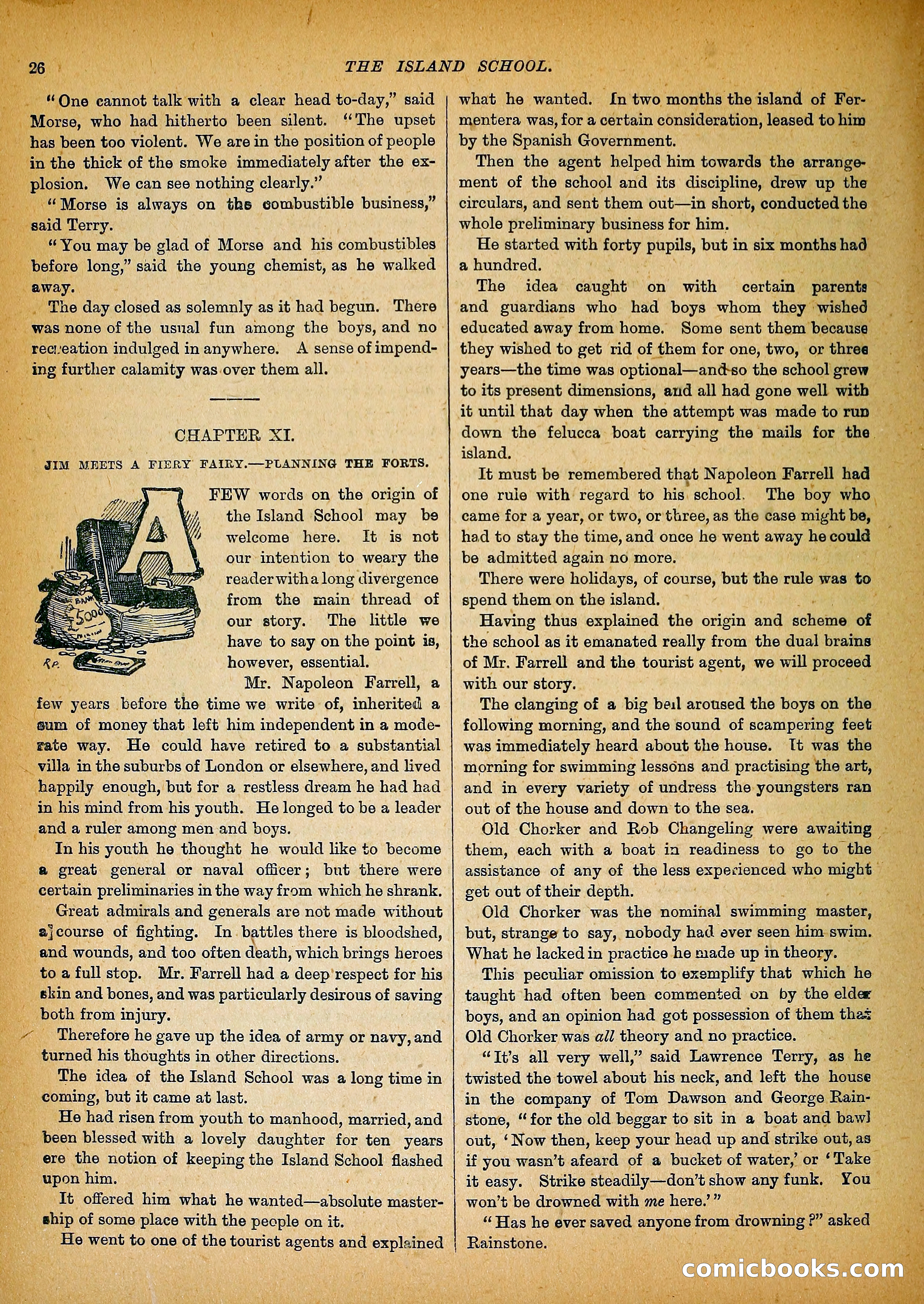
A restored page from Penny Dreadfuls, 1895. Page through the whole issue in the reader above.
📄 Transcribed text from this page (OCR, searchable)
Machine-transcribed from the original scan — historical spelling and the odd misread are preserved.
26 THE ISLAND «One cannot talk with a clear head to-day,” said Morse, who had hitherto been silent. ‘The upset has been too violent. We are in the position of people in the thick of the smoke immediately after the ex- plosion. We can see nothing clearly.” “Morse is always on ths combustible business,” said Terry. ‘You may be glad of Morse and his combustibles before long,” said the young chemist, as he walked away. The day closed as solemnly as it had begun. There was none of the usual fun among the boys, and no receation indulged in anywhere. A sense of impend- ing further calamity was over them all. ee ae ee ee CHAPTER XI. JIM MBETS A FIERY FAIRY.—PUANNING THE FORTS. ? EFEW words on the origin of 4 the Island School may be welcome here. It is not our intention to weary the reader witha long civergence from the main thread of our story. The little we have to say on the point is, however, essential. Mr. Napoleon Farrell, a few years before the time we write of, inherited a sum of money that left him independent in a mode- rate way. He could have retired to a substantial villa in the suburbs of London or elsewhere, and lived happily enough, but for a restless dream he had had in his mind from his youth. He longed to be a leader and a ruler among men and boys. In his youth he thought he would like to become @ great general or naval officer; but there were certain preliminaries in the way from which he shrank. Great admirals and generals are not made without ajcourse of fighting. In battles there is bloodshed, and wounds, and too often death, which brings heroes to afull stop. Mr. Farrell had a deep'respect for his sin and bones, and was particularly desirous of saving both from injury. Therefore he gave up the idea of army or navy, and turned his thoughts in other directions. The idea of the Island School was a long time in coming, but it came at last. He had risen from youth to manhood, married, and been blessed with a lovely daughter for ten years ere the notion of keeping the Island School flashed upon him. It offered him what he un hod aban master- ship of some place with the pecple on it. He went to one of the tourist agents and explained SCHOOL. what he wanted. Im two months the island of Fer- mentera was, for a certain consideration, leased to him by the Spanish Government. Then the agent helped him towards the arrange- ment of the school and its discipline, drew up the circulars, and sent them out—in short, conducted the whole preliminary business for him. He started with forty pupils, but in six months had a hundred. The idea caught on with certain parents and guardians who had boys whom they wished educated away from home. Some sent them because they wished to get rid of them for one, two, or three years—the time was optional—andso the school grew to its present dimensions, and all had gone well with it until that day when the attempt was made to run down the felucca boat carrying the mails for the island. It must be remembered that Napoleon Farrell had one rule with regard to his. school. came for a year, or two, or three, as the case might be, had to stay the time, and once he went away he could be admitted again no more. There were holidays, of course, but the le was to spend them on the island. Having thus explained the origin and scheme of the school as it emanated really from the dual brains of Mr. Farrell and the tourist agent, we will proceed with our story. The clanging of a big be:l aroused the boys on the following morning, and the sound of scampering feet was immediately heard about the house. It was the morning for swimming lessons and practising the art, and in every variety of undress the youngsters ran out of the house and down to the sea. Old Chorker and Rob Changeling were awaiting them, each with a boat in readiness to go to the assistance of any of the less experienced who might — set out of their depth. Old Chorker was the nominal swimming master, but, strange to say, nobody had ever seen him swim. What he lacked in practice he made up in theory. This peculiar omission to exemplify that which he taught had often been commented on by the elder boys, and an opinion had got possession of them thas Old Chorker was ald theory and no practice. “Tt’s all very well,” said Lawrence Terry, as he twisted the towel about his neck, and left the house in the company of Tom Dawson and George Rain- stone, “for the old beggar to sit in a boat and baw! out, ‘Now then, keep your head up and strike out, as if you wasn’t afeard of a bucket of water, or ‘Take it easy. Strike steadily—don’t show any funk. You won’t be drowned with me here.’ ” ‘Has he ever saved anyone from drowning ?” asked Rainstone. The boy who. comicboo ~S.co