
Penny Dreadfuls, 1895 · page 164 of 395
The Island School — page 164: what you’re looking at
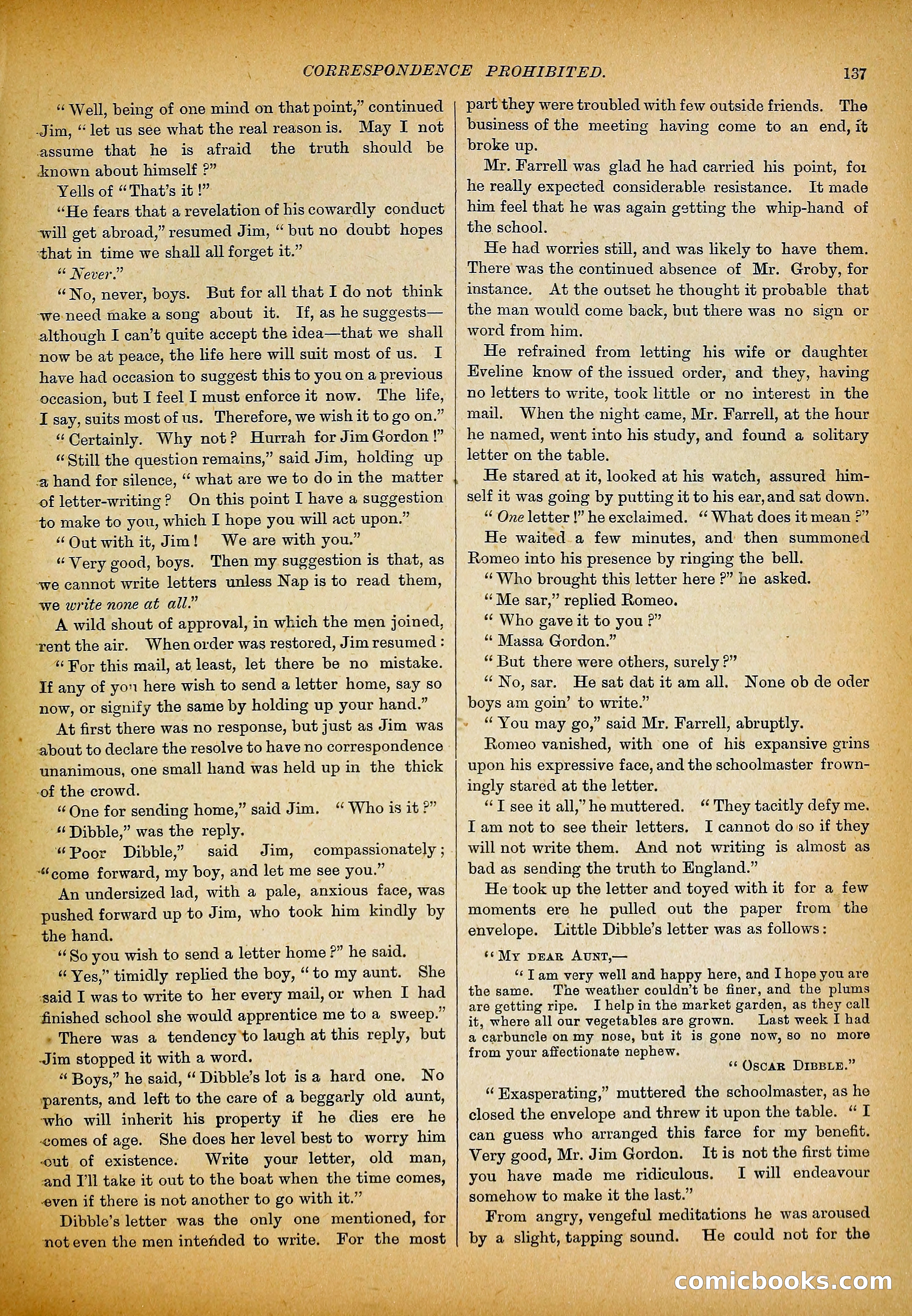
A restored page from Penny Dreadfuls, 1895. Page through the whole issue in the reader above.
📄 Transcribed text from this page (OCR, searchable)
Machine-transcribed from the original scan — historical spelling and the odd misread are preserved.
4 ‘rent the air. CORRESPONDENCE PROHIBITED. “Well, being of one mind on that point,” continued Jim, ‘“ let us see what the real reasonis. May I not assume that he is afraid the truth should be _ dgnown about himself ?” Yells of “That’s it !” ‘He fears that a revelation of hiscowardly conduct will get abroad,” resumed Jim, “but no doubt hopes that in time we shall all forget it.” *¢ Never.” “No, never, boys. But for all that Ido not think weneed make a song about it. If, as he suggests— although I can’t quite accept the idea—that we shall now be at peace, the life here will suit most of us. I have had occasion to suggest this to you on a previous occasion, but I feel I must enforce it now. The life, I say, suits most of us. Therefore, we wish it to go on.” “ Certainly. Why not? Hurrah for Jim Gordon !” “Still the question remains,” said Jim, holding up , hand for silence, “‘ what are we to do in the matter of letter-writing? On this point I have a suggestion to make to you, which I hope you will act upon.” ‘ Out with it, Jim! We are with you.” “ Very good, boys. Then my suggestion is that, as “ve cannot write letters unless Nap is to read them, we write none at all.” A wild shout of approval, in which the men joined, When order was restored, Jim resumed : ‘For this mail, at least, let there be no mistake. Tf any of yon here wish to send a letter home, say so now, or signify the same by holding up your hand.” At first there was no response, but just as Jim was about to declare the resolve to have no correspondence unanimous, one small hand was held up in the thick of the crowd. “One for sending home,” said Jim. ‘ Who is it ?” ‘‘ Dibble,” was the reply. “Poor Dibble,” said compassionately ; Jim, ‘come forward, my boy, and let me see you.” An undersized lad, with a pale, anxious face, was pushed forward up to Jim, who took him kindly by the hand. “So you wish to send a letter home ?” he said. “Yes,” timidly replied the boy, “to my aunt. She said I was to write to her every mail, or when I had finished school she would apprentice me to a sweep.” There was a tendency to laugh at this reply, but Jim stopped it with a word. “ Boys,” he said, “ Dibble’s lot isa hard one. No parents, and left to the care of a beggarly old aunt, who will inherit his property if he dies ere he comes of age. She does her level best to worry him out of existence. Write your letter, old man, and Ill take it out to the boat when the time comes, even if there is not another to go with it.” Dibble’s letter was the only one mentioned, for noteven the men intehded to write. For the most A bi) 2 ¥ z 7~ + ; 137 part they were troubled with few outside friends. The business of the meeting having come to an end, it broke up. Mr. Farrell was glad he had carried his point, for he really expected considerable resistance. It made him feel that he was again getting the whip-hand of the school. He had worries still, and was likely to have them. There was the continued absence of Mr. Groby, for instance. At the outset he thought it probable that the man would come back, but there was no sign or word from him. | He refrained from letting his wife or daughter Eveline know of the issued order, and they, having no letters to write, took little or no interest in the mail, When the night came, Mr. Farrell, at the hour he named, went into his study, and found a solitary letter on the table. He stared at it, looked at his watch, assured him- self it was going by putting it to his ear,and sat down. “One letter !” he exclaimed. ‘ What does it mean P” He waited a few minutes, and then summoned Romeo into his presence by ringing the bell. “Who brought this letter here ?” he asked. ‘Me sar,” replied Romeo. “‘ Who gave it to you ?” “ Massa Gordon.” ** But there were others, surely ?” *‘ No, sar. He sat dat it am all. boys am goin’ to write.” “You may go,” said Mr, Farrell, abruptly. Romeo vanished, with one of his expansive grins upon his expressive face, and the schoolmaster frown- ingly stared at the letter. “T see it all,” he muttered. IT am not to see their letters. None ob de oder “They tacitly defy me. I cannot do so if they will not write them. And not writing is almost as bad as sending the truth to England.” He took up the letter and toyed with it for a few moments ere he pulled out the paper from the envelope. Little Dibble’s letter was as follows: ‘¢My DEAR AUNT,— ‘¢T am very well and happy here, and I hope you are the same. The weather couldn't be finer, and the plums are getting ripe. I helpin the market garden, as they call it, where all our vegetables are grown. Last week I had a carbuncle on my nose, but it 1s gone now, 80 no more from your affectionate nephew. ‘Oscar DIBBLE.” “ Exasperating,” muttered the schoolmaster, as he closed the envelope and threw it upon the table. “I can guess who arranged this farce for my benefit. Very good, Mr. Jim Gordon. It is not the first time you have made me ridiculous. I will endeavour somehow to make it the last.” From angry, vengeful meditations he was aroused by a slight, tapping sound. He could not for the Q com 900 455 co