
Penny Dreadfuls, 1900 · page 86 of 270
In Barracks and Wigwam — page 86: what you’re looking at
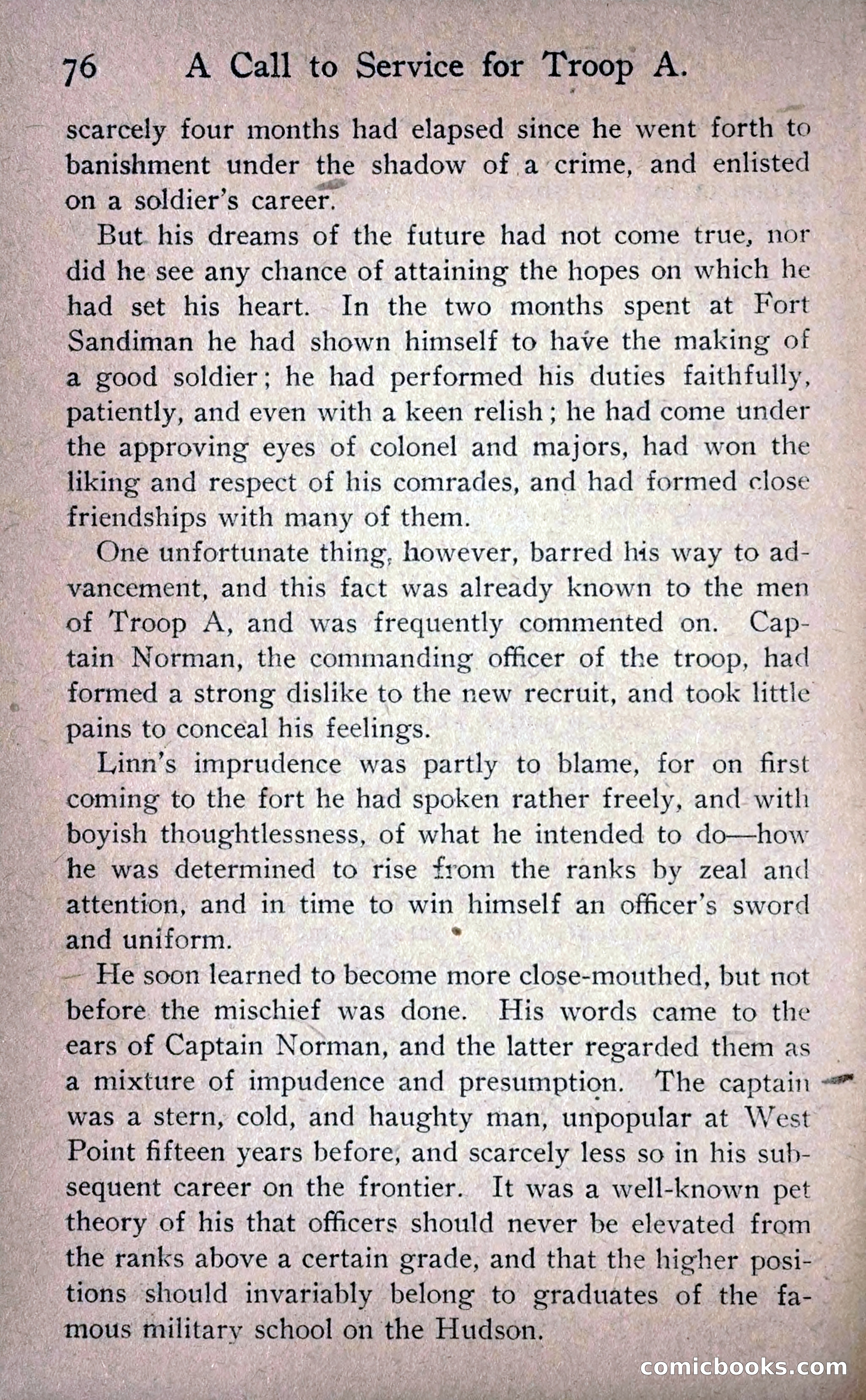
A restored page from Penny Dreadfuls, 1900. Page through the whole issue in the reader above.
📄 Transcribed text from this page (OCR, searchable)
Machine-transcribed from the original scan — historical spelling and the odd misread are preserved.
— ~ 76 A Call to Service for Troop A. scarcely four months had elapsed since he went forth to banishment under the shadow of a’crime, and enlisted ona soldier’s career, But his dreams of the future had not come true, nor did he see any chance of attaining the hopes on which he had set his heart. In the two months spent at Fort Sandiman he had shown himself to have the making of a good soldier; he had performed his duties faithfully, patiently, and even with a keen relish; he had come under _ the approving eyes of colonel and majors, had won the liking and respect of his comrades, and had formed close friendships with many of them. | One unfortunate thing, however, barred his way to ad- vancement, and this fact was already known to the men of Troop A, and was frequently commented on. Cap- tain Norman, the commanding officer of the troop, had _tormed a strong dislike to the new recruit, and took little _ pains to conceal his feelings. Linn’s imprudence was partly to blame, for on first coming to the fort he had spoken rather freely, and with boyish thoughtlessness, of what he intended to do—how he was determined to rise from the ranks by zeal and ‘attention, and in time to win himself an officer’s sword and uniform. | — He soon learned to become more close-mouthed, but not before the mischief was done. His words came to the ears of Captain Norman, and the latter regarded them as a mixture of impudence and presumption. The captain was a stern, cold, and haughty man, unpopular at West Point fifteen years before, and scarcely less so in his sub- sequent career on the frontier. It was a well-known pet theory of his that officers should never be elevated from _ the ranks above a certain grade, and that the higher posi- tions ‘should invariably belong to graduates of the fa- ) mous military school on ae Hudson, “com cboo e} Me ' a "FS ‘i byt ° 4 \ : , ee AAO of oie : FAS Rane | OMA on LD Sree SD ee pan a bi cae Sh ke ENG SPR