
Penny Dreadfuls, 1846 · page 90 of 399
The Mysteries of London, Vol. IV — page 90: what you’re looking at
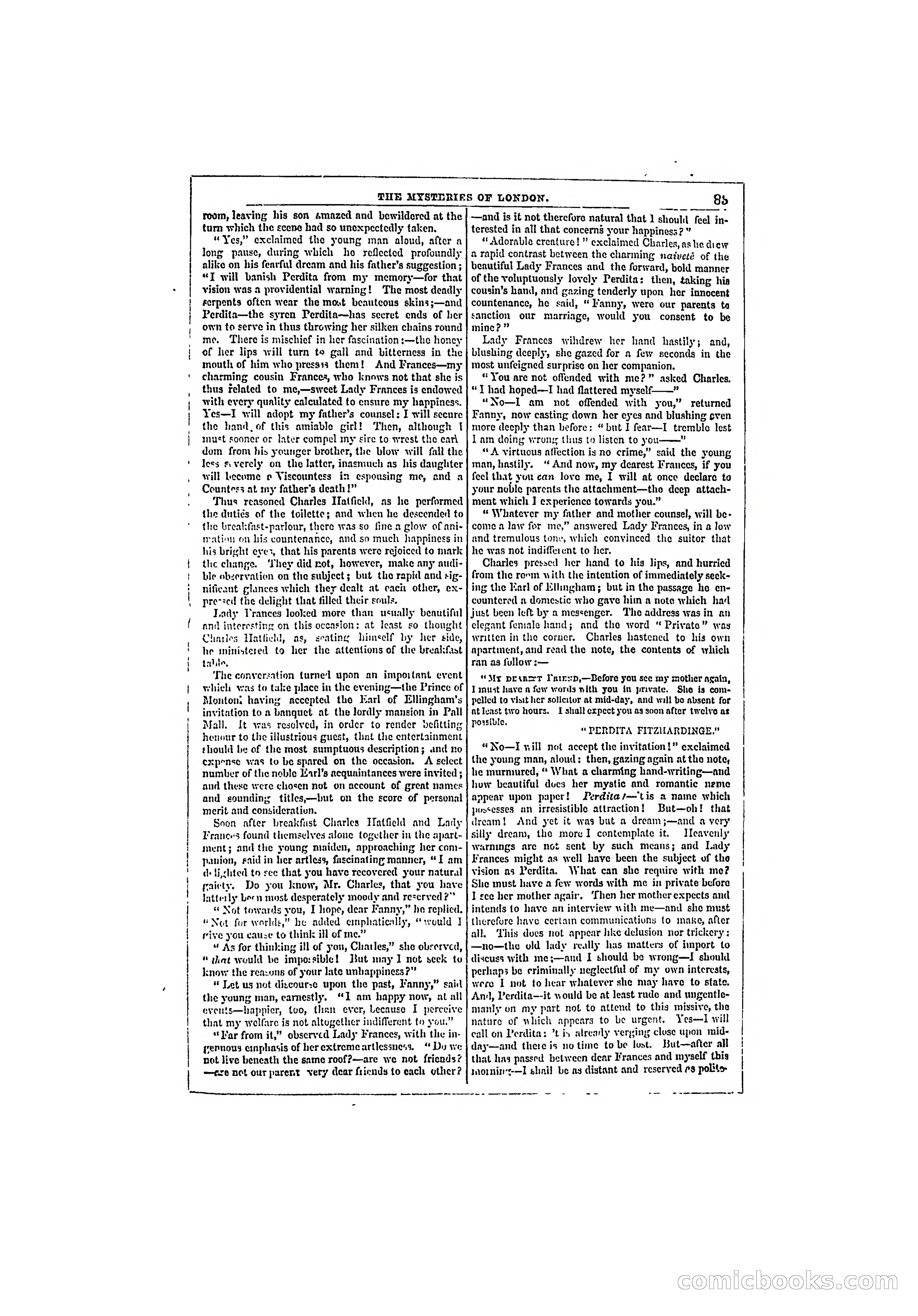
A restored page from Penny Dreadfuls, 1846. Page through the whole issue in the reader above.
📄 Transcribed text from this page (OCR, searchable)
Machine-transcribed from the original scan — historical spelling and the odd misread are preserved.
a ee ce a uaa =—— ae oe woe emenitictgy Serer Aa AL El VEE STR RT re PR ym eR oy A rc a i RNa a een gl LAP TEFEN NCES | ES EE OT EO NS cr ee - -——- —— ne eee on THE MYSTERIES OF LONDON. room, leaving his son amazed and bewildered at the turn which the scene had so unexpectedly taken. “Yes,” exclaimed the young man aloud, after a Jong panse, during which he reflected profoundly alike on his fearful dream and his father’s suggestion ; “J will banish Perdita from my memory—for that Vision was 2 providential warning! The most deadly Ferpents often wear the most beautcous skins ;—and Perdita—the syren Perdita~has secret ends of her own fo serve in thus throwing her silken chains round me. There is mischief in her fascination :—the honey of her lips will turn to gall and bitterness in the mouth of him who press13 them! And Franeces—my charming cousin Frances, who knows not that she is thus related to me,—sweet Lady Frances is endowed with every quality calculated to ensure my happiness. Yes—I will adopt my father’s counsel: I will secure the hand_of this amiable girl! Then, although I must sooner or later compel iny sire to wrest the car dom from his younger brother, the blow will fall the less s.verely on the latter, inasmuch as his daughter will become o Viscountess in espousing me, and a Countess at my father’s death!” Thus reasoned Charles Hatficld, as he performed the dutiés of the tcilette; and when he deseender to the brealifnst-parlour, there was so fine a glow of ani- mation on his countenance, and so much happiness in his bright eves, that his parents were rejoiced to mark the change. They did rot, however, make any audi- ble observation on the subject; but tho rapid and sig- nificant glances which they dealt at cach other, ex- pre-scd the delight that filled their souls. Lady Trances looked more than usually beautiful and interesting on this occasion: at Teast so thought Charles Hatlicld, as, seating himeelf by her side, he ministered to her the attentions of the breakfast tale, The converzation turnel upon an important event which was to take place in the evening—the Prince of Montom having accepted the Earl of Ellingham’s invitation to a banquet at the lordly mansion in Pall Mall. It was resolved, in order to render befitting henour to the illustrious guest, that the entertainment should be of the most sumptuous description; and no expense was to be spared on the occasion. <A select number of the neble Larl’s acquaintances were invited ; and these were chosen not on account of great namcs and soundiny titles,—but on the score of personal merit and considerativn. Soon after breakfast Charles Watfield and Lady Frances found themselves alone together ii the apart- ment; and the young niaiden, approaching her com- panion, said in her artless, fascinating manner, “I am de lihted to sce that you have recovered your natural gaicty. Do you know, Mr. Charles, that you have latterly been most desperately moody and reserved ?” Not towards you, I hope, dear Fanny,” he replied. “Nat for worlds,” be added emphatically, “would J rive you cause to think il of me.” “ As for thinking ill of you, Cliatles,” she obrerycd, “that would be impossible! But may I] not seck to know the reazuns of your late unhappiness?” “ Let us not discourse upon the past, anny,” said the young man, eamestly. “I am happy now, at all evonts—happicr, too, than ever, Lecause I perceive that my welfare is not altogether indifferent to you.” “Var from it,” observed Lady Frances, with the in- renuous einphasis of herextremeartlessness. “ Du we not live beneath the same roof?—are we not fricnds? —er0 net our parent very dear friends to each other? Sn 85 —and is it not therefore natural that 1 shoul feel in- terested in all that concerns your happiness?” “Adorable creature!” exclaimed Charles, as he diew a rapid contrast between the charming naiueté of the beautiful Lady Frances and the forward, bold manner of the voluptuously lovely Perdita: then, taking hia cousin’s hand, and gazing tenderly upon her innocent countenance, he said, “ Fanny, were our parents ta sanction our marriage, would you consent to be mine?” Lady Frances wihdrew her hand hastily; and, blushing deeply, she gazed for a few seconds in the most unfeigned surprise on her companion. * You are not offended with me?” asked Charles. “Thad hoped—TI had flattered myself——” “No—I am not offended with you,” returned Fanny, now casting down her cyes and blushing even more deeply than before: “but I fear—I tremble lest Jam doing wrong thus to listen to you———” “A virtuous affection is no crime,” said the young man, hastily. ‘‘ And now, my dearest Frances, if you fecl that you can love me, I will at once declare to your noble parents the attachment—the deep attach- ment which I expericnce towards you.” Whatever my father and mother counsel, will be- come a law for me,” answered Lady Frances, in a low and tremulous tone, which conyinced the suitor that he was not indifferent to her. Charles pressc:l her hand to his lips, and hurried from the room with the intention of immediately seck- ing the Marl of Ellingham; but in the passage he en- countered a domestic who gave him a note which had just been left by a messenger. The address was in an elegant female hand; and the word “ Private” was written in the corner. Charles hastened to his own apartment, aud read the note, the contents of which ran as fullow s— “My pranctT Fraresp,—Before you see my snother again, I must have a few words pith you in private. She is come pelicd to visit her solicitor at mid-day, and will be absent for atlvast two hours. I shall expect you as soon after twelve as possible, “PERNDITA FITZUARDINGE.” “*No—I will not accept the invitation!” exclaimed the young man, aloud: then, gazing again at tho note, he murmured, “ What a charming hand-writing—and how beautiful duces her mystic and romantic neme appear upon paper! Perdita/—tis a name which possesses an irresistible attraction! But—oh! that dream! And yet it was but a dream;—and a very silly dream, the more 1 contemplate it. Heavenly warnings are not sent by such means; and Lady Frances might as well have been the subject of tho vision as Perdita. What can she require with me? She must have a few words with me in private before I sce her mother agair. ‘Then her mother expects and intends to haye an interview with me—and she must therefore have certain communications to make, after all, his dees not appear ke delusion nor trickery ; —no—the old lady really has matters of import to discuss with me;—and I should be wrong—I should perhaps be criminally neglectful of my own interests, were I not to hear whatever she may have to state. And, Perdita—-it would be at least rude and ungentle- manly on my part not to attend to this missive, the nature of which appears to be urgent. Yes—I will call on Pordita: ’t is already verging close upon mid- day—and there is no time tobe lust. But—after all that has passed between dear Frances and myself this mornins-—I shail be as distant and reserved es polits- (C(O) (C DOO <S LL (SO)