
Penny Dreadfuls, 1846 · page 81 of 399
The Mysteries of London, Vol. IV — page 81: what you’re looking at
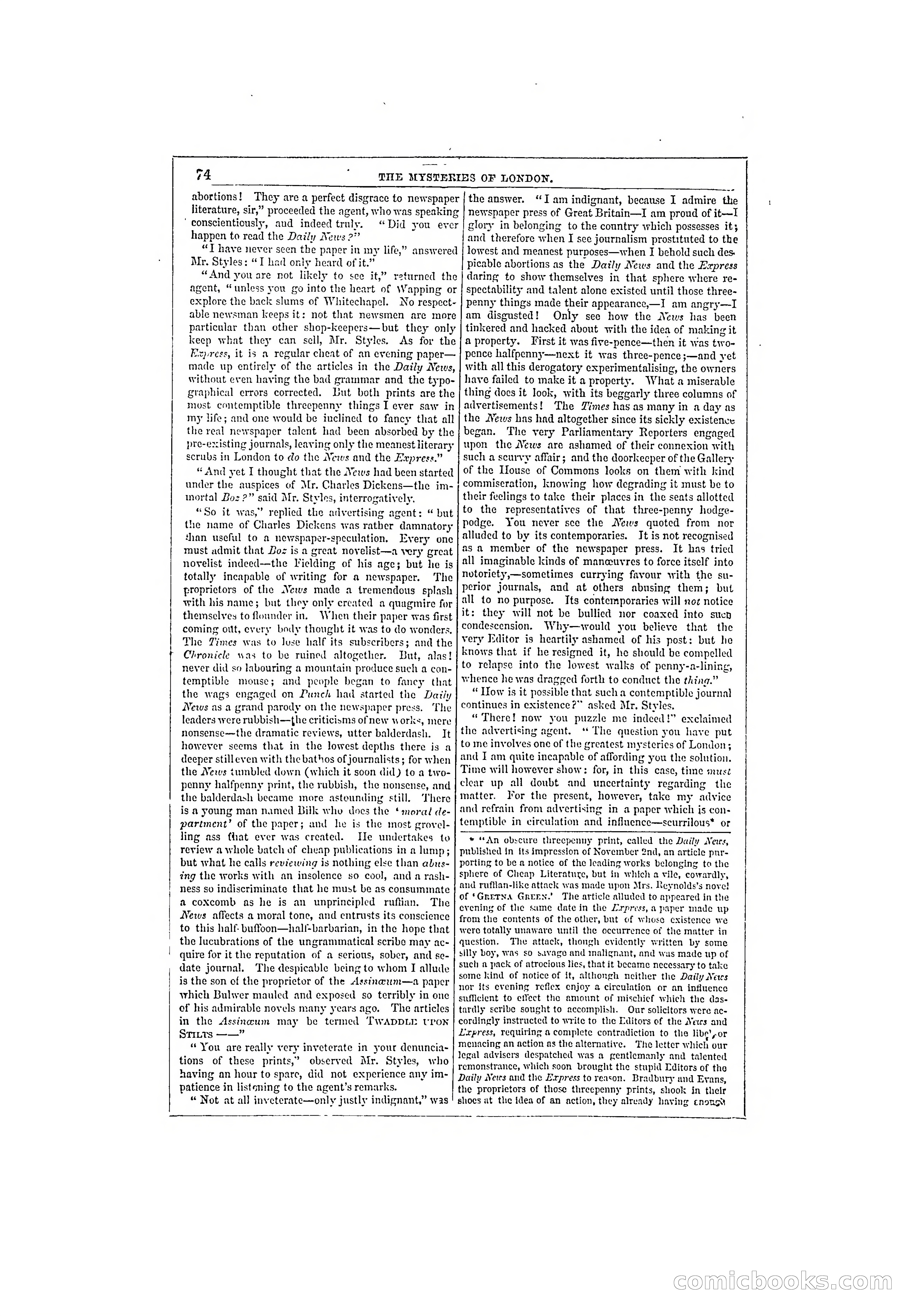
A restored page from Penny Dreadfuls, 1846. Page through the whole issue in the reader above.
📄 Transcribed text from this page (OCR, searchable)
Machine-transcribed from the original scan — historical spelling and the odd misread are preserved.
74 abortions! They are a perfect disgrace to newspaper literature, sir,” proceeded the agent, who was speaking conscientiously, and indeed truly. “Did you ever happen to read the Daily News 2” “JT have never seen the paper in my life,” answered Mr. Styles: “I had only heard of it.” “And you are not likely to see it,” returned the agent, “unless yon go into the heart of Wapping or explore the back slums of Whitechapel. No respect- able newsman keeps it: not that newsmen are more particular than other shop-keepers—but they only keep what they can sell, Mr. Styles. As for the Rizpress, it is a regular cheat of an evening paper— made up entirely of the articles in the Daily News, without even having the bad grammar and the typo- graphical errors corrected. Lut both prints are the most contemptible threepenny things I ever saw in my life; and one would be inclined to fancy that all the real newspaper talent had been absorbed by the pre-existing journals, leaving only the meanest literary scrubs in London to do the Wews and the Express.” “And yet I thought that the News had been started under the auspices of Mr. Charles Dickens—the im- mortal Boz ?” said Mr. Styles, interrogatively. “So it was,” replied the advertising agent: “ but the name of Charles Dickens was rather damnatory than useful to a newspaper-speculation. Every one must admit that Boz is a great novelist—a very great novelist indeed--the Tielding of his age; but he is totally incapable of writing for a newspaper. The Eroprictors of the .Vews made a tremendous splash with his name; but they only ereated a quagmire for themselves to flounder in. When their paper was first coming out, every body thought it was to do wonders. The Zimes was to luse half its subscribers; and the Chronicle was to be ruined altogether. But, alas! never did so Inbouring a mountain produce such a con- temptible mouse; and people began to fancy that the wags engaged on Punch had started the Daily News as a grand parody on the newspaper press. The leaders were rubbish—the criticisms of new works, mere nonsense~—the dramatic reviews, utter balderdash. It however seems that in the lowest depths there is a deeper stilleven with the bathos of journalists; for when the News tumbled down (which it soon did) to a two- penny halfpenny print, the rubbish, the nonsense, and the balderdash became more asteunding still. There is a young man named Bilk who docs the ‘moral de- partment’ of the paper; and he is the most grovel- ling ass flat ever was created. He undertakes to review a whole batch of cheap publications in a lump; but what he calls reviewing is nothing else than abus- tng the works with an insolence so cool, and a rash- ness so indiscriminate that he must be as consummate a coxcomb as he is an unprincipled ruftian. The News affects a moral tone, and entrusts its conscience to this half: buffoon—half-barbarian, in the hope that the lucubrations of the ungrammatical scribe may ac- quire for it the reputation of a serious, sober, and se- date journal. The despicable being to whom I allude is the son of the proprietor of the slssin@um—a paper which Bulwer mauled and exposed so terribly in one ef his admirable novels many years ago. The articles in the Assinaum may be termed TWADDLE UPoN STILTS ——” “ You are really very inveterate in your denuncia- tions of these prints,” observed Mr. Styles, who having an hour to spare, did not experience any im- patience in listening to the agent’s remarks. “ Not at all inveterate—only justly indignant,” was a | THE MYSTERIES OF LONDON. Rw the answer. “Iam indignant, because I admire the newspaper press of Great Britain—I am proud of it~! glory in belonging to the country which possesses it; and therefore when I see journalism prostituted to the lowest and meanest purposes—when I behold such des: picable abortions as the Daily News and the Express daring to show themselves in that sphere where re- spectability and talent alone existed until those three- penny things made their appearance,—I am angry—I am disgusted! Only see how the News has been tinkered and hacked about with the idea of making it a property. First it was five-pence—then it was two- pence halfpenny—next it was three-pence;—and yet with all this derogatory experimentalising, the owners have failed to make it a property. What a miserable thing does it look, with its beggarly three columns of advertisements! The Zimes has as many in a day as the Mews has had altogether since its sickly existence began. The very Parliamentary Reporters engaged upon the Mews are ashamed of their connexion with such a scurvy affair; and the doorkecper of the Gallery of the [louse of Commons looks on them with kind commiseration, knowing how degrading it must be to their feelings to take their places in the seats allotted to the representatives of that three-penny hodge- podge. You never sce the ews quoted from nor alluded to by its contemporaries. It is not recognised asa member of the newspaper press. It has tried all imaginable kinds of manceuvres to force itself into notoriety,—sometimes currying favour with the su- perior journals, and at others abusing them; but all to no purpose. Its contemporaries will noz notice it: they will not be bullied nor coaxed into suen condescension. Why—would you believe that the very Editor is heartily ashamed of his post: but he knows that if he resigned it, he should be compelled to relapse into the lowest walks of penny-a-lining, whence he was dragged forth to conduct the thing.” “ How is it possible that sucha contemptible journal continues in existence?” asked Mr. Styles. “There! now you puzzle me indeed!” exclaimed the advertising agent. ‘ The question you have put to me involves one of the greatest mysteries of London; and I am quite incapable of affording you the solution. Time will however show: for, in this case, time suse clear up all doubt and uncertainty regarding the matter. For the present, however, take my advice and refrain from advertising in a paper which js con- temptible in circulation and influence—scurrilous* or * “An obscure threcpenny print, called the Daily Nears, published in its impression of November 2nd, an article pnr- porting to be a notice of the leading works belonging ta the sphere of Cheap Literature, but in which a vile, cowardly, and ruffan-like attack was made upon Mrs. Reynolds’s nove! of ‘Gretna Green.’ The article alluded to appeared in the evening of the sume date in the Zrpress, a paper made up from the contents of the other, but of whose existence we were totally unaware until the occurrence of the matter in question. The attack, though evidently written by some silly boy, was so savage and malignant, and was made up of such a pack of atrocious lies, that it became necessary to take some kind of notice of it, althongh neither the Datly Netes nor fits evening reflex enjoy a circulation or an influence sufficient to effect the amount of mischief which the das- tardly scribe sought to accomplish. Our solicitors were ac- cordingly instructed to write to the Editors of the Netcs and Lepress, requiring a complete contradiction to the libe', or menacing an action as the alternative. The letter which our legal advisers despatched was a gentlemanly and talented remonstrance, which soon brought the stupid Lditors of the Daily News and the Express to reason. Bradbury and Evans, the proprietors of those threepenny prints, shook in their shoes at the idea of an action, they already having cnong (SO) GIOOKS (SO)