
Penny Dreadfuls, 1846 · page 67 of 399
The Mysteries of London, Vol. IV — page 67: what you’re looking at
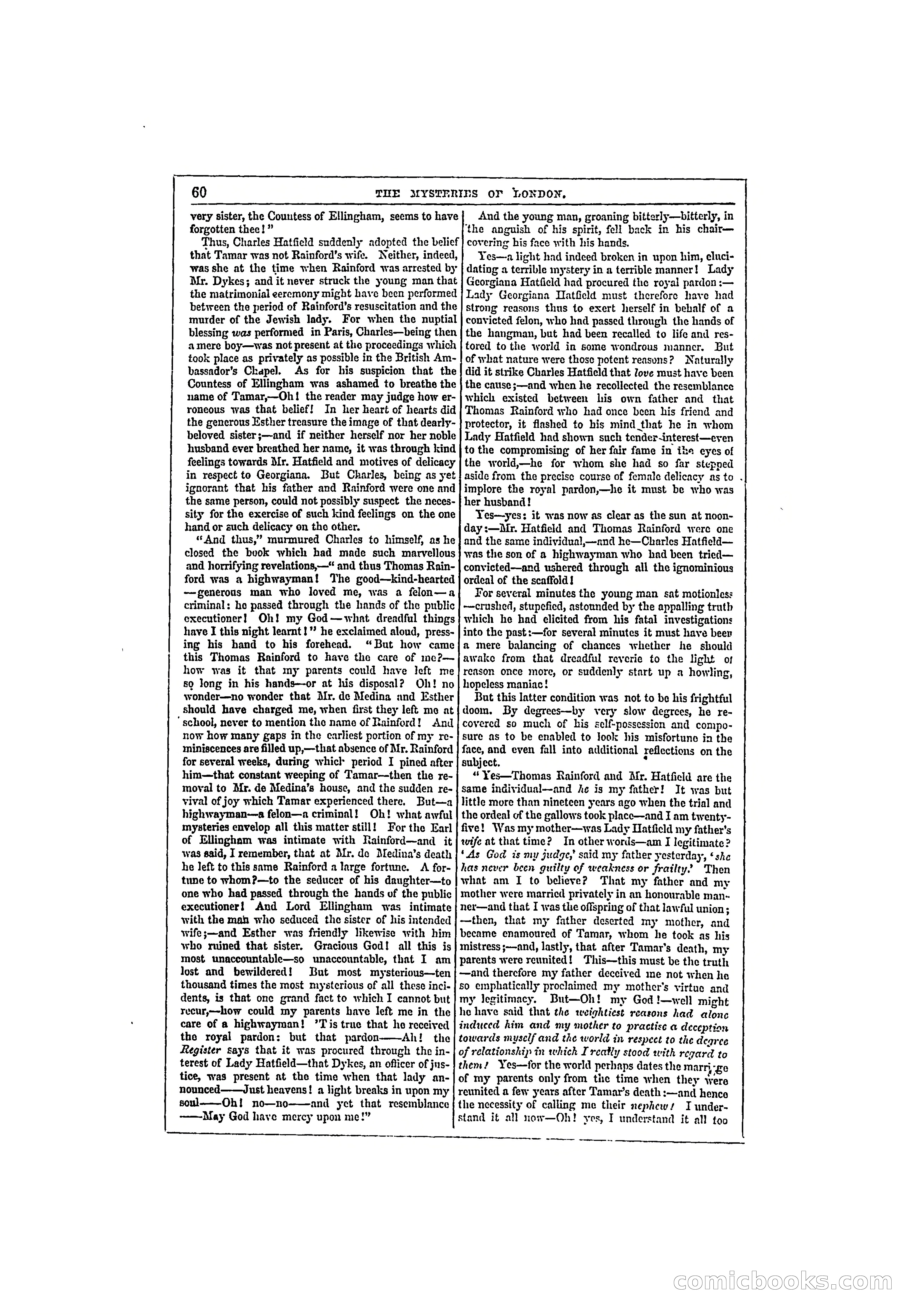
A restored page from Penny Dreadfuls, 1846. Page through the whole issue in the reader above.
📄 Transcribed text from this page (OCR, searchable)
Machine-transcribed from the original scan — historical spelling and the odd misread are preserved.
A A ES a yc ee ww 60 THE 3IYSTERIES Or LONDON, And the young man, groaning bitterly—bitterly, in ‘the anguish of his spirit, fell back in his chair— covering his face with his hands. Yes—a light had indeed broken in upon him, eluci- dating a terrible mystery in a terrible manner! Lady Georgiana Hatfield had procured the royal pardon :— Lady Georgiana Iatficld must therefore have had Strong reasons thus to exert herself in bebalf of a convicted felon, who had passed through the hands of the hangman, but had been recalled to life and res- tored to the world in some wondrous manner. But of what nature were those potent reasons? Naturally did it strike Charles Hatfield that Jove must have been the cause ;—and when he recollected the resemblance which existed between his own father and that Thomas Rainford who had once been his friend and protector, it flashed to his mind that he in whom Lady Hatfield had shown such tender-interest—even to the compromising of her fair fame in ihe eyes of the world,—he for whom she had so far stepned very sister, the Countess of Ellingham, seems to have forgotten thee!” Thus, Charles Hatfield suddenly adopted the belief that Tamar was not Rainford’s wife. Neither, indeed, was she at the time when Rainford was arrested by Mr. Dykes; and it never struck the young man that the matrimonial eeremony might have been performed between the period of Rainford’s resuscitation and the murder of the Jewish lady. For when the nuptial blessing was performed in Paris, Charles—being then a mere boy—was not present at the proceedings which took place as privately as possible in the British Am- bassador’s Chapel. <As for his suspicion that the Countess of Ellingham was ashamed to breathe the name of Tamar,—Oh! the reader may judge how er- roneous was that belief! In her heart of hearts did the generous Esther treasure the image of that dearly- beloved sister;-—~and if neither herself nor her noble husband ever breathed her name, it was through kind feelings towards Mr. Hatfield and motives of delicacy in respect to Georgiana. But Charles, being as yet ignorant that his father and Rainford were one and the same person, could not possibly suspect the neces- sity for the exercise of such kind feelings on the one hand or such delicacy on the other. “And thus,” murmured Charles to himself, as he closed the buok which had made such marvellous and horrifying revelations,—“ and thus Thomas Rain- ford was a highwayman! The good—kind-hearted —generoas man who loved me, was a felon—a criminal: he passed through the hands of the public executioner! Oh! my God—whnt dreadful things have I this night learnt!” he exclaimed aloud, press- ing his hand to his forehead. “But how came this Thomas Rainford to have the care of me?— how was it that my parents conld have left me so long in his hands—or at his disposal? Oh! no wonder—-no wonder that Mr. de Medina and Esther should have charged me, when first they left me at "school, never to mention the name of Rainford!) And now how many gaps in the carliest portion of my re- miniscences are filled up,—that absence of Mr. Rainford for several weeks, during whicl period I pined after him—that constant weeping of Tamar—then the re- moval to Mr. de Medina’s house, and the sudden re- vival of joy which Tamar experienced there. But—a highwayman—a felon—a criminal! Oh! what awful mysteries envelop all this matter still! For the Earl of Lilingham was intimate with Rainford—~and it was said, I remember, that at Mr. de Medina’s death he left to this same Rainford a large fortune. <A for- tune to whom?—to the seducer of his daughter—to one who had passed through the hands of the public executioner! And Lord Ellingham was intimate with the man who seduced the sister of his intended wife;—and Esther was friendly likewise with him who ruined that sister. Gracious God! all this is most unaccountable—so unaccountable, that I am lost and bewildered! But most mysterious—ten thousand times the most mysterious of all these inci- dents, is that one grand fact to which I cannot but recur,—how could my parents have left me in the care of a highwayman! ’T is true that ho reecived the royal pardon: but that pardon——Ah! the Register says that it was procured through the in- terest of Lady Hatfield—that Dykes, an officer of jus- tice, was present at the time when that lady an- nounced——Just heavens! a light breaks in upon my soul——-Oh | no—no——and yet that resemblance ~——May God have mercy upon me!” implore the royal pardon,—he it must be who was her husband! Yes—yes: it was now as clear as the sun at noon- day :—Mr. Hatfield and Thomas Rainford were one and the same individual,—and he—Charles Hatfield— was the son of a highwayman who bad been tried— convicted—and ushered through all the ignominious ordeal of the scaffold ! Jor several minutes the young man sat motionless ~crushed, stupefied, astounded by the appalling truth which he had elicited from his fatal investigations into the past:—for several minutes it must have been a mere balancing of chances whether he should awake from that dreadful reverie to the light of reason once more, or suddenly start up a howling, hopeless maniac! But this latter condition was not to be his frightful doom. By degrees~—by very slow degrees, he re- covered so much of his selfpossession and compo- sure as to be enabled to Jook his misfortune in the face, and even fall into additional reflections on the subject. . “Yes—Thomas Rainford and Mr. Hatfield are the same individual—and he is my father! It was but little more than nineteen years azo when the trial and the ordeal of the gallows took place—and I am twenty- five! Was my mother—was Lady Hatficld my father’s wife at that time? In other words—am I legitimate? ‘As God is my judge,’ said my father yesterday, ‘she has never been guilty of weakness or frailty? Then what am I to believe? That my father and my mother were marricd privately in an honourable man- ner—and that I was the offspring of that lawful union; —then, that my father deserted my mother, and became enamoured of Tamar, whom he took as his mistress ;~—and, lastly, that after Tamar's death, my parents were reunited! This—this must be the truth —and therefore my father deceived ine not when he s0 emphatically proclaimed my mother’s virtue and my legitimacy. But—Oh! my God !—well might he have said that the weightiest reasons had alone induced him and my mother to practise a deception towards myself and the world in respect to the degree of relationship in which I reatly stood with regard to them! Yes—for the world perhaps dates the marri-ge of my parents only from the time when they werd reunited a few years after Tamar’s death :—and hence the necessity of calling me their nephews TI under- stand if all now—Oh! yes, I understand it all too aside from the precise course of female delicacy asto . EO EE re oe eee 5} (CO) GIOOKS (CO) >