
Penny Dreadfuls, 1846 · page 51 of 399
The Mysteries of London, Vol. IV — page 51: what you’re looking at
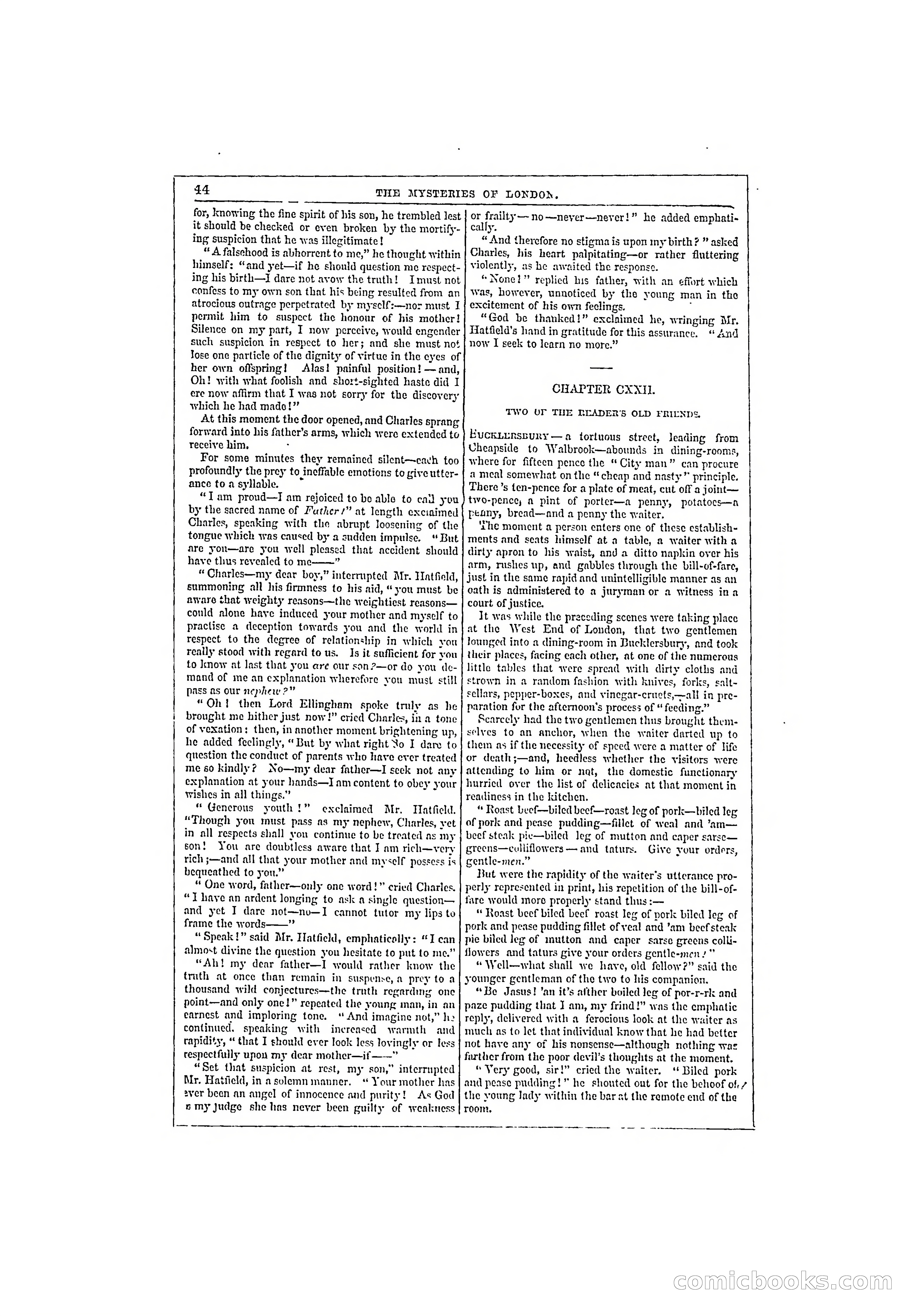
A restored page from Penny Dreadfuls, 1846. Page through the whole issue in the reader above.
📄 Transcribed text from this page (OCR, searchable)
Machine-transcribed from the original scan — historical spelling and the odd misread are preserved.
4 THE MYSTERIES OF LONDON, for, knowing the fine spirit of his son, he trembled lest | or frailty — no—neyer—never!” he added emphati- it should be checked or even broken by the mortify- ing suspicion that he was illegitimate! “ A falsehood is abhorrent to me,” he thought within himself: “and yet—if he should question me regpect- ing his birth—I dare not avow the truth! Imust not confess to my own son that his being resulted from an atrocious outrage perpetrated by myself:—nor must I permit him to suspect the honour of his mother! Silence on my part, I now perceive, would engender such suspicion in respect to her; and she must not Jose one particle of the dignity of virtue in the eyes of her own offspring! Alas! painful position! — and, Oh! with what foolish and short-sighted haste did I ere now affirm that I was not sorry for the discovery which he had made!” At this moment the door opened, and Charles sprang forward into his father’s arms, which were extended to receive him, ; For some minutes they remained silent—cach too profoundly the prey to ineffable emotions to give utter- ance toa syllable. =~ “Tam prond—I am rejoiced to be able to cad you by the sacred name of Father?” at length exciaimed Charles, speaking with the abrupt loosening of the tongue which was caused by a sudden impulse. “ But are yon—are yor well pleased that accident should have thus revealed to me——” “ Charles—my dear boy,” interrupted Mr. Hatfield, summoning all his firmness to his aid, “you must be aware that weighty reasons—the weightiest reasons— could alone have induced your mother and myself to practise a deception towards you and the world in respect to the degree of relationship in which vou really stood with regard to us. Is it sufficient for vou to know at last that you are our son?—or do you de- mand of me an explanation wherefore you must still Pass as our nephew?” “Ohl then Lord Ellingham spoke tmly as he brought me hither just now!” cried Charles, in a tone of vexation: then, in another moment brightening up, he added feclingly, “But by what right Xo I dare to question the conduct of parents who have ever treated me 60 kindly? No—my dear father—I seck not any explanation at your hands—I am content to obey your wishes in all things.” “ Generous youth!” exclaimed Mr. Tatfield. “Though you must pass as my nephew, Charles, yet in all respects shall you continue to be treated as my son! You are doubtless aware that I am rich—very rich ;—and all that your mother and myself possess is bequeathed to you.” * Qne word, father—only one word!” cried Charles. “T haye an ardent longing to ask a single question— and yet I dare not—nvu—I cannot tutor my lips to frame the words-——” “Speak!” said Mr. Iatfield, emphatically: “I can almost divine the question you hesitate to put to me.” “Ah! my dear father—I would rather know the truth at once than remain in suspense, a prey to a thousand wild conjectures—the truth regarding one point—and only one!” repeated the young man, in an earnest and imploring tone. ‘ And imagine not,” he continued. speaking with increased warmth and rapidity, “ that I should ever look less lovingly or less respectfully upon my dear mother—if ——” “Set that suspicion at rest, my son,” interrupted Mr. Hatfield, in asolemnmanner. “ Your mother has ever been an angel of innocence and purity! As God gmy Judge she has never been guilty of weakness re RR 60 9 A cally. “And therefore no stigma is upon ny birth? ” asked Charles, his heart palpitating—or rather fluttering violently, as he awaited the response. “None!” replied his father, with an effort which Was, however, unnoticed by the young man in the excitement of his own feclings. “God be thanked!” exclaimed he, wringing Mr. Hatfield’s hand in gratitude for this assurance. “And now I seek to learn no more.” —— CHAPTER CXNIL. TWO UF THE READER'S OLD FRIENDS. EUCKLERSBURY —a_ tortuous street, Jeading from Uheapside to Walbrook—abounds in dining-rooma, Where for fifteen pence the “City man” can procure a meal somewhat on the “cheap and nasty” principle. There ’s ten-pence for a plate of meat, cut off a joint— two-pence,; a pint of porter—a penny, potatoes—n peany, bread—and a penny the waiter. ‘Che moment a person enters one of these establish- ments and seats himself at a table, a waiter with a dirty apron to his waist, and a ditto napkin over his arm, rushes up, and gabbles through the bill-of-fare, Just in the same rapid and unintelligible manner as an oath is administered to a juryman or a witness ina court of justice. It was while the preceding scenes were taking place at the West End of London, that two gentlemen lounged into a dining-room in Bucklersbury, and took their places, facing each other, at one of the numerous little tables that were spread with dirty cloths and strown in a random fashion with knives, forks, salt- sellars, pepper-boxes, and vinegar-cruets,—all in pre- paration for the afternoon's process of “ feeding.” Scarecly had the two gentlemen thus brought them- selves to an anchor, when the waiter darted up to them as if the necessity of speed were a matter of Hife or death;—and, heedless whether the visitors were attending to him or nat, the domestic functionary hurried over the list of delicacies at that moment in readiness in the kitchen. “ Roast Lbeef—biled beef—roast leg of pork—biled leg of pork and pease pudding—fillet of weal and ’am— beef steak pie—biled Jeg of mutton and caper sarse— greens—cvlliflowers — and taturs. Give your orders, centle-men.” But were the rapidity of the waiter’s utterance pro- perly represented in print, his repetition of the bill-of- fare would more properly stand thus :— Roast beef biled beef roast leg of pork biled leg of pork and pease pudding fillet of veal and ’am beef steak pie biled leg of mutton and caper sarse greens colli- flowers and taturs give your orders gentle-mens" “Well—what shall we have, old fellow?” said the younger gentleman of the two to his companion. “Be Jasus! ’an it’s alther boiled leg of por-r-rk and paze pudding that J am, my frind!” was the emphatic reply, delivered with a ferocious look at the waiter as much as to let that individual know that he had better not have any of his nonsense—although nothing was farther from the poor devil's thoughts at the moment. © Very good, sir!” cried the waiter. ‘ Biled pork and pease pudding!” he shouted out for the behoof of 7 the young Jady within the bar st the remote end of the room. re ee ren ee ce ee EConnicloooks (SO)