
Penny Dreadfuls, 1846 · page 397 of 399
The Mysteries of London, Vol. IV — page 397: what you’re looking at
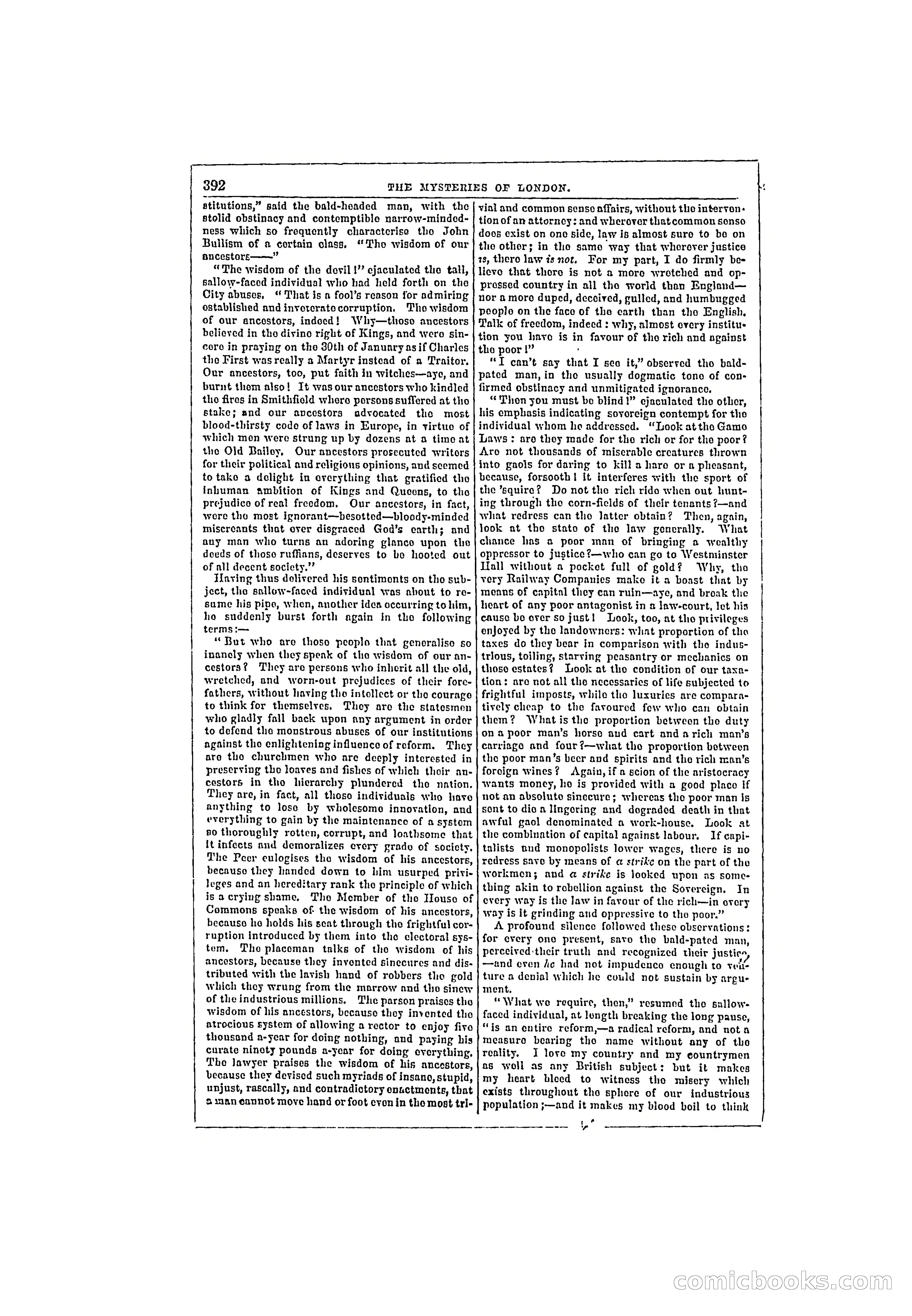
A restored page from Penny Dreadfuls, 1846. Page through the whole issue in the reader above.
📄 Transcribed text from this page (OCR, searchable)
Machine-transcribed from the original scan — historical spelling and the odd misread are preserved.
pn tf PU yet PN el gy eS ST Pie ee 392 THE MYSTERIES OF LONDON. stitutions,” said the bald-headed man, with the stolid obstinacy and contemptible narrow-minded- ness which s0 frequently charactcrise the John Bullism of a cortain olass, “Tho wisdom of our ancestors——” “The wisdom of the devil {”? ejaculated the tall, sallow-faced individual who bad held forth on the City abuses, ‘ That is a fool’s reason for admiring established and inveterate corruption. Tho wisdom of our ancestors, indoed! Why—those ancestors believed in tho divino right of Kings, and wero sin- core in praying on the 30th of January asif Charles the First was really a Martyr instead of a Traitor. Our ancestors, too, put faith in witches—aye, and burnt thom also! It was our ancestors who kindled the fires in Smithfiold where persons suffered at tho stake; and our ancestors advocated the most blood-thirsty code of laws in Europe, in virtuo of which men were strung up by dozens at a timo at the Old Bailoy, Our ancestors prosecuted writors for their political and religions opinions, and seemed to take a dolight in overything that gratified tho inhuman ambition of Kings and Queens, to the prejudico of real freedom. Our ancestors, in fact, were tho most ignorant—besotted—bloody-minded miscreants that over disgraced God’s earth; and any man who turns an adoring glance upon the deeds of those ruffians, deserves to bo hooted out of all decent society,”’ Having thus dolivered his sontimonts on tho sub- ject, the snllow-faced individual was nhout to ro- sume his pipe, when, another idea occurring to him, ho suddenly burst forth again in the following terms :— “But who are those peoplo that genoralise so inancly when they spenk of tha wisdom of our an- cestors? They are persons who inherit all the old, wretched, and worn-out prejudices of their fore- fathers, without having tho intellect or the courage to think for themselves. They aro the statesmen who gladly fall back upon any argument in order to defend the monstrous abuses of our institutions against tho enlightening influence of reform. They are tho churchmen who are deeply interested in preserving the loaves and fishes of which thoir an- cestors in tho hierarchy plundered tho nation. They are, in fact, all thoso individuals who have anything to losc by wholesome innovation, and everything to gain by the maintenanco of a system 80 thoroughly rotten, corrupt, and loathsome that Itinfects and demoralizes every grado of socicty, The Peer eulogises the wisdom of his ancestors, because they handed down to him usurped privi- Jeges and an hereditary rank tho principle of which is acrying shame. Tho Member of tho Houso of Commons speaks of the wisdom of his ancestors, because he holds his seat through tho frightful cor- ruption introduced by them into the electoral sys- tem. Tho placoman talks of tho wisdom of his ancestors, because they invented sinccures and dis- tributed with the lavish hand of robbers tho gold which they wrung from the marrow and tho sinew of the industrious millions. The parson praises tho wisdom of his ancestors, becauso they invented tho atrocious system of allowing a rector to enjoy fivo thonsond a-year for doing nothing, and paying his curate ninoty pounds a-year for doing everything, The lawyer praises the wisdom of his ancestors, because they devised such myriads of insano, stupid, unjust, rascally, and contradictory onuctmonts, that & san cannot move hand or foot evon in the most tri- vial and common sense affairs, without the intervon- tion of an attorncoy: and wherover thatcommon sonso doos exist on one side, law is almost sure to bo on the othor; in the samo way that wherever justice 18, thero law is not. For my part, I do firmly be- lieve that thore is not a moro wrotched and op- prossed country in all the world thon England— nor a moro duped, decoived, pulled, and humbugged people on the face of the carth than the English, Talk of freedom, indeed : why, almost overy institue tion you have is in favour of the rich and ogainst the poor !” “T can’t say that I seo it,” observed tho bald- pated man,in tho usually dogmatic tono of con- firmed obstinacy and unmitigated ignoranco. “Thon you must be blind!” ejaculated the other, his emphasis indicating sovorcign contempt for tho individual whom he addressed. “Look atthe Gamo Laws : are thoy made for the rich or for the poor? Aro not thousands of miserable creatures thrown into gaols for daring to kill a hare or a pheasant, because, forsooth! it interferes with the sport of the squire? Do not the rich rido when out hunt- ing through the corn-ficlds of their tenants ?—and what redress can tho latter obtain? Then, again, look at tho stato of the law generally. What chance lins a poor man of bringing a wealthy oppressor to justice ?—who can go to Westminster Hall without a pocket full of pold? Why, tho very Railway Companies make it a boast that by menns of capital they can ruin—aye, and broak the heart of any poor antagonist in 2 law-court, Ict his cause be over so just! Look, too, at the privileges onjoyed by the landowners: what proportion of tha taxes do they bear in comparison with the indus- trious, toiling, starving peasantry or mechanics on those estates? Look at the condition of our taxa- tion: arc not all the necessarics of life subjected to frightful imposts, while tho luxuries are compara- tively cheap to the favoured few who can obtain them? Whatis tho proportion betweon the duty ona poor man’s horse aud cart and arich man’s carriago and four ?—what tho proportion between the poor man’s beer and spirits and the rich man’s foroign wines? Again, if a scion of the aristocracy wants moncy, ho is provided with a good placo if not an absolute sinccure; whereas the poor man fs sont to dio a lingering and dograded death in that awful gaol denominated a work-house. Look at the combination of capital against labour. If capi- talists nnd monopolists lower wages, there is no redress save by means of a strike on the part of the workmen; and @ strike is looked upon as some- thing akin to robellion against the Sovereign. In every way is the Jaw in favour of the rich—in overy way is it grinding and oppressive to the poor.” A profound silence followed theso observations: for every one present, savo tho bald-pated man, perceived their truth and recognized their justice —and even de had not impudenco enough to veil- ture a denial which he could not sustain by argu- ment. “What wo require, then,” resumed tho sallow- faced individual, at longth breaking the long pause, “is an entire reform,—a radical reform, and uot 4 measure bearing tho name without any of tho reality. I love my country and my countrymen as woll as any British subject: but it makes my heart bleed to witness the misery which exists throughout the sphere of our industrious population ;—and it makes my blood boil to think ¢ * aa COMM GIOOKS (CO)