
Penny Dreadfuls, 1846 · page 380 of 399
The Mysteries of London, Vol. IV — page 380: what you’re looking at
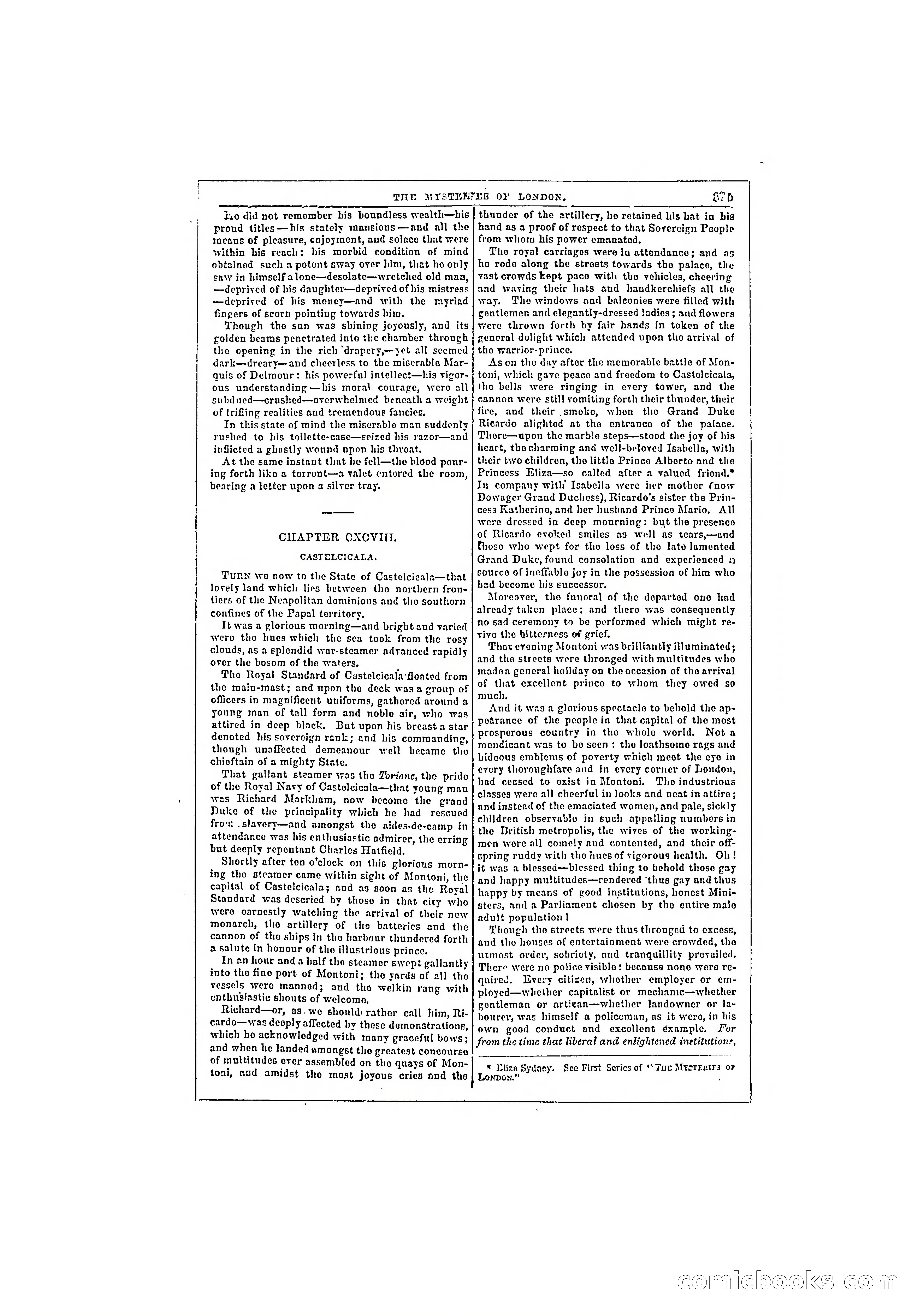
A restored page from Penny Dreadfuls, 1846. Page through the whole issue in the reader above.
📄 Transcribed text from this page (OCR, searchable)
Machine-transcribed from the original scan — historical spelling and the odd misread are preserved.
-_—— THE MYSTERFEBS OF LONDON, i iso did not remember bis boundless wealth—his proud titles—his stately mansions —and all the means of pleasure, enjoyment, and solace that were within his reach: his morbid condition of mind obtained such a potent sway over him, that ho only saw in himself alone—desolate—wretched old man, —deprived of his daughter—deprived of his mistress —deprived of his money—and with the myriad fingers of scorn pointing towards him. Though the sun was shining joyously, and its golden beams penctrated into the chamber through the opening in the rich ‘drapery,—yct all seemed dark—dreary—and cheerless to the miscrable Mar- quis of Delmour: his powerful intellect—his vigor- ous understanding —his moral courage, wero all subdued—crushed—overwhelmed beneath a weight of trifling realities and tremendous fancics. In this state of mind the miserable man suddenly rushed to his toilette-case—seized his razor—and inflicted a ghastly wound upon his throat. At the same instant that ho fell—tho blood pour- ing forth like a torrent—a valet entored the room, bearing a letter upon 2 silver tray. CHAPTER CXCVITI. CASTLLCICALA. TURN wo now to the State of Castelcicala—that lovely land which lies between tho northern fron- tiers of the Neapolitan dominions and the southern confines of the Papal territory. It was a glorious morning—and bright and varied were tho hues which the sea took from the rosy clouds, as a splendid war-stcamer advanced rapidly over the bosom of the waters. Tho Royal Standard of Custelcicala-floated from the main-mast; and upon tho deck was a group of officers in magnificent uniforms, gathered around a young man of tall form and noble air, who was attired in deep black. But upon his breast a star denoted his sovereign ranlz:; and his commanding, though unaffected demeanour well beeamo tho chioftain of a mighty State. That gallant steamer was tho Zorione, the pride of tho Royal Navy of Castelcicala—that young man wes Richard Markham, now become the grand Duko of the principality which he had rescued fron .slavery—and amongst tho aides-de-camp in attendance was his enthusiastic admirer, the erring but deeply repentant Charles Hatfield, Shortly after ton o’clock on this glorious morn- ing the steamer came within sight of Montoni, the capital of Castelcicala; and as soon as the Roval Standard was descried by those in that city who were earnestly watching the arrival of their new monarch, tho artillery of tho batteries and the cannon of the ships in the harbour thundered forth a salute in honour of tho illustrious prince. In an hour anda half tho steamer swept gallantly into the fine port of Montoni; the yards of all tho vessels wero manned; and the welkin rang with enthusiastic shouts of welcome, Richard—or, as,we should: rather call him, Ri- cardo—was deeply affected by these demonstrations, which he acknowledged with many graceful bows; and when he landed amongst tho greatest concourse of multitudes over assembled on tho quays of Mon- toni, and amidst tho most joyous crics and tho a:b thunder of the artillery, he retained his hat in hig hand as a proof of respect to that Sovercign People from whom his power emanated. The royal carriages were in attendance: and as he rode along the streets towards the palace, the vast crowds kept paco with tho vehicles, cheering and waving their hats and handkerchiefs all the way. Tho windows and balconies were filled with rentlemen and elegantly-dressed ladies ; and flowers were thrown forth by fair hands in token of the general delight which attended upon tho arrival of tho warrior-prince. As on the day after the memorable battle of Mon- toni, which gave poace and freedom to Castolcicala, the bolls were ringing in every tower, and the cannon were still vomiting forth their thunder, their fire, and their smoke, whon the Grand Duke Ricardo alighted at the entranco of the palace. Thore—upon the marble steps—stood the joy of his heart, thocharming and well-beloved Isabella, with their two children, tho little Princo Alberto and the Princess Eliza—so called after a valued friend.* In company with Isabella were her mother (now Dowager Grand Duchliess), Ricardo’s sister the Prin- cess Katherine, and her husband Prince Mario, All were dressed in deep mourning: but the presence of Ricardo evoked smiles as well as tears,—and fhuse who wept for the loss of the late lamented Grand Duke, found consolation and experienced o source of ineffablo joy in the possession of him who had becomo his successor, Moreover, the funoral of the departed ono had already taken place; and tlicre was consequently no sad ceremony to be performed which might re- vivo the bitterness of grief. Thav evening Montoni was brilliantly illuminated; and the streets were thronged with multitudes who maden general holiday on the occasion of the arrival of that excejlent prince to whom they owed so much, And it was a glorious spectacle to behold the ap- pesrance of the people in that capital of tho most prosperous country in tho wholo world. Nota mendicant was to be seen: tho loathsomo rags and hidcous emblems of poverty which meot the cyo in every thoroughfare and in every corner of London, had ceased to exist in Montoni. Tho industrious classes were all cheerful in looks and neat in attire; and instead of the emaciated women, and pale, sickly children observablo in such appalling numbers in the Dritish metropolis, the wives of the working- men were all comely and contented, and thcir off- spring ruddy with tho hues of vigorous health, Oh! it was a blessed~biessed thing to behold those gay and happy mu!titudes—rendered ‘thus gay and thus happy by means of good institutions, honest Mini- sters, and a Parliament chosen by the entire malo adult population | Though the streets were thus thronged to excess, and tho houses of entertainment were crowded, tho utmost order, sobricty, and tranquillity prevailed. There were no police visible: because nono were re- quired, Isvery citizen, whether employer or em- ployed—whether capitalist or mechanic—whether gontleman or artican—whether landowner or Ja~ bourer, was himself a policeman, as it were, in his own good conduct and exccllont dxample. Jor from the time that liberal and enlightened institutions, * Vliza Sydney. See First Series of ** Tuc MyeTEnirs op Lonpown.” , (C(O) (C DOO <S LL (SO)