
Penny Dreadfuls, 1846 · page 33 of 399
The Mysteries of London, Vol. IV — page 33: what you’re looking at
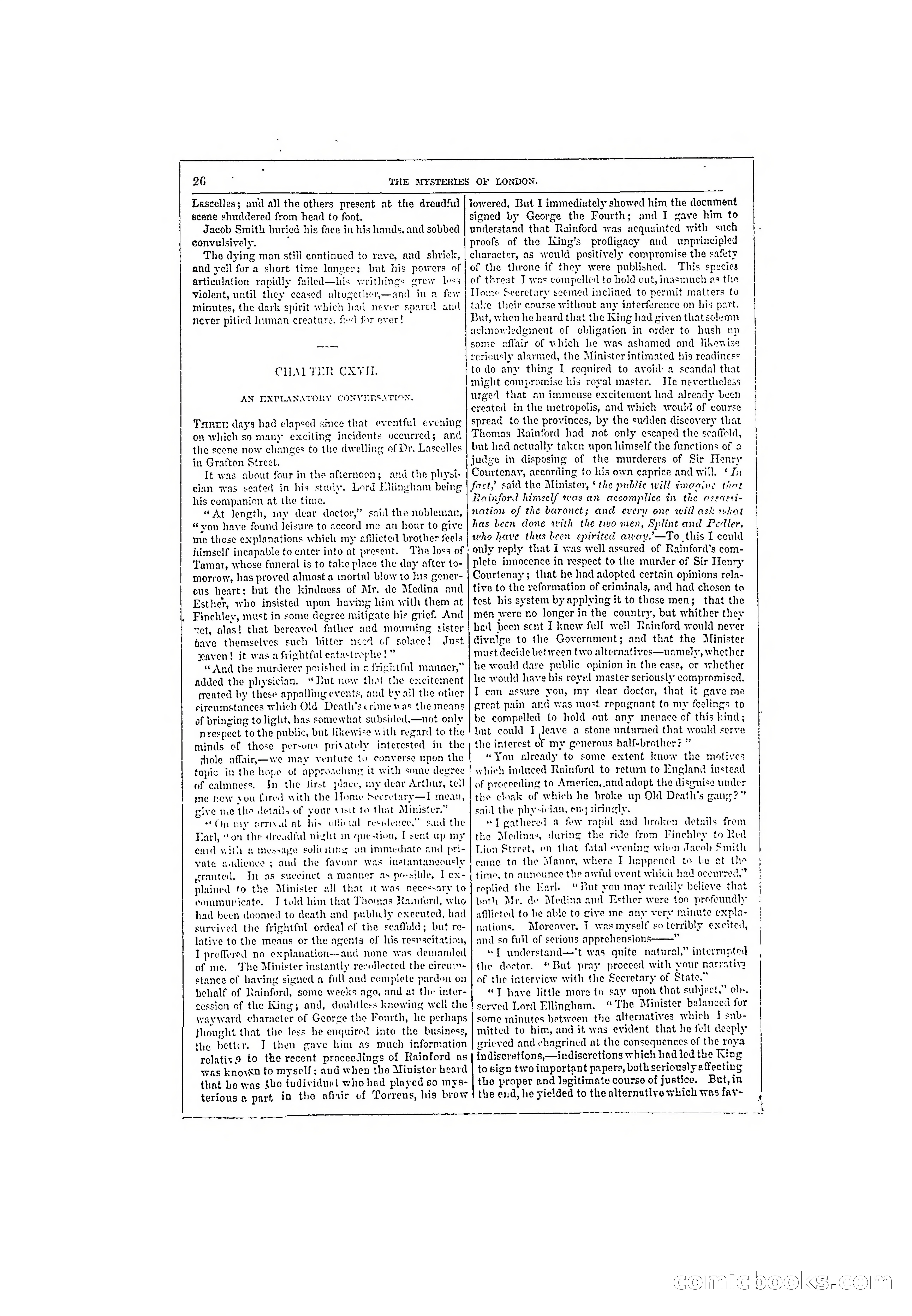
A restored page from Penny Dreadfuls, 1846. Page through the whole issue in the reader above.
📄 Transcribed text from this page (OCR, searchable)
Machine-transcribed from the original scan — historical spelling and the odd misread are preserved.
26 : THE MYSTERIES OF LONDON. i Sy RS a ee Lascelles; and all the others present at the dreadful scene shuddered from head to foot. Jacob Smith buried his face in his hands. and sobbed eonvulsirely. The dying man still continucd to rave, and shrick, and yell fora short time longer: but his powers of articulation rapidly failed—his writhings grew less violent, until they ceased altogether,—and in a few minutes, the dark spirit which had never sparcd and never pitied human creature. fled for ever! CHALTER CAT. AN EXPLANATORY CONVERSATION. Treen: days had clapsed since that eventful evening on which so many exciting incidents occurred; and the scene now changes to the dwelling of Dr. Lascelles in Grafton Strect. It was about four in the afternoon; and the physi: cian was seated in his study. Lord Euingham being his companion at the time. “At length, ny dear doctor,” said the nobleman, “vou have found Icisure to accord me an hour to give me those explanations which my afflicted brother feels himsclt incapable to enter into at present. The loss of Tamar, whose funeral is to take place the day after to- morrow, has proved almost a mortal blow to his gener- ous heart: but the kindness of Mr. de Medina and Esther, who insisted upon having him with them at Finchley, must in some degree mitigate hiv grief. And sot, alas! that bereaved father and mourning sister fave themseives such bitter need of solace! Just raven! it was a frichtful catastrophe!” «“ And the murderer perished in a frightful manner,” added the physician. “Dut now that the excitement rreated by these appalling events, and by all the other circumstances which Old Death’s crime was the means of bringing to light, has somewhat subsided,—not only nrespect to the public, but likewise with regard to the minds of those persons privately interested in the thole affair,—we may venture to converse upon the topic in the hope of approaching it with some degree of calmness. In the firet place, my dear Arthur, tell me new yeu fared with the Home Seeretary—f mean, give ne the details of your visit to that Minister.” “On my ermvalat his official residence,” said the Tarl, on the dreadful night in question, T sent up my enid with a message soliating an immediate and pri- vate audience ; and the favour was inetantancously granted, In as succinct a manner as posible, Tex- plained fo the Minister all that it was necessary to communicate. J told him that Thomas Rainford, who had been doomed to death and publicly executed, had survived the fri¢htful ordeal of the scaffuld; but re- lative to the means or the agents of his resvacitation, J proffered no explanation—and none was demanded of me. The Minister instantly recollected the circum- stance of having signed a full and complete pardon on behalf of Rainford, some weeks ago, and at the inter- eession of the King; and, doubtless knowing well the wayward character of George the Fourth, he perhaps thought that the less he enquired inte the business, ‘he bettcr. J then gave him as much information relativa to the recent proceedings of Rainford as was knovsn to myself; and when the Minister heard that he was the individual who had played so mys- terious 2 part in the afiuir of Torrens, his brow ~——_ eae * lowered. But I immedixtely showed him the document siened by George the Fourth; and J gave him to undetstand that Rainford was acquainted with such proofs of the King’s profligacy aud unprincipled character, as would positively compromise the safety of the throne if they were published. This specics of threat T was compelled to hold out, inasmuch as the Ilome Seeretary seemed inclined to permit matters to take their course without any interference on his part. But, when he heard that the King had given thatsolemn acknowledginent of obligation in order to hush up some affair of which he was ashamed and likewise seriously alarmed, the Minister intimated his readiness todo any thing I required to avoid: a scandal that might compromise his royal master. JIe nevertheless urged that an immense excitement had already Leen created in the metropolis, and which would of course spread to the provinces, by the sudden discovery that Thomas Rainford had not only escaped the scaffold, but had actually taken upon himself the functions of a judge in disposing of the murderers of Sir Henry Courtenay, according to his own caprice and will. ‘Jn fect, said the Minister, ‘the public will tiaaaine that Rainford himself wvas an accomplice in the asscsst- nation of the baronet; and every one will ask what has been done with the tuo men, Splint and Peddler, who have thus been spirited away.’—To this I could only reply that I was well assured of Rainford’s com- plete innocence in respect to the murder of Sir Henry Courtenay; that he had adopted certain opinions rela- tive to the reformation of criminals, and had chosen to test his system by applying it to those men; that the mén were no longer in the country, but whither they bed been sent I knew full well Rainford would never divulge to the Government; and that the Minister must decide bet ween two alternatives—namely, whether he would dare public opinion in the case, or whether he would have his royel master seriously compromised. I can assure you, my dear doctor, that it gave ma great pain and was mot repugnant to my feelings to be compelled to hold out any menace of this kind; but could J Jeave a stone unturned that would serve the interest of my generous half-brother? ” “You already to some extent know the motives which induced Rainford to return to England instead of proceeding to America,.and adopt the disguise under the cloak of which he broke up Old Death’s gang?” said the physician, eny tringly. “Tpathered a few rapid and broken details from the Medinas, during the ride from Finchley to Red Lion Street, on that fatal evening when Jacob Smith came to the Manor, where T happened to be at the time, to announce the awful event whica had ocenrred,” replied the Earl. “Put you may readily believe that beth Mr. de Medina and Esther were too profoundly afflicted to be able to give me any very minute expla- nations. Moreaver, I was myself’ so terribly excited, and so full of serious apprehensions - “fT understand—‘t was quite natural,” interrupted the doctor. “But pray proceed with vour narrative of the interview with the Secretary of State.” “T have little more to say upon that subject,’ ob-. served Lord Ellingham. “The Minister balanced for some minutes between the alternatives which I sub- mitted to him, and it was evident that he felt deeply erieved and chagrined at the consequences of the roya indisoretions,—indiseretions which had led the hing to sign two important papers, both seriously effecting the proper and legitimate course of justice. But,in the end, he yielded to the alternative which was fay- a ee, oo ee or a a ee nm a A GE I LD COA GIOOKS (SO)