
Penny Dreadfuls, 1846 · page 316 of 399
The Mysteries of London, Vol. IV — page 316: what you’re looking at
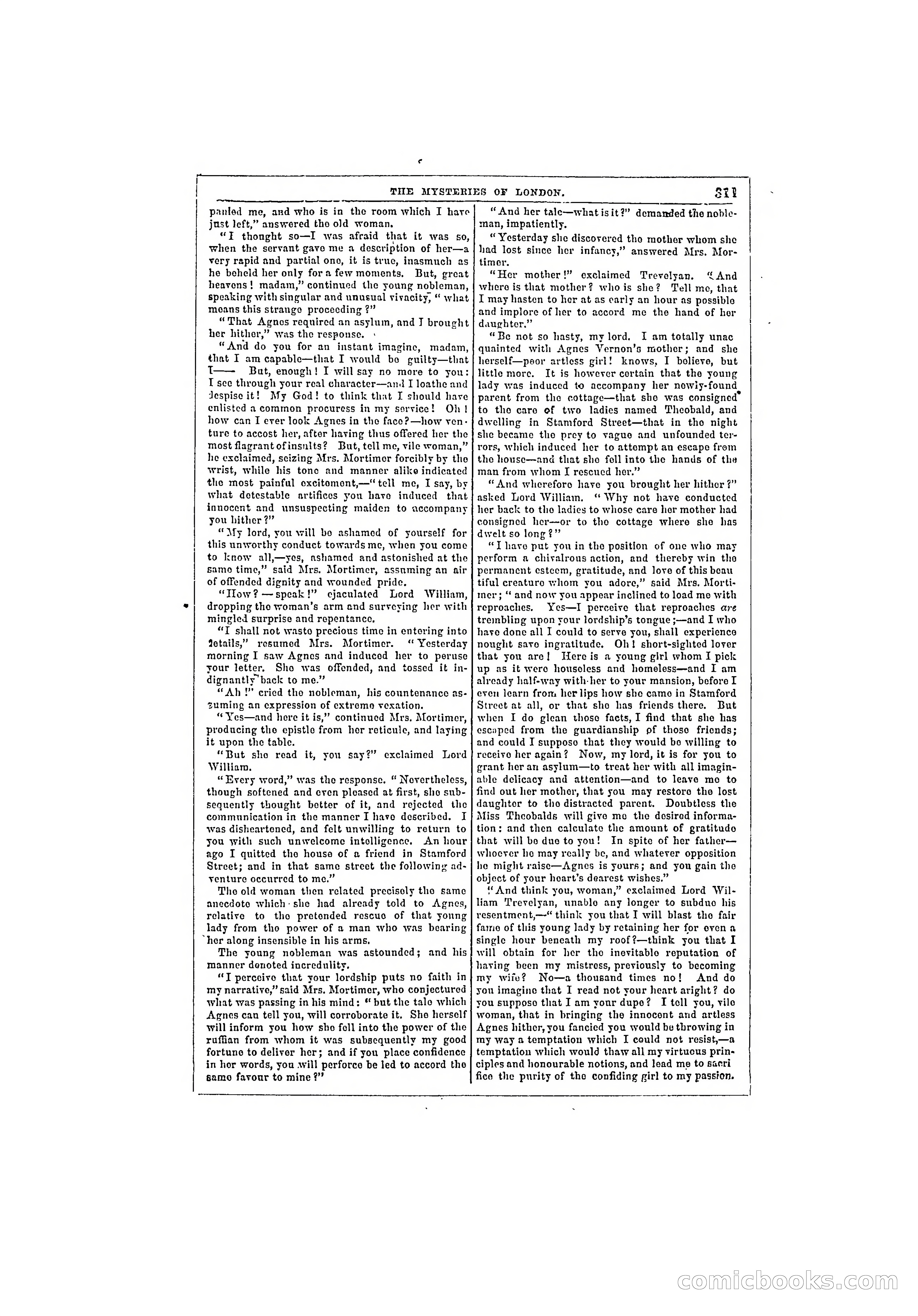
A restored page from Penny Dreadfuls, 1846. Page through the whole issue in the reader above.
📄 Transcribed text from this page (OCR, searchable)
Machine-transcribed from the original scan — historical spelling and the odd misread are preserved.
THE MYSTERIES panted me, and who is in the room which I hare just left,” answered tho old woman. “fF thonght so—I was afraid that it was so, when the servant gave me a description of her—a very rapid and partial ono, it is true, inasmuch eas he beheld her only fora few moments, But, great heavens! madam,” continued the young nobleman, speaking with singular and unusual vivacity, “ what means this strange proceeding ?” “That Agnes required an asylum, and J brought her hither,” was the response. + “And do you for an instant imagine, madam, that I am capable—that I would be guilty—that T—— But, enough! I will say no more to you: I see through your real character—and I loathe and despise it! My God! to think that I should have enlisted a common procuress in my service! Oh! how can I ever look Agnes in the face? —how ven- ture to accost her, after having thus offered her the most flagrantofinsnits? But, tell me, vile woman,” he exclaimed, seizing Mrs. Mortimer forcibly by the wrist, while his tone and manner alike indicated the most painful excitoment,— tell me, I say, by what detestable artifices you have induced that innocent and unsuspecting maiden to accompany you hither 2” “My lord, you will bo ashamed of yourself for this unworthy conduct towards me, when you come to know all,—yes, ashamed and astonished at the samo time,” said Mrs. Mortimer, assuming an air of offended dignity and wounded pride. “Wow? —speak!” cjaculated Lord William, dropping the woman’s arm end surveving her with mingled surprise and repentance, “T shall not wasto precious time in entering into fetails,” resumed Mrs. Mortimer. ‘“ Yesterday morning I saw Agnes and induced her to peruse your letter. Sho was offended, and tossed it in- dignantly back to me.” “Ah? cried the nobleman, his countenance as- tuming an expression of extreme vexation. ““Yes—and here it is,” continued Mrs. Mortimer, producing the epistle from her reticule, and laying it upon the table. “But she read it, you say?’ exclaimed Lord William. “Every word,” was the response. “ Novertheless, though softened and even pleased at first, sho snb- sequently thought better of it, and rejected the communication in the manner I have described. I was disheartened, and felt unwilling to return to you with such unwelcome intolligence. An hour ago I quitted the house of a friend in Stamford Street; and in that same street the following ad- venture occurred to me.” The old woman then related precisely the same anecdote which-she had already told to Agnes, relative to tho pretonded rescuc of that yonng lady from tho power of a man who was bearing ‘her along insensible in his arms. The young nobleman was astounded; and his manner denoted incredulity. “T perceive that your lordship puts no faith in my narrative,” said Mrs. Mortimer, who conjectured what was passing in his mind: * but the tale which Agnes can tell you, will corroborate it. She herself will inform you how she fell into the power of the ruffian from whom it was subsequently my good fortune to deliver her; and if you place confidence in hor words, you will perforce be led to accord the samo favour to mine ?”’ OF LONDON. sit ‘And her tale—whatisit?” demanded the noble- man, impatiently. * Yesterday she discovered the mother whom she had lost since her infancy,” answered Mrs. Mor- timer. “Her mother!” exclaimed Trevelyan. “And where is that mother? whois she? Tell mo, that I may hasten to her at as early an hour as possible and implore of her to accord me the hand of hor daughter.” “Be not so hasty, my lord, I am totally unac quainted with Agnes Vernon’s mother; and she herself—peor artless girt! knows, I bolieve, but little more. It is however certain that the young lady was induced to accompany her nowiy-found parent from the cottage—that she was consigned to tho caro ef two ladies named Theobald, and dwelling in Stamford Street—that in the night she became the prey to vague and unfounded ter- rors, Which induced her to attompt an escape from the housec—and that she fellinto the hands of the man from whom I rescued her.” “And wherefore have you brought her hithor ?” asked Lord William. ‘ Why not have conducted her back to the ladies to whose care her mother had consigned her-—~or to the cottage where she has dwelt so long?” “J have put you in the position of one who may perform a chivalrous action, and thereby win tho permanent esteem, gratitude, and love of this beau tiful creaturo whom you adore,” said Mrs, Morti- mer; “and now you appear inclined to load me with reproaches. Yes—I perceive that reproaches are treinbling upon your lordship’s tongue ;—and I who have done all I could to serve you, shall experience nought save ingratitude. Oh! short-sighted lover that you are! Here is a young girl whom I pick up as it were houseless and homeless—and I am already half-way with-her to your mansion, before [ even learn from her lips how she camo in Stamford Strect at all, or that sho has friends there. But when I do glean those facts, I find that she has escaped from the guardianship pf those friends; and could I supposo that they would bo willing to receive her again? Now, my lord, it is for you to grant her an asylum—to treat her with all imagin- able delicacy and attention—and to leave mo to find out her mother, that you may restore the lost daughtor to the distracted parent. Doubtless thie Miss Theobalds will give mo the dosired informa- tion: and then calculate the amount of gratitude that will bo due to you! In spite of her father— whoever he may really be, and whatever opposition he might raise—Agnes is yours; and you gain the object of your hoart’s dearest wishes.” “And think you, woman,” exclaimed Lord Wil- liam Trevelyan, unablo any longer to subduo his resentment,—* think you that I will blast the fair faire of this young lady by retaining her for even a single hour beneath my roof?—think you that I will obtain for her tho inevitable reputation of having been my mistross, previously to becoming my wife? No—a thousand times no! And do you imagine that I read not your heart aright? do you suppose that Iam your dupe? I tell you, vile woman, that in bringing the innocent and artless Agnes hither, you fancied you would be throwing in my way a temptation which I could not resist,—a temptation which would thaw all my virtucus prin- ciples and honourable notions, and lead me to sacri fice the purity of the confiding girl to my passion. . (C(O) (C DOO <S LL (SO)