
Penny Dreadfuls, 1846 · page 301 of 399
The Mysteries of London, Vol. IV — page 301: what you’re looking at
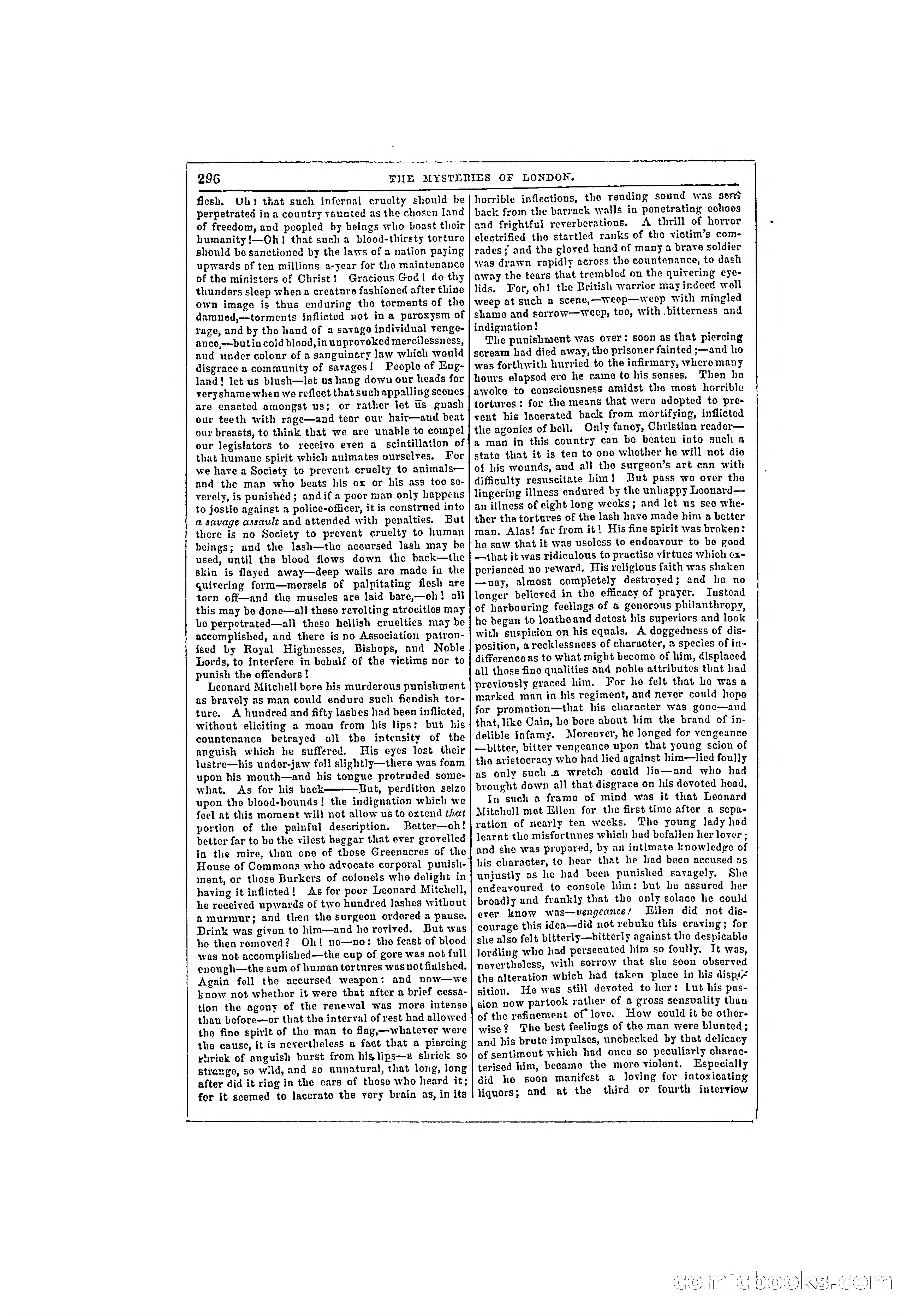
A restored page from Penny Dreadfuls, 1846. Page through the whole issue in the reader above.
📄 Transcribed text from this page (OCR, searchable)
Machine-transcribed from the original scan — historical spelling and the odd misread are preserved.
296 TIE MYSTERIES OF LONDON. flesh. Oh} that such infernal cruelty should be perpetrated ina country vaunted as the chosen land of freedom, and peopled by belngs who boast their humanity !—Oh! that such a blood-thirsty torture should be sanctioned by the laws of a nation paying upwards of ten millions a-ycar for tho maintenance of the ministers of Christ! Gracious God! do thy thunders sleep when a creature fashioned after thine own image is thus enduring the torments of the damned,—torments inflicted not ina paroxysm of rage, and by tho hand of a savago individual venge- ance,-—butin cold blood, in unprovoked mercilessness, aud under colour of a sanguinary law which would disgrace a community of savages! People of Eng- land! let us blush—let us hang down our heads for very shame when we reflect that such appalling scones are enacted amongst us; or rather let us gnash our teeth with rage—and tear our hair—and beat our breasts, to think that we are unable to compel our legislators to receive even a scintillation of that humane spirit which animates ourselves. Tor we have a Society to prevent cruelty to animals— and the man who beats his ox or his ass too Se- verely, is punished; andif a poor man only happens to jostle against a police-officer, it is construed into a savage assault and attended with penalties. But there is no Society to prevent cruelty to human beings; and the lash—the accursed lash may be used, until the blood flows down the back—the skin is flayed away—deep wails are made in the quivering form—morsels of palpitating flesh are torn off—and the muscles are laid bare,—oh! all this may be done—all these revolting atrocities may be perpetrated—all these hellish cruelties may be accomplished, and there is no Association patron- ised by Royal Highnesses, Bishops, and Noble Lords, to interfere in behalf of the victims nor to punish the offenders ! Leonard Mitchell bore his murderous punishment as bravely as man could endure such fiendish tor- ture. A hundred and fifty lashes had been inflicted, without eliciting a2 moan from his lips: but his countenance betrayed ull the intensity of the anguish which he suffered. His eyes lost their lustre—his under-jaw fell slightly—there was foam upon his mouth—and his tongue protruded some- what. As for his back But, perdition seizo upon the blood-hounds! the indignation which we feel at this moment will not allow us to extend that portion of the painful description. Better—oh! better far to be the vilest beggar that ever grovelled in the mire, than one of those Greenacres of the House of Commons who advocate corporal punish- ment, or those Burkers of colonels who delight in having it inflicted! As for poor Leonard Mitchell, he received upwards of two hundred lashes without a. murmur; and tlren the surgeon ordered a pause. Drink was given to him—and he revived. But was he then removed? Oh! no—no: the feast of blood was not accomplished—the cup of gore was not full cnough—the sum of human tortures wasnotfinished. Again fell the accursed weapon: and now—we know not whether it were that after a brief cessa- tion the agony of the renewal was more intense than before—or that tho interval of rest had allowed the fine spirit of the man to flag,—whatever were the cause, it is nevertheless a fact that a piercing vhriek of anguish burst from hig lips—a shriek so strezge, so wild, and so unnatural, that long, long after did it ring in the ears of those who heard it; for it seemed to lacerate the very brain as, in its horrible inflections, the rending sound was ser back from the barrack walls in penetrating echoos and frightful reverberations. A thrill of horror electrified the startled ranks of the victim’s com- rades ;' and the gloved hand of many a brave soldier was drawn rapidly across the countenance, to dash away the tears that trembled on the quivering eye- lids. For, oh! the British warrior may indeed well weep at such a scene,—weep—weep with mingled shame and sorrow—weep, too, with bitterness and indignation! The punishment was over: soon as that piercing scream had diced away, the prisoner fainted ;—and he was forthwith hurried to the infirmary, where many hours elapsed ere he came to his senses. Then ho awoke to consciousness amidst the most horrible tortures: for the means that were adopted to pre- vent his lacerated back from mortifying, inflicted the agonies of hell. Only fancy, Christian reader— a4 man in this country can be beaten into such a state that it is ten to one whether he will not dio of his wounds, and all the surgeon’s art can with difficulty resuscitate him! But pass we over the lingering illness endured by the unhappy Leonard— an illness of eight long weeks; and let us seo whe- ther the tortures of the lash have made him a better man. Alas! far from it! His fine spirit was broken: he saw that it was useless to endeavour to be good —that it was ridiculous to practise virtues which ox- perienced no reward. His religious faith was shaken —uay, almost completely destroyed; and he no longer believed in the efficacy of prayer. Instead of harbouring feelings of a generous philanthropy, he began to loathoand detest his superiors and look with suspicion on his equals. A doggedness of dis- position, arecklessnoss of character, a species of in- difforence as to what might become of him, displaced a)l those fino qualities and noble attributes that had previously graced him. For ho felt that he was a marked man in his regiment, and never could hope for promotion—that his character was gonc—and that, like Cain, he bore about him the brand of in- delible infamy. Moreover, he longed for vengeance —bitter, bitter vengeance upon that young scion of the aristocracy who had lied against him—lied foully as only such .a wretch could lic—and who had brought down all that disgrace on his devoted head, In such a frame of mind was it that Leonard Mitchell met Ellen for the first time after a sepa- ration of nearly ten weeks. The young lady had learnt the misfortunes which had befallen her lover; and she was prepared, by an intimate knowledge of his character, to hear that he had been accused as unjustly as ho had been punished savagely. She endeavoured to console him: but he assured her broadly and frankly that the only solace he could ever know was—vengeance/’ Ellen did not dis- courage this idea—did not rebuke this craving; for she also felt bitterly—bitterly against the despicable Jordling who had persecuted him so foully. It was, nevertheless, with sorrow that she soon observed the alteration which had taken place in his dispé sition. Je was still devoted to her: Lut his pas- sion now partook rather of a gross sensvality than of the refinement of love. How could it be other- wise? The best feelings of the man were blunted; and his brute impulses, unchecked by that delicacy of sentiment which had once so peculiarly charac- terised him, became the more violent. Especially gid he soon manifest a loving for intoxicating liquors; and at the third or fourth interview EConnicloooks (CO)