
Penny Dreadfuls, 1846 · page 287 of 399
The Mysteries of London, Vol. IV — page 287: what you’re looking at
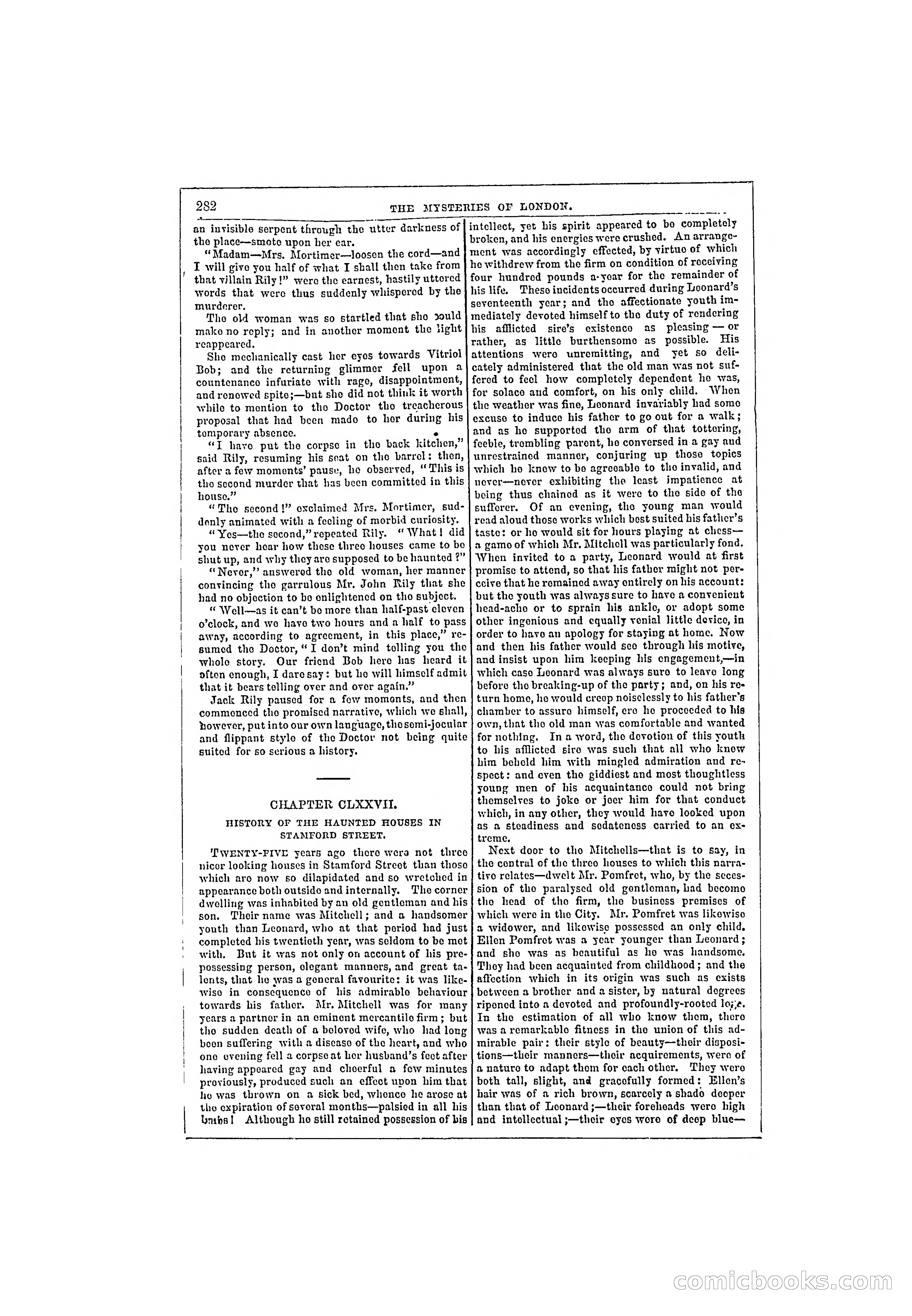
A restored page from Penny Dreadfuls, 1846. Page through the whole issue in the reader above.
📄 Transcribed text from this page (OCR, searchable)
Machine-transcribed from the original scan — historical spelling and the odd misread are preserved.
282 an invisible serpent through the utter darkness of the place—smete upon her ear. ‘Madam—Mrs. Mortimer—loosen the cord—and I will give you half of what I shall then take from that villain Rily!” were the earnest, hastily uttered words that were thus suddenly whispered by the murderer. The old woman was so startled that sho sould make no reply; and in another moment the light reappeared. Sho mechanically cast her eyos towards Vitriol Bob; and the returning glimmer fell upon a countenanco infuriate with rage, disappointment, and renowed spite;—bnt sho did not think it worth while to mention to tho Doctor tho treacherous proposal that had been mado to her during his tomporary absence. e “JT have put the corpse in the back kitchen,” said Rily, resuming his seat on the barrel: then, after a few moments’ pause, ho observed, “ This is tho second murder that has been committed in this house.” “ho second!” oxclaimed Mrs. Mortimer, sud- denly animated with a fecling of morbid curiosity. “ Yos—the second,” repeated Rily. “ What! did you never hoar how these threo houses came to be shut up, and why they aro supposed to be haunted 2” “Nevor,’”’ answered tho old woman, her manner convincing the garrulous Mr. John Rily that she had no objection to bo enlightened on tho subject. “ Well—as it can’t bo more than half-past cleven o’clock, and wo have two hours and a half to pass away, according to agreement, in this place,” re- sumed tho Doctor, “I don’t mind tolling you tho whole story. Our friend Bob here has heard it often enough, I daresay: but he will himself admit that it bears telling over and over again.” Jack Rily paused for 1. fow momonts, and then commenced the promised narrative, which we shall, however, put into our own language, thosoemi-jocular and flippant style of the Doctor not being quite suited for so serious a history. CHAPTER CLXXVII. HISTORY OF THE HAUNTED HOUSES IN STAMFORD STREET, TWENTY-FIVE years ago there wera not threo nicor looking houses in Stamford Street than those which aro now so dilapidated and so wretched in appearance both outsido and internally. The corner dwelling was inhabited by an old gentleman and his son. Their name was Mitchell; and a handsomer youth than Leonard, who at that period had just completed his twentieth year, was seldom to be mot with. But it was not only on account of his pre- possessing person, clegant manners, and great ta- lents, that lhe was a general favourite: it was like- wise in consequence of his admirablo behaviour towards his fathor. Mr. Mitchell was for many years a partner in an eminent mercantile firm; but tho sudden death of a boloved wife, who had long been suffering with a diseaso of the heart, and who one evening fell a corpse at hor husband’s fect after having appeared gay and cheerful a few minutes proviously, produced such an effect upon him that he was thrown on a Sick bed, whence he arose at the expiration of several months—palsied in all his bnibs! Although ho still retained possession of bis THE MYSTERIES OF LONDON. —— ew et! intellect, yet his spirit appeared to bo completely broken, and his energies were crushed. An arrange~ ment was accordingly effected, by virtuo of which he withdrew from the firm on condition of receiving four hundred pounds a-year for the remainder of his life. These incidents occurred during Liconard’s seventeenth year; and the affectionate youth im- mediately devoted himself to the duty of rendering his afflicted sire’s existence as pleasing — or rather, as little burthensome as possible. His attentions were unremitting, and yet so deli- cately administered that the old man was not suf- fered to feel how completely dependent he was, for solace and comfort, on his only child. When the weather was fine, Leonard invariably had somo excuse to induce his father to go out for a walk; and as he supported the arm of that tottering, feeble, trombling parent, he conversed in a gay and unrestrained manner, conjuring up those topics which ho know to be agreeable to the invalid, and nover—nerer exhibiting the least impatience at being thus chained as it were to the side of the sufforer. Of an evening, the young man would read aloud those works which best suited his father’s taste: or he would sit for hours playing at chess— a gamo of which Mr, Mitchell was particularly fond. When invited to a party, Leonard would at first promise to attend, so that his father might not per- ccive that he remained away ontircly on his account: but the youth was always sure to have a convenient head-achoe or to sprain his ankle, or adopt some other ingenious and equally venial little device, in order to have an apology for staying at home. Now and then his father would seo through his motive, and insist upon him keeping his engagement,—in which case Leonard was always sure to leavo long before the breaking-up of the party; and, on his ro- turn homo, he would ercop noiselessly to his father’s chamber to assure himself, ero he proceeded to his own, that tho old man was comfortable and wanted for nothing. Ina word, the devotion of this youth to his afflicted sire was such that all who knew him beheld him with mingled admiration and re spect: and even tho piddiest and most thoughtless young men of his acquaintance could not bring themselves to joke or jecr him for that conduct which, in any other, they would have looked upon as a steadiness and sedateness carried to an ex- treme. Nest door to tho Mitchells—that is to say, in the central of the threo houses to which this narra- tive relates—dwelt Mr. Pomfret, who, by the seces- sion of tho paralysed old gontloman, had becomo the head of the firm, the businoss premises of which were in the City. Mr. Pomfret was likewiso a widower, and likewise possessed an only child. Ellen Pomfret was a year younger than Leonard ; and sho was as beautiful as he was handsome. They had been acquainted from childhood; and the affection which in its origin was such as exists between a brother and a sister, by natural degrees ripened into a devoted and profoundly-rooted loge. In the estimation of all who know them, thero was aremarkablo fitness in the union of this ad- mirable pair: their style of beauty—their disposi- tions—their manners—thoir acquirements, were of a nature to adapt thom for each other. They were both tall, slight, and gracefully formed: Ellen’s hair was of a rich brown, scarcely a shado deoper than that of Leonard ;—thoir foreheads were high | and intellectual ;—their oyes wore of deep blue— econmlelooolks (CO)