
Penny Dreadfuls, 1846 · page 279 of 399
The Mysteries of London, Vol. IV — page 279: what you’re looking at
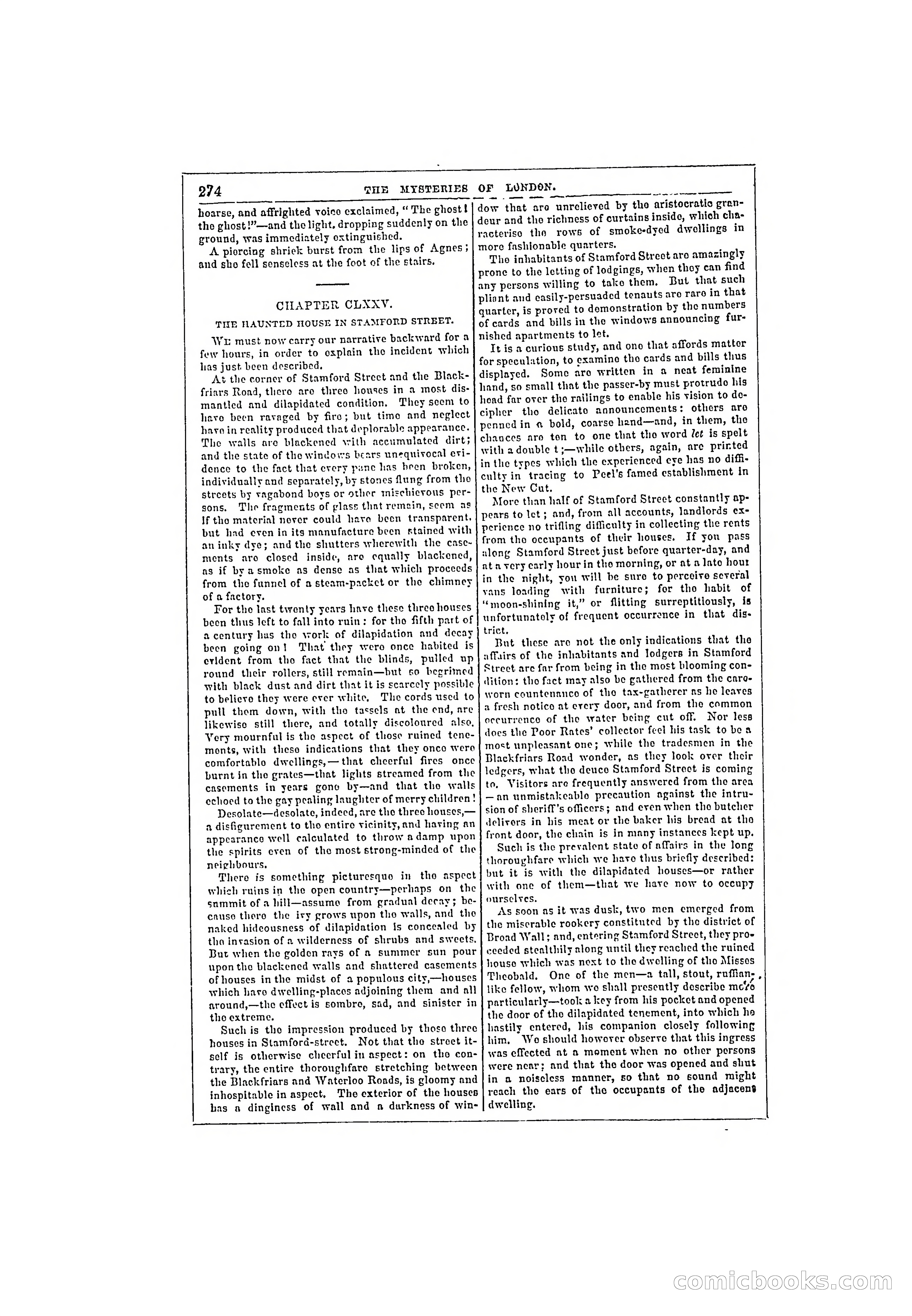
A restored page from Penny Dreadfuls, 1846. Page through the whole issue in the reader above.
📄 Transcribed text from this page (OCR, searchable)
Machine-transcribed from the original scan — historical spelling and the odd misread are preserved.
074 GUE MYSTERIES eine enema ae hoarse, and affrighted voice exclaimed, “ The ghost! the ghost!”—and the light. dropping suddenly on the ground, was immediately oxtinguished. A piorcing shriek burst from the lips of Agnes; and sho fell senseless at the foot of the stairs. etal CHAPTER CLXAXY. THE HAUNTED HOUSE IN STAMFORD STREET. Wr must now carry our narrative backward for a few hours, in order to oxplain tho incident which lias just been described. + the corner of Stamford Strect and the Black- friars Road, there are three houses in a most dis- mantied and dilapidated condition. They seem to linve been ravaged by firo; but time and neglect havo in reality produced that deplorable appearance. The walls are blackened with accumulated dirt; and the state of the windows bears unequivocal evi- dence to the fact that every pune has been broken, individually and separately, by stones flung from tho streets by vagabond boys or other mischievous per- sons. The fragments of glass that remain, seem as If tho material never could have been transparent, but had even in its manufacture been stained with aninky dye; andthe shutters wherewith the case- ments aro closed inside, are equally blackened, as if by asmoke as dense as that which procecds from the funnel of a steam-packct or the chimney of a factory. For the Inst twenty years have these threo houses been thus left to fall into rnin: for tho fifth part of a century hus tho work of dilapidation and decay been going on! That they wero once habited is evident from tho fact that the blinds, pulled up round their rollers, still remain—but so begrimed with black dust and dirt that itis scarecly possible to belicve they were ever white, The cords used to pull them down, with tho tassels at the end, are likewise still there, and totally discoloured also, Very mournful ts the aspect of those ruined tene- monts, with these indications that they once wero comfortablo dwellings, that cheerful fires once burnt in the grates—that lights streamed from the casements in years gone by—and that the walls echoed to the gay pealing laughter of merry children! Desolate—desolate, indeed, are the three houses,— a disfigurement to tho entiro vicinity, and having an appearance well calculated to throw adamp upon the spirits even of tho most strong-minded of the neighbours, There is something picturesquo in tho aspect which ruins in the open country—perhaps on the snmmit of a hill—assume from gradual decay; be- cause there the ivy grows upon the walls, and the naked hideousness of dilapidation is concealed by tha invasion of a wilderness of shrubs and sweets. But when the golden rays of n summer sun pour upon the blackened walls and shattered casements of houses inthe midst of a populous city,—houses which havo dwelling-places adjoining them and ali ground,—the effect is sombro, sad, and sinister in tho extreme. Such is the impression produced by thoso three houses in Stamford-strect. Not that the strect it- self is otherwise cheerful in aspect: on the con- trary, the entire thoroughfare stretching between the Blackfriars and Waterloo Roads, is gloomy and inhospitable in aspect. The exterior of the houses has a dinginess of wall and no durkness of win- vn ner | OF LUNDON. —— ae —_—- oom aa on tal oat dow that aro unrelieved by the aristocratic gran- deur and the richness of curtains inside, whioh cha- racterise the rows of smokeedyed dwellings in more fashionable quarters. Tho inhabitants of Stamford Street aro amazingly prone to the letting of lodgings, when thoy can find any persons willing to take them. But that such pliant and easily-persuaded tenants aro rare in that quarter, is proved to demonstration by the numbers of cards and bills in the windows announcing fur- nished apartments to let. It is a curious study, and ono that affords matter for speculation, to examine tho cards and bills thus displayed. Some aro written in a neat feminine hand, so small that the passer-by must protrude his head far over the railings to enable his vision to de- cipher tho delicate announcements * others aro pennedin « bold, coarse hand—and, in them, the chances aro ten to one that tho word let is spelt wvith 2 double t:—while others, again, are printed inthe types which the experienced eye has no diffi- culty in tracing to Peel's famed establishment in the New Cut. More than half of Stamford Street constantly ap- pears to Ict; and, from all accounts, landlords ex- perience no trifling difficulty in collecting the rents from tho occupants of their houses. If yon pass along Stamford Strect just before quarter-day, and at avery carly hourin the morning, or at a lato hour in the night, you will be sure to perceive several vans loading with furniture; for tho habit of “moon-shining it,” or flitting surreptitiously, is unfortunatoly of frequent occurrence in that dis- trict, But these aro not the only indications that the affairs of the inhabitants and lodgers in Stamford Street are far from being in the most blooming con- ditions tho fact may also be gathered from the caro- worn countenanco of the tax-gatherer as he leaves a fresh notico at erery door, and from the common occurrence of the water being cut off. Nor less does the Poor Rates’ collector feel his task to be a most unpleasant one; while the tradesmen in the Blackfriars Road wonder, as they look over their ledgers, what tho deuce Stamford Streot is coming to, Visitors are frequently answered from the area —an unmistakeablo precaution against the intru- sion of sheriff’s officers; and even when tho butcher delivers in his meat or the baker his bread at tho front door, the chain is in many instances kept up. Such is the prevalent state of affairs in the long thoroughfare which we havo thus briefly described: but it is with the dilapidated houses—or rather with one of them—that we have now to occupy ourselyes. As soon as it was dusk, two men emerged from the miscrable rookery constituted by the district of Broad Wall: and, entering Stamford Street, they proe ceeded stealthily along until they reached the ruined house which was noxt to the dwolling of tho Misses Theobald. One of the men—a tall, stout, raffian- like fellow, whom we shall preseutly describe mcvo particularly—took a key from his pocket and opened the door of tho dilapidated tenement, into which he hastily entered, hig companion closely following him, We should howorer observe that this ingress was effected at o moment when no other persons were nenr; and that the door was opened and shut in a noiseless manner, 50 that no sound might reach the ears of the occupants of the adjacent dwelling. EConnicloooks (CO)