
Penny Dreadfuls, 1846 · page 27 of 399
The Mysteries of London, Vol. IV — page 27: what you’re looking at
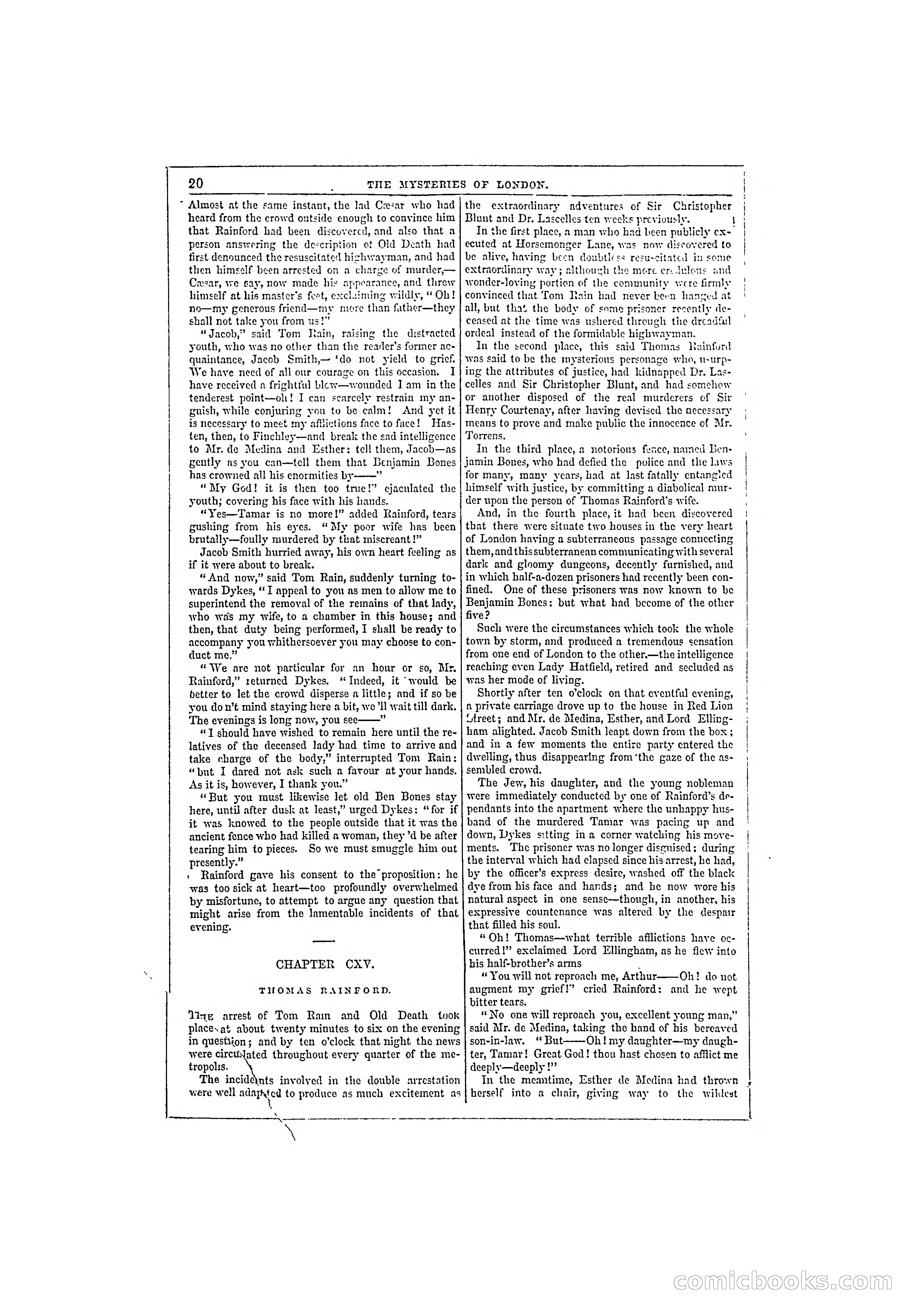
A restored page from Penny Dreadfuls, 1846. Page through the whole issue in the reader above.
📄 Transcribed text from this page (OCR, searchable)
Machine-transcribed from the original scan — historical spelling and the odd misread are preserved.
aa aN ea rt et 20 ; THE MYSTERIES OF LONDON. ~ Almost at the same instant, the lad Cesar who had heard from the crowd outside cnough to convince him that Rainford had been discovercd, and also that a person answering the description of Old Death had first denounced the resuscitated highwayman, and had then himself been arrested on a charge of murder,— Cesar, we say, now made his appearance, and threw himself at his master’s feet, excluiming wildly, “Oh! no—my generous friend—my more than father—they shall not take you from us!” “Jacob,” said Tom Rain, raising the distracted youth, who was no other than the reader's former ac- quaintance, Jacob Smith,— ‘do not yield to grief. We have need of all our courage on this occasion. I have received a frightful blcw—wounded Iam in the tenderest point—oh! I can scarcely restrain my an- guish, while conjuring you te be calm! And yet it is necessary to meet my aftiictions face to face! Has- ten, then, to Finchley—and break the sad intelligence to Mr. de Medina and Esther: tell them, Jacob—as gently as you can—tell them that Benjamin Bones has crowned all his enormities by-———” “My God! it is then too true!” ejaculated the youth; covering his face with his hands. “Yes—Tamar is no more!” added Rainford, tears gushing from his eyes. “My poor wife has been brutally—foully murdered by that miscreant!” Jacob Smith hurried away, his own heart feeling as if it were about to break. “And now,” said Tom Rain, suddenly turning to- wards Dykes, “I appeal to you as men to allow me to superintend the removal of the remains of that lady, who was my wife, to a chamber in this house; and then, that duty being performed, 1 shall be ready to accompany you whithersoever you may choose to con- duct me,” “We are not particular for an hour or so, Mr. Rainford,” returned Dykes. “Indeed, it “would be better to let the crowd disperse a little; and if so be you don’t mind staying here a bit, we ll wait till dark. The evenings is long now, you see si “1 should have wished to remain here until the re- latives of the deceased lady had time to arrive and take charge of the body,” interrupted Tom Rain: “but I dared not ask such a favour at your hands. As it is, however, I thank you.” “But you must likewise let old Ben Bones stay here, until after dusk at least,” urged Dykes: “for if it was knowed to the people outside that it was the ancient fence who had killed a woman, they ’d be after tearing him to pieces. So we must smuggle him out presently.” 1 Rainford gave his consent to the proposition: he was too sick at heart—too profoundly overwhelmed by misfortune, to attempt to argue any question that might arise from the lamentable incidents of that evening. ———9 CHAPTER CXY. THOMAS RAINFORD. lige arrest of Tom Rain and Old Death took place.at about twenty minutes to six on the evening in questiion; and by ten o’clock that night the news were circuNated throughout every quarter of the me- tropolis. a The incide\nts involyed in the double arrestation were well adaphted to produce as much excitement as i te i re ee re ee ene the extraordinary adventures of Sir Christopher Blunt and Dr. Lascelles ten weeks previously. { In the first place, a man who had been publicly ex-_ ecuted at Horsemonger Lane, was now discovered to be alive, having been doubtless resuscitated in some extraordinary way; elthouch the more eredulons and wonder-loving portion of the community were firmly convinced that Tom Rain had never been hanged at all, but that the body of some prisoner recently de- ceased at the time was ushercd through the dreadful ordeal instead of the formidable highwayman. In the second place, this said Thomas Rainfurd was said to be the mysterious personage who, t-urp- ing the attributes of justice, had kidnapped Dr. Las- celles and Sir Christopher Blunt, and had somchow or another disposed of the real murderers of Sir Henry Courtenay, after having devised the necessary means to prove and make public the innocence of Mr. Torrens, In the third place, a notorious fence, named Ben- Jamin Bones, who had defied the police and the laws for many, many years, had at last fatally entangied himself with justice, by committing a diabolical mur- der upon the person of Thomas Rainford's wife. And, in the fourth place, it had been discovered that there were situate two houses in the very heart of London having a subterrancous passage connecting them, andthissubterranean communicating with several dark and gloomy dungeons, decently furnished, and in which half-a-dozen prisoners had recently been con- fined. One of these prisoners was now known to be Benjamin Bones: but what had become of the other five ? Such were the circumstances which took the whole town by storm, and produced a tremendous sensation from one end of London to the other.—the intelligence reaching even Lady Hatfield, retired and secluded as was her mode of living. Shortly after ten o’clock on that eventful evening, a private carriage drove up to the house in Red Lion vtreet; and Mr. de Medina, Esther, and Lord Elling- ham alighted. Jacob Smith leapt down from the box; and in a few moments the entire party entered the dwelling, thus disappearing from‘the gaze of the as- sembled crowd. The Jew, his daughter, and the young nobleman were immediately conducted by one of Rainford’s de- pendants into the apartment where the unhappy hus- band of the murdered Tamar was pacing up and down, Dykes sitting in a corner watching his move- ments. The prisoner was no longer diseuised; during the interval which had elapsed since his arrest, he had, by the officer’s express desire, washed off the black dye from his face and hands; and he now wore his natural aspect in one sense—though, in another, his expressive countenance was altered by the despair that filled his soul. * Oh! Thomas—what terrible afflictions have oc- curred!” exclaimed Lord Ellingham, as he ficw into his half-brother’s arms : “You will not reproach me, Arthur——Oh! do not augment my grief!’ cried Rainford: and he wept bitter tears. «No one will reproach you, excellent young man,” said Mr. de Medina, taking the hand of his bereaved son-in-law. “ But~—Oh! my daughter—my daugh- ter, Tamar! Great God! thou hast chosen to afflict me deeply—deeply !” In the meantime, Esther de Medina had thrown herself into a chair, giving way to the wildest . i cee AA ES i a a EConnicloooks ee a ee me ee ee ae meee a —~_—— ~ ~ . (SO)