
Penny Dreadfuls, 1846 · page 268 of 399
The Mysteries of London, Vol. IV — page 268: what you’re looking at
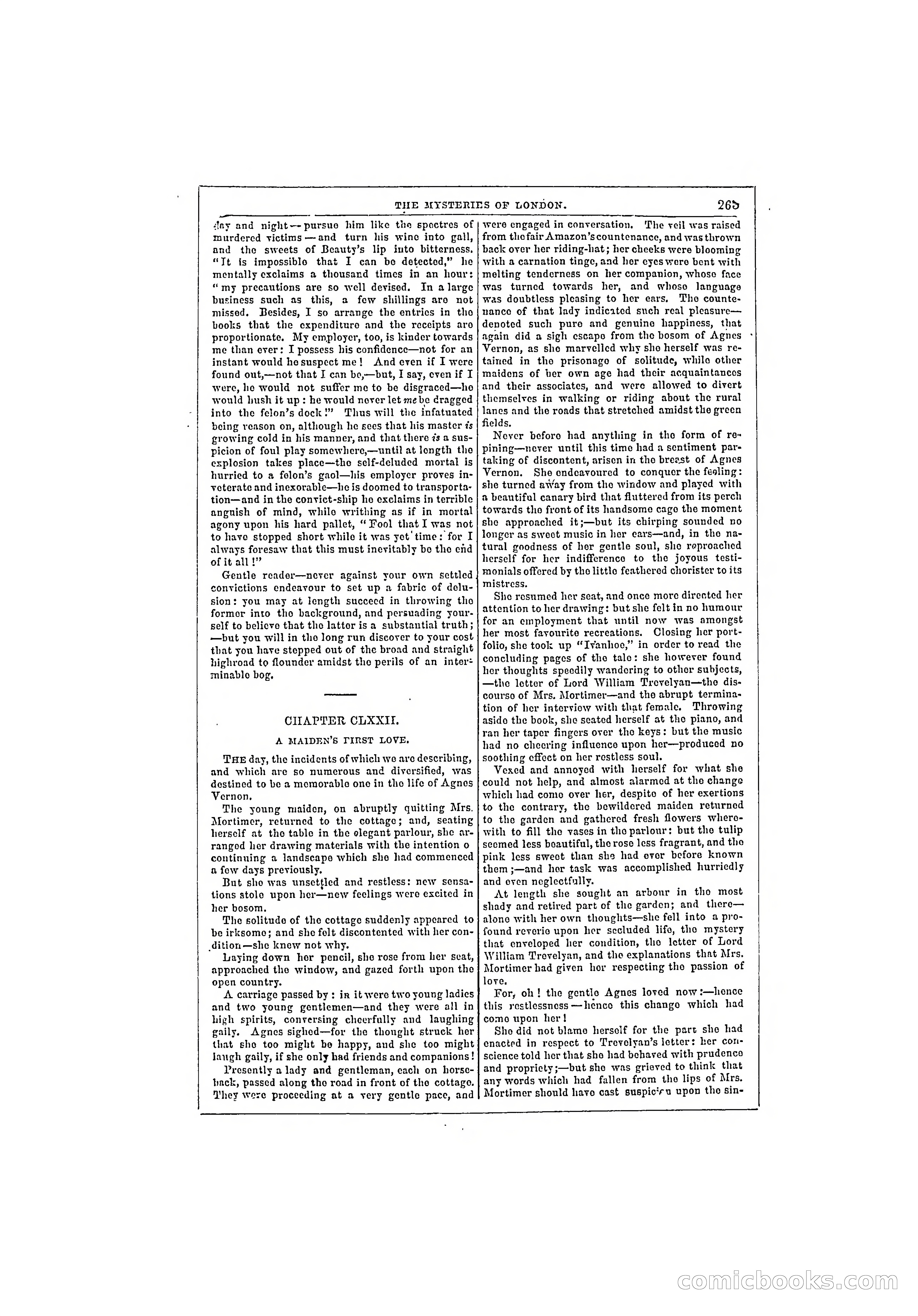
A restored page from Penny Dreadfuls, 1846. Page through the whole issue in the reader above.
📄 Transcribed text from this page (OCR, searchable)
Machine-transcribed from the original scan — historical spelling and the odd misread are preserved.
THE MYSTERIES OF LONDON. ny and night-- pursue him like the spectres of murdered victims —-and turn his wine into gall, and the sweets of Beauty’s lip into bitterness. “Jt is impossible that I can be detected,” he mentally exclaims a thousand times in an hour: “my precautions are so well devised. In a large business such as this, a few shillings are not missed, Besides, I so arrange the entrics in the books that the expenditure and the receipts aro proportionate. My employer, too, is kinder towards me than ever: I possess his confidence—not for an instant would hesuspect me! And even if I were found out,—not that J can bo,—but, I say, even if I were, he would not suffer me to be disgraced—ho would hush it up: he would never let mebe dragged into the felon’s dock?” Thus will the infatuated being reason on, although he sees that his master ts growing cold in his manner, and that there 7s a sus- picion of foul play somewhere,—until at longth the explosion takes place—the self-deluded mortal is hurried to a felon’s gaol—his employer proves in- veterate and inexorable—he is doomed to transporta- tion—and in the convict-ship he exclaims in terrible anguish of mind, while writhing as if in mortal agony upon his hard pallet, “Fool that I was not to have stopped short while it was yet time: for I always foresaw that this must inevitably be tho end of it all !” Gentle reader—never against your own Settled convictions endeavour to set up a fabric of delu- sion: you may at length succecd in throwing the former into the background, and persuading your- self to belicve that the latter is a substantial truth; —but you will in the long run discover to your cost that you have stepped out of the broad and straight highroad to flounder amidst the perils of an inter minablo bog, CIIAPTER CLXXITI, A MALIDEN’S TINST LOVE. THE day, the incidents of which we are describing, and which are so numerous and diversified, was destined to be a momorable one in the life of Agnes Vernon, The young maiden, on abruptly quitting Mrs. Mortimer, returned to the cottage; and, seating herself at tho table in the olegant parlour, she ar- rangod her drawing materials with the intention o continuing a landscape which she had commenced a fow days previously. But sho was unsettled and restless: new sensa- tions stole upon her—new feelings were excited in her bosom. The solitude of the cottage suddenly appeared to be irksome; and she folt discontented with her con- dition —she knew not why. Laying down her pencil, she rose from her seat, approached the window, and gazed forth upon the open country. A carriage passed by: in it were two young ladies and two young gentlemen—and they were all in high spirits, conversing cheerfully and laughing gaily. Agnes sighed—for the thought struck her that she too might be happy, and she too might Jaugh gaily, if she only had friends and companions! Presently a lady and gentleman, each on horse- back, passed along the road in front of the cottage. Vhey were proceeding at a yery gentle pace, and 2695 were engaged in conversation. The veil was raised from tho fair Amazon’s countenance, and was thrown back over her riding-hat; her cheeks were blooming with a carnation tinge, and her eyes were bent with melting tenderness on her companion, whose face was turned towards her, and whose language was doubtless pleasing to her ears, The counte- nance of that lady indicated such real pleasure— denoted such pure and genuine happiness, that again did a sigh escape from the bosom of Agnes Vernon, as she marvelicd why she herself was re- tained in the prisonage of solitude, while other maidens of ber own age had their acquaintances and their associates, and were allowed to divert themselves in walking or riding about the rural lanes and the roads that stretched amidst the green fields. Never before had anything in the form of re« pining—never until this time had a sentiment par- taking of discontent, arisen in the breast of Agnes Vernon. She endeavoured to conquer the feoling: she turned away from the window and played with a beautiful canary bird that fluttered from its perch towards the front of its handsome cage the moment she approached it;—but its chirping sounded no longer as sweet music in her ears—-and, in the na- tural goodness of her gentle soul, she reproached herself for her indifference to the joyous testi- monials offered by the little feathered choristcr to its mistress. She resumed her seat, and once more directed her attention to her drawing: but she felt in no humour for an employment that until now was amongst her most favourite recreations. Closing her port- folio, she took up “Ivanhoe,” in order to read the concluding pages of the tale: she however found her thoughts speedily wandering to other subjects, —the letter of Lord William Trevelyan—the dis- courso of Mrs. Mortimer—and the abrupt termina- tion of her interview with that female. Throwing aside the book, she seated herself at the piano, and ran her taper fingers over the keys: but the music had no cheering influence upon her—produced no soothing effect on her restless soul. Vexed and annoyed with herself for what she could not help, and almost alarmed at the change which had come over her, despito of her exertions to the contrary, the bewildered maiden returned to the garden and gathered fresh flowers where- with to fill the vases in tho parlour: but the tulip seemed less boautiful, the rose less fragrant, and tho pink less sweet than she had ever before known them ;—and hor task was accomplished hurriedly and oren neglectfally. At length she sought an arbonr in tho most shady and retired part of the garden; and thero— alone with her own thoughts—she fell into a pro- found reveric upon her secluded life, the mystery that enveloped her condition, the letter of Lord William Trevelyan, and the explanations that Mrs. Mortimer had given hor respecting the passion of love. For, oh ! the gentile Agnes loved now :—hlence this restlessness —henco this chango which had come upon her! Sho did not blame herself for the part she had enacted in respect to Trevelyan’s letter: her con- science told her that she had behaved with prudence and propriety ;—but she was grieved to think that any words which had fallen from tho lips of Mrs. Mortimer should have cast suspic’ru upon tho sin- (C(O) G DOO <S LL (SO)