
Penny Dreadfuls, 1846 · page 249 of 399
The Mysteries of London, Vol. IV — page 249: what you’re looking at
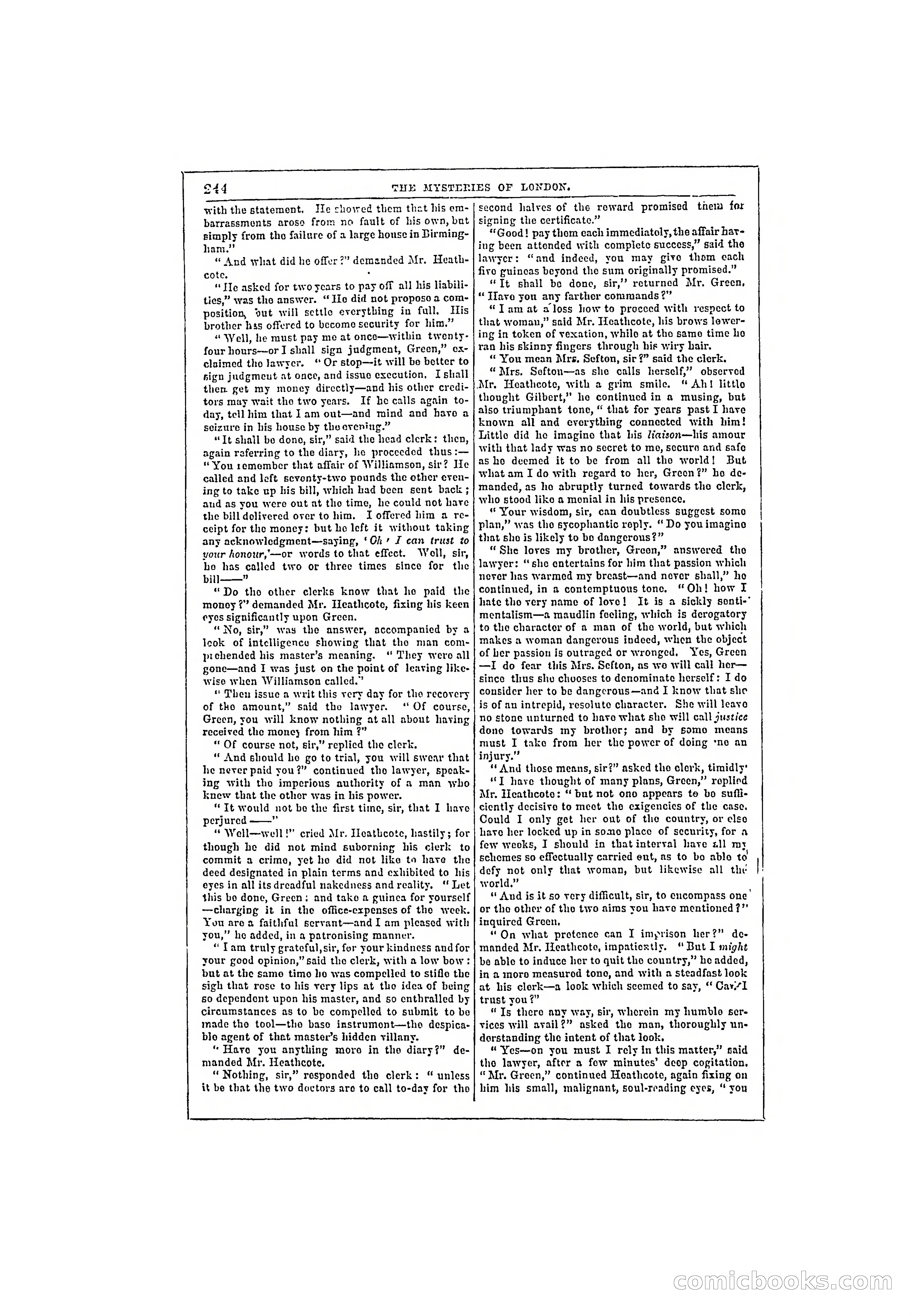
A restored page from Penny Dreadfuls, 1846. Page through the whole issue in the reader above.
📄 Transcribed text from this page (OCR, searchable)
Machine-transcribed from the original scan — historical spelling and the odd misread are preserved.
nn C44 SHE MYSTERIES OF LONDON, Tee en ee ee with the statement. IIe showed them thet his em- barrassments aroso from no fault of his own, but simply from tho failure of a large house in Birming- ham.” “ And what did he offer?’ demanded Mr. Heath- cote. : “Sle asked for two years to pay off all his liabili- tics,” was the answer. “Iie did not proposo a com- position, out will settle everything in full. His prother hss offered to become security for him.” “Well, he must pay me at once—within twenty- four hours~or J shall sign judgment, Green,” ex- claimed tho lawyer. “ Or stop—it will be better to sign judgmeut at once, and issue execution, I shall then get my money dircctly—and his other credi- tors may wait the two years. If he calls again to- day, tell him that Jam out—and mind and have a seizure in his house by the evening.” “Tt shall bo done, sir,” said the head clerk: then, again raferring to the diary, he proceeded thus :— “You remember that affair of Williamson, sir? Iie called and left seventy-two pounds the ether even- ing to take up his bill, which had been sent back ; and as you were out at the time, he could not hare the bill dolivered over to him. I offered him a re- ceipt for the money: but ho left it without taking any acknowledgment—saying, ‘Oh’ J can trust to vour honour,'—or words to that effect. Well, sir, he has called two or three times since for tlic bill——” “Do tho other clerks know that he paid the monoy ?’ demanded Mr. Heathcote, fixing his keen eyes significantly upon Green. “No, sir,’ was the answer, accompanied by a leok of intelligence showing that tho man com- prchended his master’s meaning. “ They wero all gone—and I was just on the point of leaving like- wise when Williamson called.” “ Then issue a writ this very day for the recovery of the amount,” said the lawyer. ‘ Of course, Green, sou will know nothing at all about having received the money from him ?” “Of course not, sir,” replied the clerk. “‘ And should ho go to trial, you will swear that he never paid you?” continued tho lawyer, speak- ing with tho imperious authority of a man who knew that the other was in his power. Tt would not be the first time, sir, that I have perjured ——”’ “ Well—well!”’ cried Mr. Ileathcote, hastily; for though he did not mind suborning his clerk to commit a crime, yet ho did not like to have the deed designated in plain terms and exhibited to his eyes in all its dreadful nakedness and reality. ‘ Let this be done, Green: and take a guinea for yourself —charging it in the office-expenses of the week. You are a faithful serrant—and I am pleased with you,” hoe added, in a patronising manner. “Tam truly grateful, sir, for your kindness and for your good opinion,” said the clerk, with a low bow: but at the same timo ho was compelled to stifle the sigh that rose to his very lips at tho idea of being so dependent upon his master, and so enthralled by circumstances as to be compelled to submit to be made the tool—tho baso instrumont—tho despica- blo agent of thet master’s hidden villany. * Haro you anything more in the diary?” de- manded Mr. Heathcote. “ Nothing, sir,” responded the clerk: “ unless it be that the two doctors are to call to-day for tho second halves of the reward promised thew fer signing the certificate.” “Good! pay thom each immediately, the affair har- ing been attended with complete success,” said the lawyer: “and indeed, you may givo thom each firo puinoas beyond the sum originally promised.” ‘Tt shall be dono, sir,’? returned Mr. Green, “TIavo you any farther commands ?” “Tam at aloss how to proceed with respect to that woman,” said Mr. Heathcote, his brows lewer- ing in token of vexation, whilo at the samo time ho ran his skinny fingers through his wiry hair. “You mean Mrs. Sefton, sir?” said the clerk. “Mrs. Sefton-——as she calls herself,” observed Mr. Jfeathcote, with a grim smile. “ Ah! littlo thought Gilbert,” he continucd in a musing, but also triumphant tone, “ that for years past I have known all and everything connected with him! Little did he imagino that his Uiatson—his amour with that lady was no secret to me, securo and safe 2s he deemed it to be from all the world! But what am I do with regard to her, Green?” ho de- manded, as he abruptly turned towards the clerk, who stood like a menial in his presence. “ Your wisdom, sir, can doubtless suggest somo | plan,” was tho sycophantic reply. “ Do you imagine that sho is likely to bo dangerous?” “She loves my brother, Green,” answered tho lawyer: “she entertains for him that passion which never has warmed my breast—and never shall,” ho continued, in a contemptuous tone. “Oh! how IT hate the very name of love! It is a sickly sonti-" mentalism—a maudlin feeling, which is derogatory to the charactor of a man of the world, but which makes a woman dangerous indeed, when the object of her passion is outraged or wronged, Yes, Green ~—I do fear this Mrs. Sefton, as wa will call her— since thus sho chooses to denominate herself: I do consider her to be dangcrous—and I know that she is of an intrepid, resolute character. She will leave no stone unturned to have what sho will call gustice done towards my brother; and by s9mo means must I take from her the power of doing ‘ne an injury.” ‘And those means, sir?” asked the clerk, timidly' “JT have thought of many plans, Green,” roplied Mr, Tcathcote: “ but not one appears te bo sufli- ciently decisive to meet the cxigencics of tlie case. Could I only get her out of the country, or else have her locked up in somo place of security, for a few weoks, I should in that interval have 211 my schemes so effectually carried eut, as to bo able to defy not only that woman, but likewise all the | world.” And is it so very difficult, sir, to cucompass one’ or tho other of the two aims you have mentioned ?”’ inquired Green, “On what protence can I imyrison her?” de- manded Mr. ILeathcoto, impatiertly. “But I might be able to induce her to quit the country,” he added, in a more measurod tone, and with a steadfast look at his clerk—a look which seemed to say, “ Carl trust you ?” “Ts there any way, sir, Wherein my humble sere vices will avail?” asked the man, thoroughly un- derstanding the intent of that look, “Yes—on you must I rely in this matter,” said tho lawyer, after a few minutes’ deep cogitation, “Mr. Green,” continued Heathcote, again fixing on him his small, malignant, soul-reading eyes, ‘ you EConnicloooks (CO)